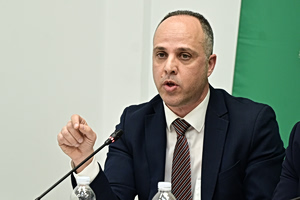
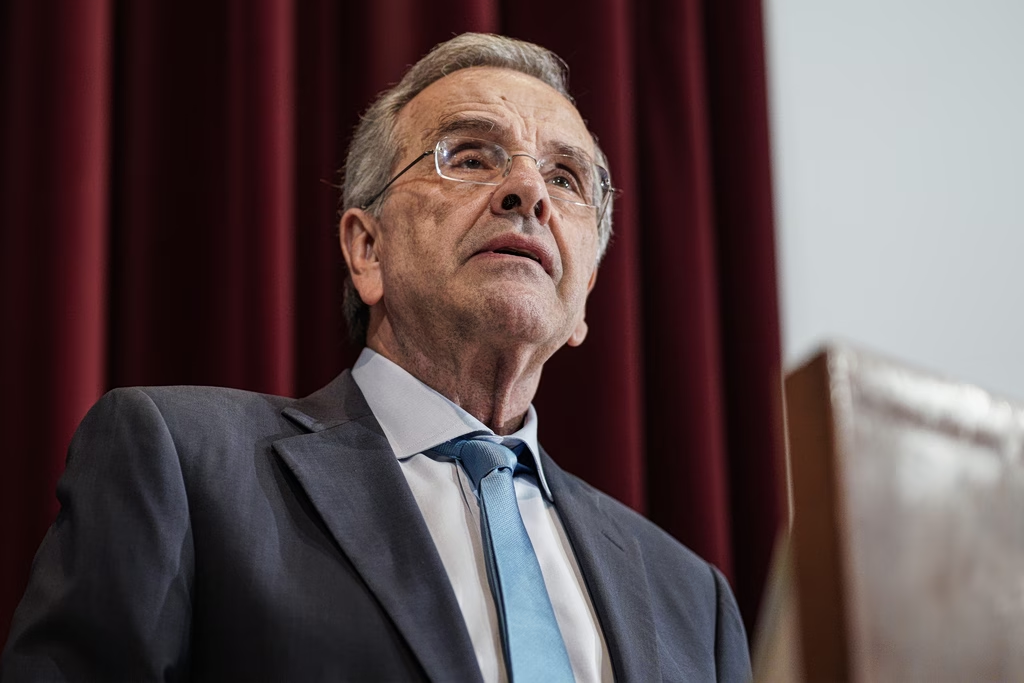
When Grigoris Dimitriadis, the former secretary-general of the prime minister’s office who quit over the Predator spyware scandal in 2022, sat down for a lengthy YouTube interview broadcast Friday evening, the fallout was swift and predictable. By the weekend, his remarks had effectively monopolized the Greek political conversation, and by Monday, the government was scrambling once again to contain the situation.
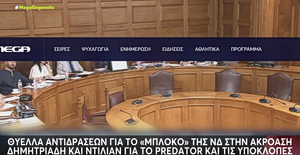
Dimitriadis, who is also the nephew of Prime Minister Kyriakos Mitsotakis, gave his second interview of the year, days after New Democracy blocked opposition requests to summon Predator developer Tal Dilian and Dimitriadis himself before Parliament’s Institutions and Transparency Committee.
The extensive interview covered a wide array of topics, ranging from Greek politics to his favorite books, and was noteworthy not only because of its contents but also because of the tone struck by Dimitriadis himself — one that critics were quick to liken to the language of a consigliere rather than a former public official. He described his role at Maximos Mansion, as the prime minister’s residence is known, in terms that left little to the imagination. “A good deputy knows when to disturb the prime minister and when to deal with things himself. Kazantzakis said to love responsibility. Nothing that lands on your desk at Maximos ever has an easy solution,” the former secretary-general said.
On the wiretapping scandal, Dimitriadis was adamant that he had nothing more to add. “All I did was take political responsibility. Someone had to take it, the government had to move forward. I have no intention of ever saying anything more. And when I say never, I mean never.” The reason, he said, was simple: “I have to respect the state, the intelligence services, my government, my political family. My job is to protect all of that, not to cause damage.” Dimitriadis also suggested that similar spyware scandals — involving Predator or the Israeli-developed Pegasus software — had emerged across Europe without bringing down governments, and that the issue had already been politically adjudicated in the 2023 elections. He took direct aim at PASOK leader Nikos Androulakis, accusing him of an obsession that was partly personal and partly driven by what he called vested media interests. “Androulakis wants to put me in prison,” he said flatly.
Another striking section of the interview was when he described his role at the prime minister’s side. His job, he explained, was to act as the “back office” — to shield the prime minister from unnecessary noise, to handle what could be handled and to know what warranted escalation. If he bombarded the prime minister with too many details, he said, he would not be doing his job properly. He also said, in a manner that unsettled many political observers, that he had “taken the bullet” for his boss, using that word to refer to Mitsotakis.
The reaction from political and legal circles was immediate. The language Dimitriadis used did not go unnoticed. Legal observers were quick to draw comparisons to omertà — the code of silence most commonly associated with organized crime. Pavlos Eleftheriadis, a law professor at Oxford University and a former New Democracy European Parliament candidate, was scathing. Writing on social media, he argued that Dimitriadis, as a suspect in serious criminal offenses, should be answering questions to a prosecutor rather than giving interviews. “Why is he not subject to investigation like the rest of us? Because he is the grandson of Konstantinos Mitsotakis?” he wrote. He dismissed Dimitriadis’s suggestion that the 2023 election results had effectively settled questions of criminal liability as “the ramblings of populists and the far right,” adding that what Dimitriadis calls a “code of honor” reads, to anyone following the case, as a confession of guilt and a confession of the failure of the Greek justice system. Separately, commentators noted that Dimitriadis’s sworn statement to the Supreme Court’s deputy prosecutor in June 2024 — in which he claimed to have forwarded National Intelligence Service (EYP) bulletins directly to the prime minister without reading them — sits in open contradiction to Friday’s statements.
Asked why neither Dimitriadis nor Intellexa founder Tal Dilian had been called before Parliament’s Committee on Institutions and Transparency, spokesman Pavlos Marinakis accused media outlets of running “TV tribunals.” He then pointed to the Supreme Court’s decision to shelve the case. “When you have a court ruling,” he said, “you cannot sit around debating whether you like it or not.”
PASOK and SYRIZA both seized on the interview as evidence that the scandal remains unresolved, renewing their calls for a parliamentary inquiry. PASOK argued that Dimitriadis’s vow of silence was not an act of loyalty but a threat directed at Mitsotakis, pointing to him as the “architect of the illegal surveillance of half the cabinet, military leadership, journalists and political opponents”. The party also warned that should New Democracy lose the next election, both Dimitriadis and the prime minister would face judicial accountability.