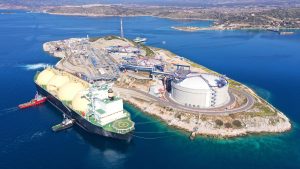
Greece is rapidly gaining strategic importance in the global energy landscape, as Athens and Washington move closer in an ambitious plan to expand liquefied natural gas (LNG) transfers from Greek terminals at Revithoussa and Alexandroupolis to Central and Eastern Europe through what officials now call the “Central Corridor.”
The Greek-American initiative underscores a broader Western strategy to accelerate Europe’s independence from Russian energy. It comes as the European Union finalizes a decision to ban all Russian gas imports by the end of 2027, starting with LNG a year earlier, and as the United States imposes new sanctions on Russian energy giants Rosneft and Lukoil. These measures, Washington insists, are both economic and geopolitical — tightening Moscow’s isolation after renewed diplomatic failure over the war in Ukraine.
Athens Hosts P-TEC Energy Summit
Against this backdrop, Athens will host the Partnership for Transatlantic Energy Cooperation (P-TEC) summit on November 6–7, organized jointly by the U.S. Department of Energy and the Greek government. The meeting will bring together senior officials from both sides of the Atlantic, including U.S. Energy Secretary Chris Wright and Interior Secretary Doug Burgum.
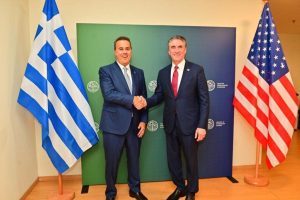
Burgum, who visited Greece recently, reportedly examined both the readiness of Greek LNG infrastructure and Athens’s willingness to serve as a central hub for American gas heading toward Europe — and ultimately, Ukraine.
Secretary Wright is in regular contact with Greece’s Energy and Environment Minister Stavros Papastavrou, and together they have extended invitations to 24 European counterparts to attend. The summit will also mark the first public appearance of the new U.S. Ambassador to Greece, Kimberly Guilfoyle, who is said to have deep knowledge of the East Mediterranean’s energy landscape and plans to support the existing initiatives and play an active role in shaping future ones.
Washington’s Regional Strategy
According to U.S. diplomatic sources, including US Ambassador Tom Barrack in Ankara, the Trump administration sees the Eastern Mediterranean as fertile ground for what it calls “energy integration” — a framework that would boost both American corporate interests and regional state revenues.
The recent appointment of John Breslow as the new U.S. ambassador to Cyprus further strengthens this approach. Breslow, who comes from the private sector, is expected to take on a proactive role in energy security, interconnectivity, and investment across the region, reflecting a coordinated American effort to consolidate influence in the Eastern Mediterranean.
“Energy Cooperation Means Security”
“U.S. officials firmly believe that energy cooperation translates into broader gains for transatlantic security,” a senior diplomatic source familiar with the White House’s thinking told To Vima.
If Washington’s long-term aim is to dominate energy flows in the Eastern Mediterranean — while advancing the India–Middle East–Europe Corridor (IMEC) as a counterweight to China’s Belt and Road Initiative — Athens sees the process as a historic opportunity to cement its role as a strategic partner of the United States.
Beyond energy, the P-TEC initiative further reinforces the defense and diplomatic ties that have long anchored U.S.–Greek relations. Greek officials believe this convergence could make the country an integral part of the Western security architecture at a time of heightened uncertainty.
The Real Prize: Long-Term LNG Contracts
For both Washington and Athens, the ultimate test of success will be whether Central and Eastern European nations commit to purchasing U.S. LNG, which would be channeled northward through Greek facilities.
Market indicators are promising, though US LNG prices remain sky-high. The EU’s reliance on Russian gas has already dropped to 19% in 2024, down from 45% in 2021, and the full embargo by 2028 is expected to open even more space for American imports.
European energy ministers gathering in Athens are likely to push for price stabilization, either through long-term contracts with fixed rates — even for unused capacity — or through bulk agreements that might persuade U.S. exporters to lower costs.
Industry insiders note that the P-TEC summit will feature seasoned energy executives capable of brokering these complex deals. Regardless of how negotiations unfold, Greece is already positioned to play a key role in routing U.S. LNG toward Ukraine, with high-level talks already under way.
Given that Kyiv’s economy remains heavily reliant on Western funding, analysts expect it to be more flexible and receptive to U.S. energy imports, potentially making Greece the vital gateway between American gas and Eastern Europe’s energy future.