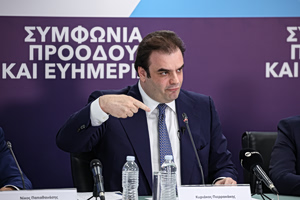
Greece will create a new digital platform to publicly track government entities that delay payments, National Economy and Finance Minister Kyriakos Pierrakakis said Thursday.
Speaking at a meeting of the Board of Directors of the Athens Chamber of Commerce and Industry, Pierrakakis said the platform, named “Synepeia,” will allow citizens and businesses to see which public entity is late in paying its obligations and how long the delay has lasted.
“The state must be consistent when it demands consistency from the private sector,” Pierrakakis said, explaining that the initiative aims to strengthen transparency and public accountability.
“Through this platform, which will be public, anyone will be able to see who is delaying, how long they are delaying, and pressure can consequently be brought to bear,” he said.
Corporate tax prepayments to be reduced
Pierrakakis also referred to plans to gradually reduce the corporate income tax prepayment rate from 80% to 50%.
The reduction will take place in annual steps of five percentage points. He said, however, that the measure is particularly costly, with each five-percentage-point reduction reducing the available fiscal space by about €400 million.
“We would obviously like it to be more, but it is an extremely costly measure,” he said.
A faster reduction, he added, could absorb almost all of the fiscal space available in a given year.
Pierrakakis also reiterated that the business tax, known as the “business levy,” will be gradually abolished in the coming years, depending on fiscal capacity.
“Today, to be credible, we had to position ourselves on the money we have and not on some imaginary amount that we do not have,” he said.
€5 billion financing for small and medium-sized businesses
The minister also announced a new €1.5 billion lending program for small and medium-sized businesses through the Hellenic Development Bank and the Recovery and Resilience Fund’s loan component.
Through leverage, the program is expected to mobilize a total of €5 billion in financing.
“The Recovery Fund is coming to an end, but the country’s momentum, its investment momentum, is not,” Pierrakakis said.
According to figures he presented:
- €1.66 billion in grants have been approved through the Recovery Fund.
- Through InvestEU guarantees, 15,700 small and medium-sized businesses received €3.29 billion in loans.
- The European Union’s Partnership Agreement, known as the NSRF in Greece, funded 17,661 investment projects worth €3.95 billion.
- The Hellenic Development Bank approved 60,696 loans to small and medium-sized businesses worth €10.49 billion.
The government’s central policy objective, he said, has been “a smaller burden on businesses, more capital for investment.”
23 business measures since 2019
Pierrakakis also reviewed government measures introduced for businesses since 2019, saying 23 measures have been implemented covering taxation, investment and competitiveness.
They include:
- Reducing the corporate income tax rate from 28% to 22%.
- Cutting the dividend tax rate to 5%.
- Reducing the corporate tax prepayment rate from 100% to 80%.
- Cutting social security contributions by 5.4 percentage points.
- Reducing the capital concentration tax from 1% to 0.2%.
- Cutting the stock transaction tax by 50%.
- Reducing the tax on interest from listed corporate bonds from 15% to 5%.
- Suspending VAT on new construction.
- Providing incentives for mergers, innovation, green investments and strategic investments.
“Supporting businesses is a consistent choice,” Pierrakakis said, stressing that the goal was not only to reduce taxation but also to reward “the business that invests, innovates, grows and creates jobs.”
Government targets 30% cut in energy costs
Pierrakakis placed particular emphasis on energy costs, reiterating a target announced at the Thessaloniki International Fair to reduce them by 30%.
The National Public Investment Program will be strengthened to finance new energy projects and infrastructure, he said.
“Subsidies provide temporary relief. Investments in generation, grids, interconnections and storage are what structurally reduce costs for households and businesses,” he said.
Greek businesses, he added, “are not asking for preferential treatment,” but for the ability to compete internationally without starting from a disadvantageous position.
Investment accounts for children
The minister also discussed a proposed investment account for the younger generation, known as a “piggy bank,” designed to encourage a culture of saving and investment among Greek families.
Parents will be able to choose between different investment profiles, while the state will contribute an amount equal to the family’s deposit, up to €1,200 per year.
“For every one euro I put in, I put in another euro, up to €1,200 a year,” Pierrakakis said, adding that the measure is also intended to mobilize savings held in the Greek banking system.
Private debt and out-of-court settlements
On private debt, Pierrakakis said government policy would continue to focus on expanding the tools available for debt restructuring.
“I do not believe in a state that wags its finger. I believe in a state that extends its hand,” he said.
He cited measures including lowering the minimum income threshold for entering Greece’s out-of-court debt settlement mechanism from €10,000 to €5,000, allowing repayment over as many as 240 installments, increasing the protected bank account threshold and turning the out-of-court mechanism into a tool for protecting primary residences.
“2% is not our ceiling”
Turning to the economy, Pierrakakis said unemployment fell to 7.9% in July, while investment is expected to reach 17.7% of gross domestic product and public debt to stand at 136.8% of GDP in 2026 and below 120% in 2029.
He argued that a 2% growth rate, although twice the European average, is not sufficient.
“An economic growth rate of 2% is not our ceiling. We deserve better. We must do better,” he said.
Concluding his remarks, Pierrakakis compared economic policy to the games Tetris and Jenga.
“Successes disappear and mistakes accumulate,” he said, warning that “if you pull the wrong block, the whole structure collapses.”
“We can move forward together, go faster and farther, but standing on solid ground,” he said.