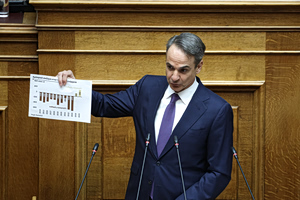
A heated debate over electricity prices and energy security unfolded in the Hellenic Parliament on Friday, as Prime Minister Kyriakos Mitsotakis and opposition leader Nikos Androulakis sparred over the government’s energy policy and the cost of living facing Greek households and businesses.
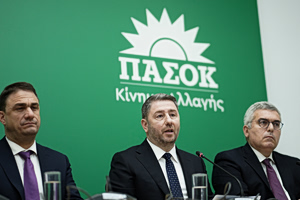
The discussion was prompted by a formal question submitted by Androulakis, head of PASOK, focusing on high energy costs and what he described as risks to Greece’s energy security.
Androulakis: “Energy policy fuels high prices”
Androulakis painted a bleak picture of the strain facing Greek households and businesses, arguing that the government’s energy policy has deepened cost-of-living pressures.
Citing comparative data, he said 32% of Greeks have overdue utility bills, compared with 6.9% across the European Union. Nearly one in five households, he added, is unable to adequately heat its home.
“Behind these numbers are people who turn off their heating so they can afford groceries,” he said.
While nominal electricity prices may appear close to the EU average, Androulakis argued that when adjusted for purchasing power Greece effectively ranks among the most expensive countries in Europe.
He accused the government of rushing the country’s phase-out of lignite without first ensuring sufficient investment in electricity grids and energy storage, calling the transition neither “fair” nor properly planned.
The opposition leader also criticized the Public Power Corporation (PPC), alleging it failed to show a “social face” during the energy crisis and instead prioritized profitability. He claimed market concentration has strengthened under the current framework and argued that energy communities (cooperative renewable schemes involving citizens and farmers) remain marginal in Greece compared with other European countries.
Androulakis further pressed the government for clarity on major interconnection projects, including the planned electricity link involving Israel, Cyprus and Crete, questioning timelines and transparency.
At one point, he suggested the prime minister was disconnected from everyday reality. “Take a walk in Athens,” he said, linking electricity bills to broader pressures from rent and food prices.
Mitsotakis: “The numbers tell a different story”
Mitsotakis rejected the opposition’s claims as exaggerated, arguing that the available data supports a different conclusion.
“You are lying when you say Greece has the most expensive electricity,” the prime minister said, citing Eurostat figures indicating that household electricity tariffs in the first half of 2025 were 21% lower than the EU average.
“If the numbers don’t agree with you, so much the worse for the numbers,” he added.
Mitsotakis portrayed current pricing levels as the result of government intervention during the European energy crisis that followed Russia’s invasion of Ukraine. Wholesale electricity prices, he said, surged from around 60 euros per megawatt-hour to as high as 400 euros at the peak.
He said the government imposed a windfall tax on refinery profits and used the proceeds to subsidize electricity bills, preventing the full impact from reaching consumers.
The prime minister contrasted the present situation with 2019, when he said Greece had the highest wholesale electricity prices in Europe. In January this year, he noted, the average wholesale price in Greece stood at 109 euros per megawatt-hour, compared with 143 euros in Poland.
“For the first time, our energy balance is positive,” he claimed, describing this as evidence of improved energy security.
He also defended the government’s management of PPC, saying it would not return to what he described as its financially distressed position in 2019.
“Today we are not hostages to ‘green union bosses’ who could pull the switch whenever they wanted,” he said.
Energy mix and investment push
Mitsotakis said the government’s strategy rests on expanding renewable energy production while using natural gas as a complementary fuel when renewables cannot meet demand.
He stressed that the gas would not be Russian but liquefied natural gas — potentially of American origin — if prices are competitive. Lignite, he said, would be used only in extraordinary circumstances, arguing that lignite-based generation is not economically viable.
He pointed to increased infrastructure spending, saying annual energy investments rose from 400 million euros in 2019 to 1.5 billion euros in 2024. Island interconnections and grid upgrades, he said, are central to lowering long-term costs.
Hydrocarbon exploration and regional strategy
Broadening the scope of the debate, Mitsotakis also emphasized hydrocarbon exploration and regional gas infrastructure as part of Greece’s long-term energy positioning.
He reiterated that Greece should explore whether domestic natural gas reserves exist, presenting such efforts as a matter of national interest and energy resilience. Energy policy, he suggested, is closely tied to foreign policy and geopolitical strategy.
He also highlighted progress on the so-called Vertical Corridor, a regional natural gas route linking Greece with Southeastern and Central Europe. Mitsotakis portrayed the project as strengthening Greece’s role as an energy gateway and enhancing its strategic importance within the region.
According to the prime minister, sustained investment in natural gas infrastructure since 2019 has given “substance” to these ambitions and contributed to what he described as greater energy security.
Hydrocarbon exploration and regional strategy
Mitsotakis also emphasized hydrocarbon exploration and regional gas infrastructure as part of Greece’s long-term energy positioning.
He reiterated that Greece should explore whether domestic natural gas reserves exist, presenting this as a matter of national resilience.
He highlighted progress on the so-called Vertical Corridor, a regional natural gas route linking Greece with Southeastern and Central Europe, portraying it as strengthening the country’s role as an energy gateway.
According to the prime minister, sustained investment in natural gas infrastructure since 2019 has strengthened Greece’s regional standing.
Green transition under scrutiny
Both leaders acknowledged that Greece, like other European countries, is grappling with the costs and pace of the green transition.
Mitsotakis noted that debates are emerging across Europe about how quickly decarbonization should proceed and who should bear the cost. Greece, he said, remains committed to climate neutrality by 2050 but must balance environmental goals with social fairness.
“The question is who shoulders the burden of the green transition,” he said, adding that fiscal stability allows the government to support vulnerable households.
He reiterated the government’s commitment to raising the minimum wage to 950 euros by 2027, linking income growth to broader efforts to ease cost-of-living pressures.