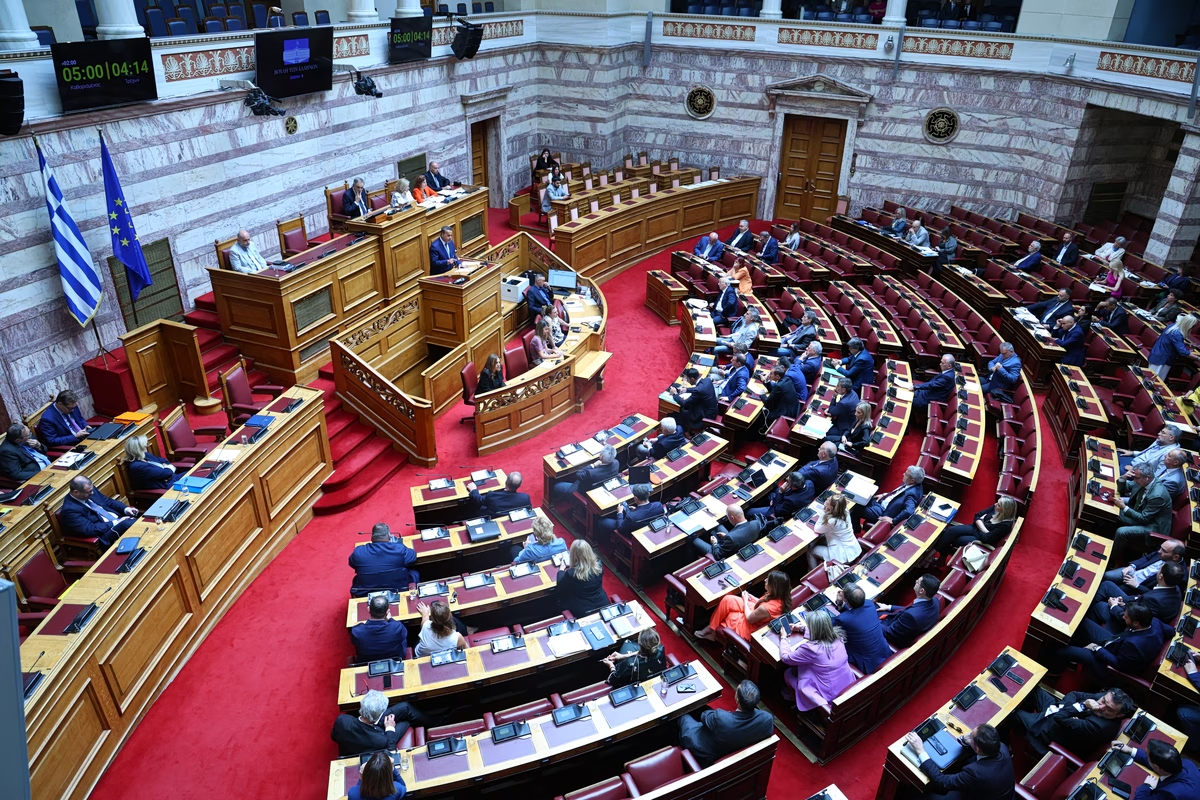
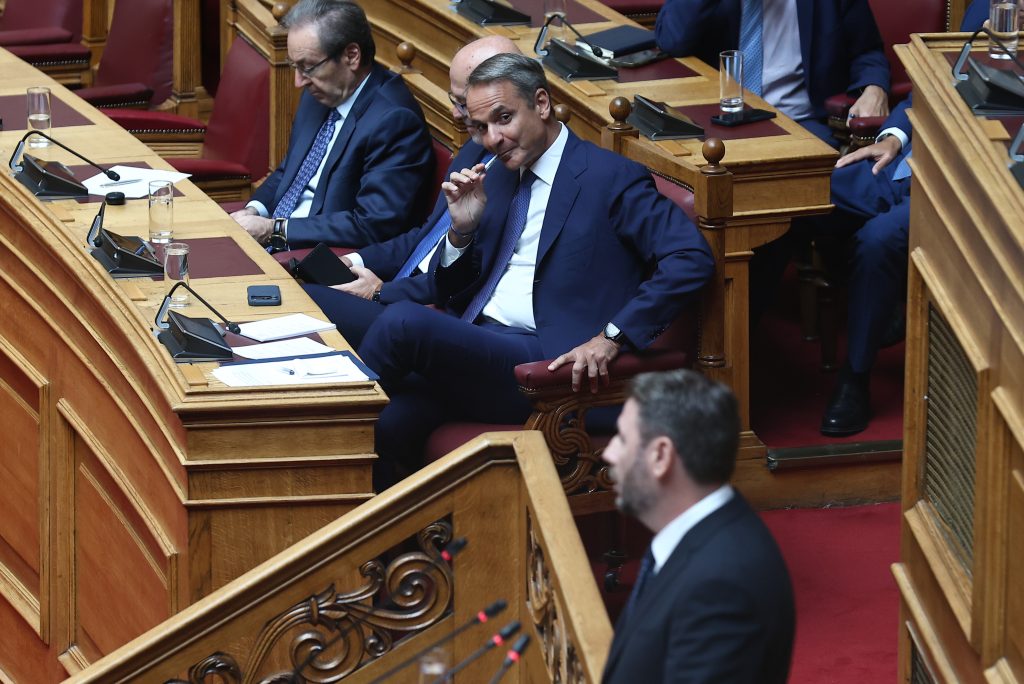
Prime Minister Kyriakos Mitsotakis launched a pointed attack on PASOK and its leader, Nikos Androulakis, from the floor of Parliament on Wednesday during the second vote on constitutional revision. The PM accused the main opposition party of voting “no” on changes he claimed they substantially agree on. Androulakis fired back, accusing Mitsotakis of equating political stability with New Democracy staying in power and of treating a change of government as a threat to the country.
Mitsotakis presses PASOK on its refusal to back reforms
Mitsotakis framed his speech around what he described as a lack of consensus, arguing that the point of a second vote is to let parties revisit their positions after further debate, not simply to dig their heels in. He argued that the constitution would not require two separate votes on the same amendments unless it were meant to allow lawmakers to reach a different conclusion the second time around.
The PM directed most of his criticism at PASOK, saying the party had reached the point of voting against reforms it agrees with simply because the government proposed them. Addressing Androulakis directly, Mitsotakis argued that PASOK’s refusal to give New Democracy unconditional backing for the constitutional revision process amounted to an admission that the center-left party expects New Democracy to win the next election. If PASOK believed it could win instead, he said, it would have no reason to take that position.
Mitsotakis invoked Greece’s last constitutional revision, carried out between 1999 and 2001, noting that New Democracy, in opposition at the time, had backed changes both before and after national elections. He used the comparison to contrast his party’s past conduct with PASOK’s current approach.
Among the changes he cited as reforms PASOK should support were the establishment of private universities under a revised Article 16, extending postal voting to all elections, and enshrining performance evaluations for civil servants in the constitution itself. He also pointed to Article 86, which currently gives Parliament the power to decide whether a minister faces criminal investigation, arguing it should be amended so that such a decision rests with the courts instead.
PM widens the attack to economic policy
The speech extended well beyond constitutional matters. Mitsotakis linked the opposition’s posture in Parliament to the political sparring that preceded it at the Thessaloniki International Fair (TIF), accusing his opponents of blankly rejecting everything the government does without considering it first.
The PM suggested that the public had seen during TIF a government with a plan and a defined timeline as well as measures that have been “costed down to the last euro.” He then turned on the oppositions’ economic pledges, accusing them of promising unfunded tax cuts and higher spending, a “recipe for bankruptcy” as he called it.
Mitsotakis also took aim at Alexis Tsipras, saying he would not dwell on him at length since Tsipras “is not in this room and cannot respond to me,” before turning back to PASOK, which he accused of returning to what he called old, discredited promises dressed up as something new. He argued that PASOK and Tsipras’s Greek Left Alliance amounted to “two sides of the same coin.” Both parties, he said, had fallen back on the worst habits of the past, and he questioned whether voters believe either party would actually be held to the commitments it is now making.
Mitsotakis closed by casting Wednesday’s vote as a record of where each party stands, arguing that a “no” vote, or an abstention, would deny the next Parliament the ability to move more easily on broader constitutional reform. He then gave the debate an explicitly electoral edge, framing the choice facing voters as one between his government’s stability and the risk of change, a dilemma he has used before and described again Wednesday as a choice between “hope” and “adventure.” He said his platform offered “stability, continuity and consistency,” and warned that any cooperation among New Democracy’s rivals would produce “a nightmare scenario of turmoil and ungovernability,” potentially aligned, he said, “with the fringes of populism.”
He tied his argument for political stability to global economic conditions, pointing to rising oil prices and turmoil in international bond markets as evidence, in his telling, that his decision not to call early elections had been the right one. “Imagine if we were in an election right now,” he said, warning that the coming winter would be difficult. He closed by saying that even under those conditions, his choice would “never” be “to put party interest above the interest of my country.”
Androulakis accuses PM of conflating stability with power
Androulakis took the podium immediately after Mitsotakis. “You went from ‘Mitsotakis or chaos’ to ‘Mitsotakis or Erdogan,'” he said, asking whether, by that logic, the peaceful transfer of power through elections, the popular vote and elections themselves amounted to a “game that undermines the national interest.”
Androulakis pushed back on that framing. “Today we have a new dilemma: hope for you, adventure for us,” he said, calling the government’s framing of voters’ choices “insulting.”
He also responded to government proposals to include protections for the Greek language and flag into the constitution. “Fortunately we have them,” he said, adding that it seemed strange for Greece to suddenly need such protections nearly 200 years after its war of independence. Separately, he pushed back on Mitsotakis’s economic critique, saying PASOK’s own platform was costed “down to the last euro.”
The leader of PASOK reserved some of his sharpest language for former minister Makis Voridis, saying Voridis had used Article 86 to avoid facing an investigation himself and was now criticizing PASOK for not supporting a revision of the very article that had protected him.
He closed by saying New Democracy remained unrepentant, both in how it governs and in its approach to constitutional revision. PASOK, he said, had set out clear priorities, including revising Article 86 so that criminal accountability for political figures would be examined by a special judicial body rather than Parliament. “Society is with us,” he said.