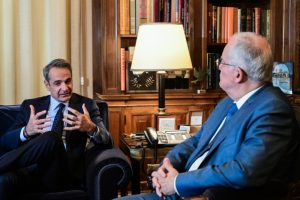
Greek Prime Minister Kyriakos Mitsotakis is set to deliver a comprehensive address in Parliament on Tuesday, focusing on foreign policy, defense strategy, and government diplomacy, while also facing scrutiny over several domestic issues.
The session will begin immediately after a vote on the government’s labor reform bill, with the prime minister’s briefing on foreign policy expected to broaden beyond its original focus — a debate on the Palestinian issue requested by the leader of the opposition PASOK party.
According to government sources, Mitsotakis intends to use the opportunity to present Greece’s broader diplomatic strategy, emphasizing what he describes as the benefits of active diplomacy and the country’s enhanced role in international affairs.
Greece’s Foreign Policy and Global Position
The prime minister is expected to highlight Greece’s steady stance on European, U.S., and Middle Eastern affairs, arguing that the country’s active engagement has strengthened its international position.
He is also likely to stress the link between Greece’s economic progress and national security, stating that the government’s policies since 2019 have both stabilized the economy and reinforced the country’s defense capabilities.
According to government officials, Mitsotakis will describe defense and diplomacy as “two sides of the same shield,” showcasing Greece’s effort to balance military readiness with international cooperation.
Focus on the Palestinian Issue and Greece’s Role
A key part of Mitsotakis’ address will concern the Palestinian question, particularly following his recent participation in the Peace Conference on Gaza.
He is expected to underline Greece’s balanced diplomatic approach — maintaining strong relations with Israel while also engaging directly with Palestinian representatives, including the recent visit to Athens by Palestinian Foreign Minister Varsen Aghabekian Shahin.
Through these actions, the prime minister will reportedly argue that Greece is seeking an active role in post-war Gaza, whether in humanitarian assistance or reconstruction efforts, positioning the country as a credible regional mediator.
Calm Waters in Greek-Turkish Relations
On relations with Turkey, Mitsotakis will defend his government’s “policy of calm waters”, emphasizing its positive impact on regional stability.
He is expected to reiterate that while Greece remains open to dialogue, fundamental disagreements — particularly over maritime zones and continental shelf rights — persist, and that Athens continues to pursue its national strategic objectives independently of Ankara’s positions.
Domestic Tensions and Upcoming Amendment
Although today’s focus will be foreign policy, debate may also drift into domestic issues, as the government faces challenges on multiple fronts — including disputes over agricultural payments (OPEKEPE) and strong opposition criticism regarding the Tomb of the Unknown Soldier.
The government is preparing to table a controversial amendment next week concerning the maintenance, security, and management of the historic monument. Under the new measure, oversight would shift to the Ministry of National Defense, while overall security would remain under the Hellenic Police and the Ministry for Citizen Protection.
Government officials argue that the move responds to public requests to preserve the monument’s solemnity, insisting that the Tomb of the Unknown Soldier should serve “only to honor the fallen” — prohibiting protests, demonstrations, or unrelated gatherings at the site.
Opposition parties, however, have strongly condemned the plan, accusing the government of attempting to restrict public expression and politicize a national symbol.
Despite the growing backlash, officials close to the prime minister maintain that the government has no intention of erasing or altering other memorials, such as those linked to the Tempi train disaster victims, and insist the amendment merely enforces “respect for national heroes.”