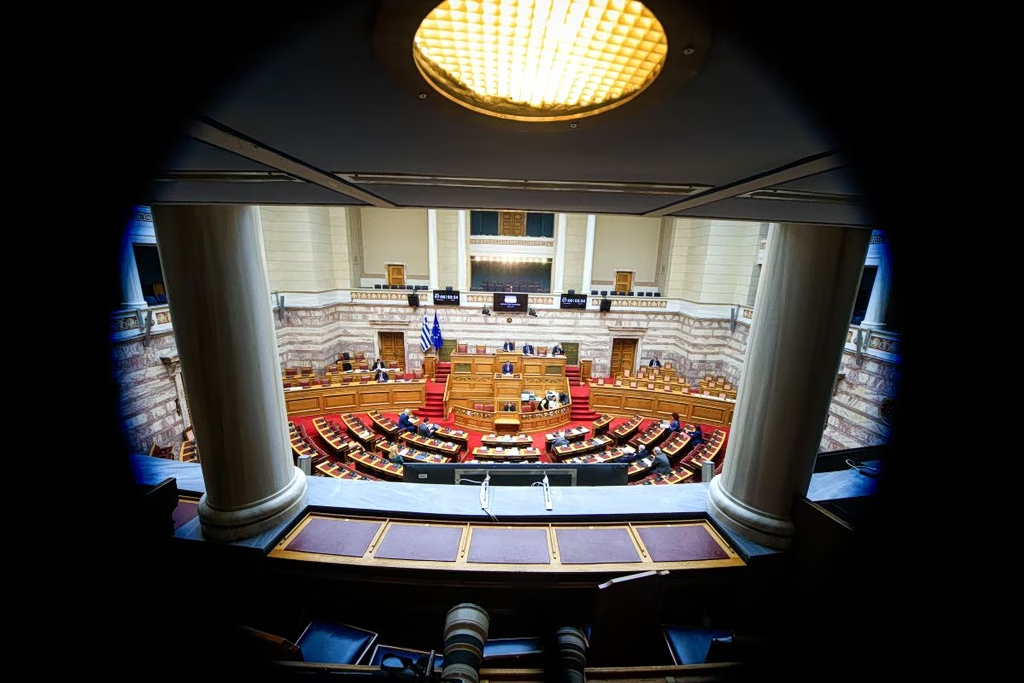
A political storm is sweeping through Greece as the second case file related to the Agricultural subsidies scandal— the misuse of EU funds via OPEKEPE, Greece’s authority responsible for distributing EU agricultural subsidies—is expected to be submitted to Parliament at any moment. The developments are already triggering demands for the lifting of immunity for 13 MPs, the dismissal of two ministers and one deputy minister, the resignation of a senior party official, and calls for some lawmakers to surrender their parliamentary seats.
At the same time, a third case file involving two additional MPs is expected to reach Parliament after the Easter recess. Prime Minister Kyriakos Mitsotakis, after a series of meetings with close aides and reviewing all available information circulating in public debate, has outlined a clear course of action.
First, he will carefully examine the contents of the case file, with the support of his legal team, in order to form a personal assessment of the scale and degree of involvement of each minister and MP linked to the OPEKEPE case.
Second, the government will formally request the lifting of parliamentary immunity for the MPs involved—a necessary legal step in Greece before criminal proceedings can move forward.
Third, in the case of ministers—who fall under a special legal regime where the European Public Prosecutor forwards cases to Parliament under Article 86 of the Constitution—there will be immediate dismissals. A cabinet reshuffle is expected to be announced as early as Holy Monday. Whether this will involve only replacing the three implicated government members or a broader reshuffle will be decided by the prime minister over the weekend.
Fourth, for MPs accused of offenses classified as felonies, Mitsotakis is expected to request that they relinquish their parliamentary seats, allowing runners-up from their electoral districts to take their place. Should any refuse—something not currently seen as likely—the possibility of expulsion from the parliamentary group will be examined.
Fifth, any MPs or ministers facing justice over the case will not be included on New Democracy’s electoral lists in the next elections unless they have been definitively acquitted.
Sixth, all ministers and MPs of the ruling New Democracy party are presumed innocent until proven otherwise by a court ruling.
Seventh, those accused of lesser offenses (misdemeanors) who do not surrender their seats will continue to perform their duties as normal—just as dozens of MPs from various parties have done in the past after their immunity was lifted while awaiting judicial outcomes.
According to sources cited by TO BHMA, Mitsotakis is determined to make no concessions—either legally or ethically—regarding members of his party. At the same time, he is preparing to go on the offensive against increasingly intense criticism from opposition parties.
One of the government’s key arguments will be the long-standing nature of the OPEKEPE scandal, which reportedly stretches back at least a decade—well before Mitsotakis assumed office as prime minister.
The government is also expected to point to the involvement of figures linked to the core of PASOK (the center-left party), arguing that OPEKEPE is not a problem confined to New Democracy but rather a systemic issue.
Furthermore, officials will argue that the fact the case has reached the judiciary is not accidental, but the result of efforts to strengthen the rule of law through reforms implemented by the current administration—including controversial initiatives such as those related to surveillance practices.
This, government sources will claim, is precisely why the OPEKEPE case has taken such a far-reaching turn, with every aspect now under investigation—even at the cost of deeply damaging New Democracy itself.
Still, these remain defensive arguments. The political outcome is far from certain. Once again, the shadow of scandal looms over the government, reinforcing a growing narrative of recurring controversies—one that risks overshadowing its policy achievements, particularly in the economic sphere.