“A meeting between Mitsotakis and Erdogan is never just ceremonial,” Greek Foreign Minister Giorgos Gerapetritis remarked in recent weeks, stressing that talks between neighboring leaders should be seen as part of a normal diplomatic process.
Yet as Prime Minister Kyriakos Mitsotakis and Turkish President Recep Tayyip Erdogan prepare to meet on September 23 on the sidelines of the United Nations General Assembly, the atmosphere is far from calm.
A year since the last encounter
The two leaders last met in New York exactly one year ago. Since then, efforts to convene the long-delayed High-Level Cooperation Council have repeatedly failed, while the “calm waters” of recent months in bilateral relations have given way to renewed tensions.
Structural disputes in the Aegean and Eastern Mediterranean have resurfaced, once again highlighting the limits of Greek-Turkish dialogue. Analysts now question what can realistically be achieved from what is expected to be a brief conversation between the two.
Points of friction
Athens points to Ankara’s irritation with several recent Greek moves: the submission of a Marine Spatial Plan, the designation of marine parks, and—most significantly—the official expression of interest by U.S. energy giant Chevron in conducting exploration south of Crete, in areas overlapping with the Turkey-Libya maritime memorandum.
Prime Minister Mitsotakis has underlined that Greece will never negotiate on issues of sovereignty, demilitarization, or so-called “grey zones.” “As long as these matters are on the table, resolving our main dispute—the delimitation of maritime zones—becomes extremely difficult,” he said, while adding that the two countries can “learn to live with our differences.”
SAFE program, casus belli, and energy cables
Another flashpoint is Greece’s insistence that Turkey cannot participate in European defense initiatives, such as the SAFE program, while it maintains its parliamentary threat of war (casus belli) against Greece. Erdogan is expected to push back strongly if this issue is raised.
Pending as well are discussions on the Greece–Cyprus electricity interconnection project, a frequent but unresolved item in bilateral and multilateral talks.
Diplomatic observers warn that Erdogan is unlikely to leave any challenge unanswered, and that the delay in finalizing the meeting may reflect difficulties in agreeing on an agenda due to these unresolved disputes.
International backdrop
Greek officials emphasize the importance of situating bilateral relations within the wider international context—marked by wars in Ukraine and the Middle East, and uncertainty over U.S. policy in the Eastern Mediterranean should Donald Trump return to office. In such a climate, Athens argues, there is little room for renewed escalation with Turkey.
Erdogan’s Washington visit
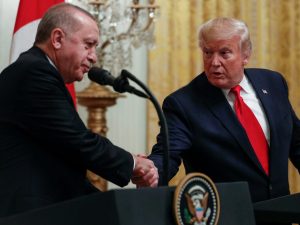
Adding to the delicate timing, Erdogan will meet U.S. President Donald Trump at the White House on September 25, fulfilling a long-standing ambition to enter the Oval Office. Talks are expected to cover F-16 upgrades, new purchases, and the more complex question of Turkey’s potential reentry into the F-35 program, conditional on removing Russian S-400 systems from its territory.