The countdown has begun for the historic return of the Artemis II mission to Earth, following an impressive lunar voyage that has captivated the world.
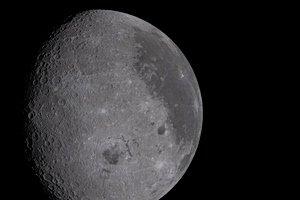
More than two-thirds of the Moon showcasing the intricate features of the nearside photographed by the NASA Artemis II crew from the Orion spacecraft during the lunar flyby mission, April 6, 2026. NASA/Handout via REUTERS
On their way home, commander Reid Wiseman, pilot Victor Glover, and mission specialists Christina Koch and Jeremy Hansen have been sending stunning images from their journey around the far side of the Moon.
The Artemis II crew is already on its way back to Earth and is in communication with the International Space Station.
NASA mission chiefs are anxiously awaiting the moment when, at 3 a.m. Saturday (Greek time), the capsule carrying the four astronauts will splash down in the Pacific Ocean, off the coast of San Diego, California.
Thorough medical examinations will follow, as the four crew members are the first human subjects for research into the effects of space on the human body in 50 years. They will undergo vital signs checks, imaging tests, and biological sample collection, among other procedures.
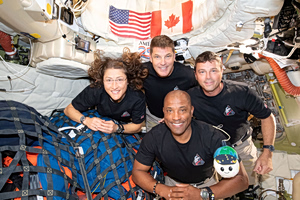
The NASA Artemis II crew, Mission Specialist Christina Koch, Mission Specialist Jeremy Hansen, Commander Reid Wiseman, and Pilot Victor Glover, pose for a group photo inside the Orion spacecraft on their way home following a flyby of the far side of the Moon on April 6, 2026. NASA/Handout via REUTERS THIS IMAGE HAS BEEN SUPPLIED BY A THIRD PARTY.
Relatives, friends, and scientists from around the world are waiting with bated breath for the return of the four astronauts, anxious right up until the last moment.
The Astronauts Witnessed Meteorites Striking the Moon
During their historic lunar orbit, the Artemis II crew observed meteorites striking the Moon’s rugged surface, a sight that has captured the interest of scientists.
“Those were definitely impact flashes on the Moon, and Jeremy Hansen just saw another one,” commander Reid Wiseman said on Monday while orbiting the Moon.
“Amazing,” responded Kelsey Young, the mission’s chief lunar scientist, watching from Earth at a distance of over 400,000 kilometres.
“I don’t know that I expected the crew to see something like that on this mission, so the surprise and shock probably showed on my face,” she said the following day at a press briefing, referring to the strikes.
At NASA’s control centre in Houston, “shouts of excitement” were heard from scientists when the crew described the flashes of light caused by the meteorite impacts, Young said.
The phenomenon is “something we don’t observe often,” backup mission astronaut Jenny Gibbons told AFP.
“It was very scientifically significant for us, so the fact that they saw four or five was really exceptional.”
THE ARTEMIS II ECLIPSE.
April 6, 2026.Totality, beyond Earth. From lunar orbit, the Moon eclipses the Sun, revealing a view few in human history have ever witnessed. Photo: NASA pic.twitter.com/2cLJD3oL7p
— The White House (@WhiteHouse) April 7, 2026
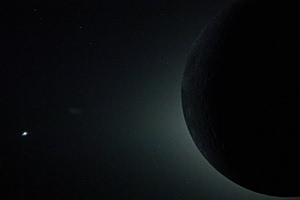
A portion of the Moon backlit by the Sun during a solar eclipse as the planet Venus shows as a bright silver glint at left, during the Artemis II crew’s flyby of the Moon April 7, 2026. NASA/Handout via REUTERS
A Millisecond
As the astronauts headed back toward Earth, NASA asked them on Tuesday about the impacts they observed during nearly seven hours of observation.
“Were they prolonged? And did you notice any colour?” Young asked.
“It was like a tiny pinprick of light,” Canadian astronaut Hansen replied. “I suspect there were more.”
“I would say they lasted about a millisecond — like the fastest camera shutter opening and closing,” Wiseman added, noting the flashes were “white to bluish-white.”
“For me there was no doubt that we were seeing it, and we were all seeing it,” he added.
According to NASA’s records, the record-breaking crew, who reached the farthest distance from Earth during the flight, reported a total of six meteorite impacts on the lunar surface.
Ground teams are now trying to match these observations with data from a satellite orbiting the Moon, Young said, adding that most were recorded during a solar eclipse, when the Moon passed in front of the Sun.
“It personally surprises me that they saw so many, although they were trained to spot them,” said Bruce Betts, chief scientist of the Planetary Society.
He noted that the descriptions will help scientists build a picture of the frequency of impacts, as well as the size of the objects involved.
A key question is what size an object must be to produce a flash visible to astronauts. “It’s not a dust particle, but it’s also not a one-metre boulder.”
These observations raise new questions and suggest that “the daily flux of meteorites will need to be more closely monitored in the future, before a lunar base is established,” said Peter Schultz, professor emeritus of geological sciences at Brown University.
On Earth, smaller objects “burn up high in the atmosphere due to friction” before reaching the ground, Betts noted, something that does not happen on the Moon.
“The Moon presents a greater challenge,” he concluded.
Photo of the Day
Less than a day after completing the lunar flyby, that resulted in temporary loses in communication with Earth, the crew turned their cameras towards the galaxy beyond the small neighborhood of our solar system, and took a photo.
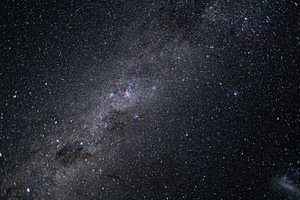
The Milky Way photographed by the NASA Artemis II crew from inside the Orion spacecraft on April 7, 2026. NASA/Handout via REUTERS
The photo captures a glowing stream of stars and dusty strands belonging to the galactic plane of the Milky Way, the immense galaxy that our solar system inhabits. In this image, the view is not directed toward the galaxy’s central core but instead looks along one of its spiral arms, where numerous deep-space objects shine vividly against the dark backdrop of space.
Why is it remarkable?
At the center of the image lies a pink cloud known as the Homunculus Nebula. This enormous, glowing formation of dust and gas is located about 7,500 light-years from Earth and was produced by a dramatic eruption in the binary star system Eta Carinae, according to NASA. The violent outburst expelled massive amounts of material, creating the striking nebula visible today.