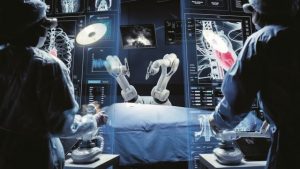
A new voice-controlled surgical robot is transforming the way complex operations are performed, combining artificial intelligence with real-time adaptability. Developed by researchers at Johns Hopkins University, the SRT-H (Surgical Robot Transformer-Hierarchical) has successfully completed intricate surgical tasks by following only spoken instructions from doctors.
Teaching a Robot to “Think” Like a Surgeon
Unlike previous robotic systems, which could only operate in highly controlled environments, SRT-H learns from surgical videos, observing both technical steps and the reasoning behind them. This approach allows it to respond flexibly to unpredictable conditions, rather than simply repeating a preset sequence of movements.
Using transformer-based AI, similar to the technology behind ChatGPT, the robot interprets instructions, adapts to changing situations, and improves its performance over time. For example, it can follow precise commands like, “move the left hand slightly to the left,” while simultaneously adjusting for unexpected obstacles or simulated fluids.
Realistic Testing and Precision
In pilot tests using realistic human-body models, the SRT-H performed multiple delicate steps of a laparoscopic gallbladder removal, including identifying bile ducts, positioning surgical instruments, and cutting tissue with scalpel precision. Researchers introduced challenges such as repositioned models and added fluids to simulate blood, yet the robot adapted flawlessly and completed all tasks without errors.
A Milestone in Autonomous Surgery
Until now, autonomous surgical robots handled mostly simple procedures in tightly controlled settings. SRT-H represents a significant leap forward, showing the ability to operate with human-like dexterity under realistic conditions. Lead researcher Axel Krieger describes it as teaching a robot to “drive anywhere, under any conditions,” compared to previous models that followed only fixed paths.
Published in Science Robotics, this breakthrough points toward a future where autonomous surgeries could potentially be performed without any human intervention, combining AI learning with surgical precision and adaptability.