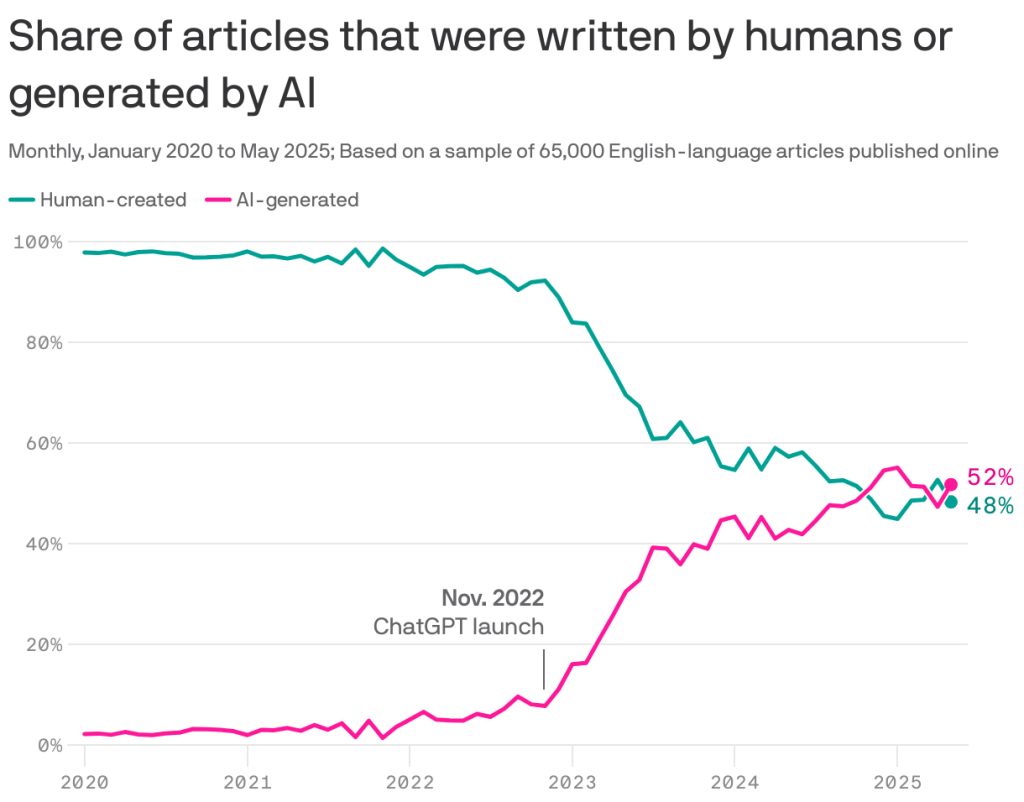
The number of AI-generated articles has surged dramatically since the launch of ChatGPT in late 2022. Today, the volume of AI-written content is nearly equal to that of human-authored material.
Graphite’s analysis, which excluded subscription-based sites where content is typically human-written, examined more than 300 billion web pages.
Human writers still dominate major outlets
Despite the explosion of AI-generated content, leading news organizations remain largely human-driven. Lower-quality “content farms,” however, increasingly rely on AI tools to mass-produce articles — though even search algorithms tend to favor traditional writing.
According to the report, 86% of Google’s top-ranked articles are written by humans, while 14% are AI-generated. Similarly, 82% of the articles cited by ChatGPT and Perplexity originate from human writers. AI-generated pieces, the study found, generally rank lower on search engines.
Why it matters
Researchers warn that if AI continues flooding the web with its own output, language models could begin training on AI-generated text — potentially degrading and even “collapsing” the overall quality of online information.
A 2022 Europol report had predicted that by 2026, 90% of all online content could come from AI. The new Graphite data suggest that this forecast may not be far off.
Inside the Graphite study
The company analyzed 65,000 URLs published between 2020 and 2025 using the Surfer tool to detect AI-written material. Articles containing less than 50% human input were classified as AI-generated.
AI content creation began to accelerate after 2023, briefly surpassing human output in November 2024 before stabilizing. Surfer’s detection accuracy was tested with sample articles, showing just 4.2% false positives and 0.6% false negatives.
Defining “AI-generated” remains complex
Experts note that defining AI authorship is increasingly difficult, as more writers now collaborate with AI tools. “There’s more of a symbiosis than a rivalry between humans and AI,” said Stefano Soatto, professor of computer science at UCLA and a Google representative, speaking to Axios.
The study may also underestimate the share of human-written content since Common Crawl — the database used — excludes paywalled sites, where writing is almost entirely human-produced.
While AI-generated summaries are gaining traction, user trust remains low. A Pew Research survey found that only 20% of respondents consider AI-written summaries “very useful,” and just 6% say they trust them “a lot.”