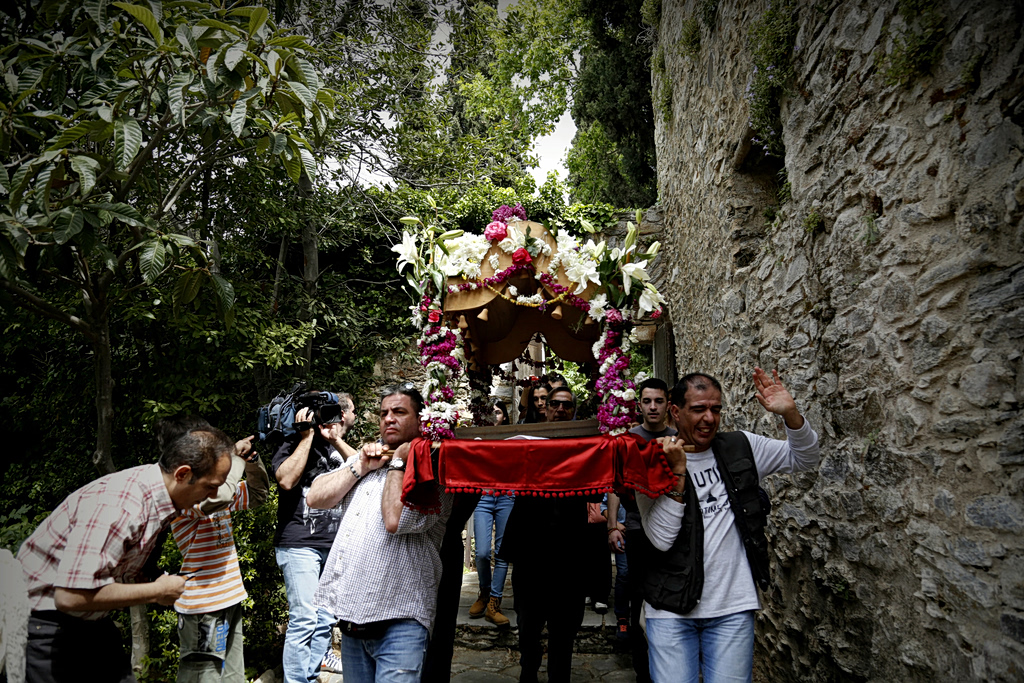
The bells of Holy Week are ringing, and preparations for decorating the Epitaphios are in full swing. However, this year, the traditional adornment of the carved wooden bier with flowers is not only an act of devotion — it has also become a difficult financial equation that churches are being called upon to solve, with the help of their faithful.
Colorful flowers, fragrant wreaths, and elaborate arrangements create an image of deep emotion. But behind this beauty lies a reality that has become increasingly pressing in recent years: the cost of floral decoration. Growers and florists speaking to To Vima say the problem stems from high energy costs, transportation expenses, and broader market price increases.
From their side, churches explain that they are forced either to lower the quality of flowers, or to appeal to their faithful to contribute whatever they can from their gardens and their limited means.
“This year, the churches and the Epitaphios rely on people’s offerings”
“Churches have increased costs, from maintaining the buildings to utility bills. Especially after the pandemic, when people had stopped coming, we faced major problems and had to ask for help from the faithful,” church representatives explain. “The situation is tragic because of the high cost of living. At one point, we didn’t even have oil to keep the vigil lamps lit,” they add.
It is also noted that in recent years there has been a significant rise in flower prices. “As the florists told us, this year there are notable shortages due to heavy rains in the preceding days, as well as generally reduced production. Flower prices have risen for that reason,” church representatives emphasize.
“This year, the churches and the Epitaphios rely primarily on the generosity of the public,” they conclude.
Why is the Epitaphios facing so many difficulties this year?
The rise in flower prices is not a random event, but a phenomenon that has become particularly noticeable in recent years, reaching a peak ahead of the Epitaphios decorations. Behind the steep prices lies a “perfect storm” of economic, environmental, and international factors.
The root of the problem lies in production costs. The energy required for lighting and heating greenhouses, combined with soaring fertilizer and pesticide prices, is squeezing producers hard. These higher operating costs are passed directly on to the consumer at the flower shop, while labor costs — especially in higher-wage countries — add yet another layer to the final price.
At the same time, due to their fragility, flowers require special transport conditions (refrigerated vehicles) to arrive fresh at their destination. Continuous fuel price increases, shortages of refrigerated trucks, and supply chain delays create an expensive “journey” for flowers, one that is ultimately paid for by the buyer. Furthermore, climate change is now baring its teeth in the floriculture sector as well. Extreme weather events such as heatwaves and frosts destroy entire harvests of sensitive species. With supply dropping dramatically and demand, especially during the Easter period, remaining high, price increases are inevitable.
Finally, the flower market is inextricably linked to international trading hubs. The Netherlands, as the global leader, often sets prices. Any disruption at these nodes, whether due to inflation or geopolitical tensions, triggers a cascade of price increases that reaches all the way to the last flower shop in the Greek countryside.
Indicatively, a modest decoration that previously cost between €300 and €400 is now estimated, based on the latest data, to potentially exceed €600 this year, depending on the density and type of flowers used.
What flowers are used on the Epitaphios?
Decorating the Epitaphios is a ritual that blends faith with the symbolic language of flowers. Every blossom and every color chosen carries deep meaning connected to the Passion of Christ and the anticipation of the Resurrection.
The colors chosen are also deliberate. Purple is the color of mourning, solemnity, and sorrow. Red symbolizes the blood Christ shed on the Cross, while white represents the purity, innocence, and splendor of the coming Resurrection.
The flowers typically chosen for the Epitaphios include carnations, the most common choice. Red carnations symbolize love and sacrifice (blood), while white ones represent the purity of the soul. Lilies and calla lilies, known as “lilies of the Virgin Mary,” symbolize purity, humility, and Christian faith. Legend has it that calla lilies bloomed from the Virgin Mary’s tears beneath the Cross.
Lilacs, whose very name in Greek evokes Easter (paskhalies), also traditionally adorn the Epitaphios. Legend holds that the tree withered upon witnessing the Crucifixion, then bloomed again in its characteristic purple color and fragrance at the moment of the Resurrection, symbolizing liberation from the bonds of death.
Violets, for their part, represent humility and deep Christian piety. Their purple color makes them central to the mournful atmosphere of Good Friday. Roses are also considered a symbol of divine protection and the Virgin Mary, often arranged to form the Cross or lettering on the Epitaphios, symbolizing the victory of life over death.
Hyacinths symbolize rebirth and hope and among the first spring flowers, they herald the return of nature and of life itself. Finally, there is the amaranth, whose very name means “the one that does not wither”, symbolizing the immortality of the soul and eternal life.