In the ethnic, vibrant neighborhoods of Athens — from Omonia, Vathi and Acharnon to Koliactou and Kypseli — those of us who love exploring the city’s hidden corners discover an Athenian New Orleans.
Where our parents in the 1970s and ’80s would close their shops and take us out at night for dinner with guitars and bouzouki, now gospel bands resound and choirs of the faithful gather in spontaneous joy. Where once migrants from rural Greece crowded into the apartment blocks of the 1960s, today families from Mama-Africa, Asia, and the former Eastern Bloc have made their homes.
Antonis Samarakis, who once wrote “rooftops were never so close and hearts never so far apart,” might smile today seeing African families celebrating together, for example, a baby’s first bath.
A World Mosaic
Sunday morning in the concrete alleyways — Menandrou, Fylis, Aristomenous, Naxou. Digital nomads with pink hair and their parents’ jackets eat at Victoria’s Afghan tavern next to Erasmus students and Afghan builders.
African women in niqab and Pakistani women in sari haggle over watermelons with a Roma man who has parked his red Toyota on Acharnon, in front of Bangladeshi groceries that stay open day and night, their flashing lights glowing like an “after” club.
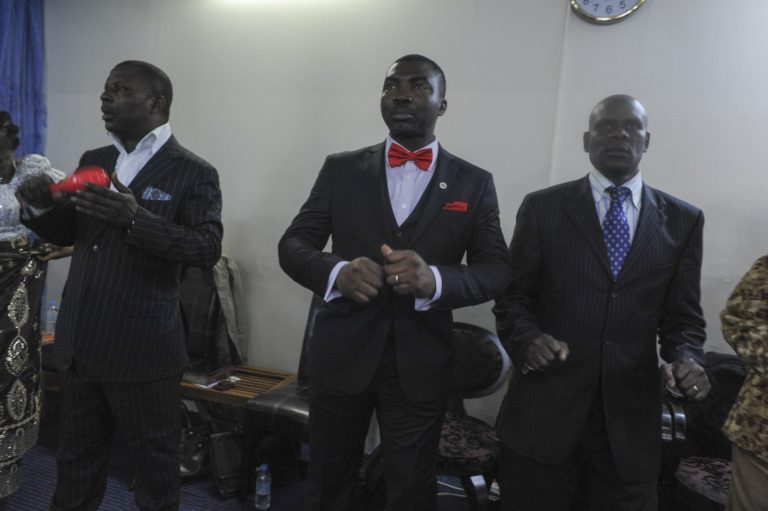
At 10:30 a.m., the Africans arrive like guest stars, dressed to the nines, in polished patent shoes, sharp suits and red bow ties. The women, statuesque like deities, balance on high pastel heels along the crumbling sidewalks. Babies are swaddled on their mothers’ backs, nestled against elaborate, delicate braids.
Photography by Maro Kouri
Children of all ages follow, also in their Sunday best. Orthodox Christians in Western dress return from liturgies at Agios Panteleimon, Agios Nikolaos, Agios Loukas. Families of other faiths head to Catholic and Pentecostal churches in Kypseli and Liosion. A mosaic of the world in moments of peace.
“The Music Comes From My Heart”
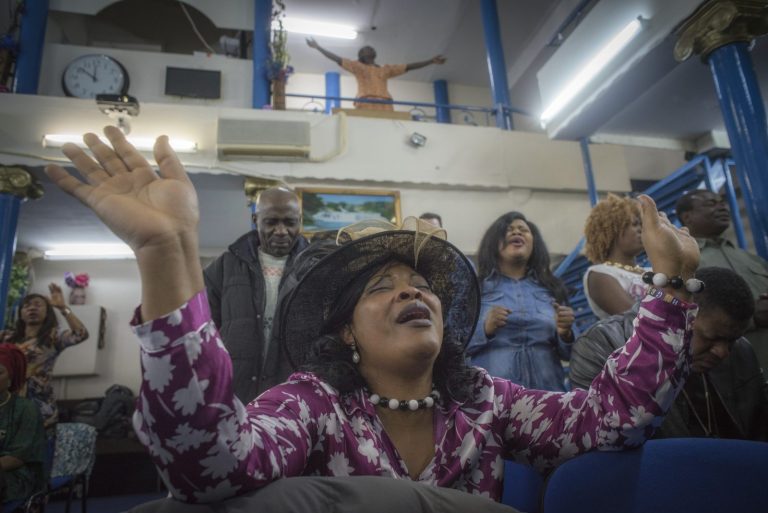
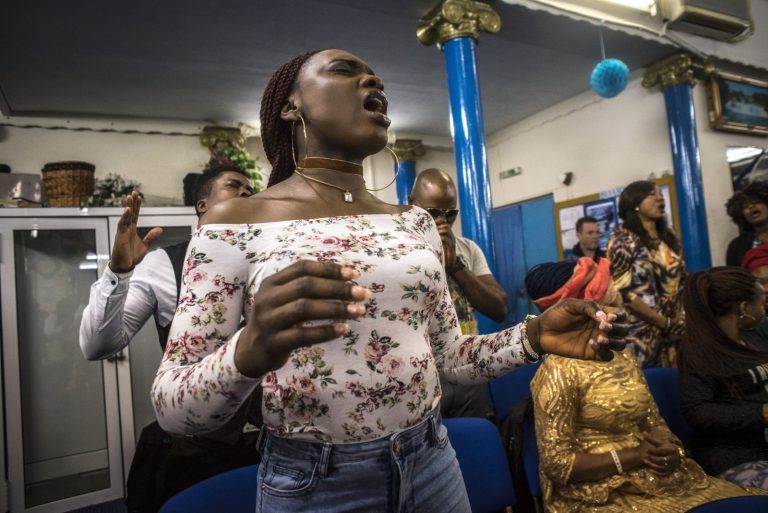
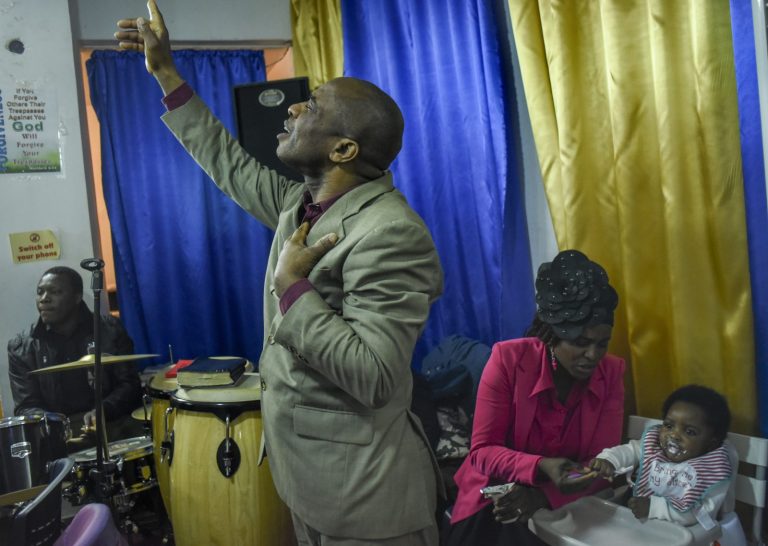
But it is the spiritual music that breaks Sunday’s silence! An echo of Aretha Franklin drifts from behind the white iron gate of a ground-floor church — once a popular music hall — on Naxou Street. Bible and tambourine in hand, the pastor preaches forgiveness, hope, trust. Whoever feels it rises to the “stage” of the altar and confesses in song with all their soul. A young boy on the drums, a middle-aged man sets fire to the strings of his electric guitar.
The congregation rises, eyes closed, hands lifted in passionate longing for cleansing. Babies strapped to their mothers’ backs are lulled to sleep as the faithful whisper prayers, confessing their fears, sins, and guilt. Murmurs swell into a crescendo of spiritual psalms, carrying the crowd into ecstatic dance with wooden percussion. A liberating experience.
Photography by Maro Kouri
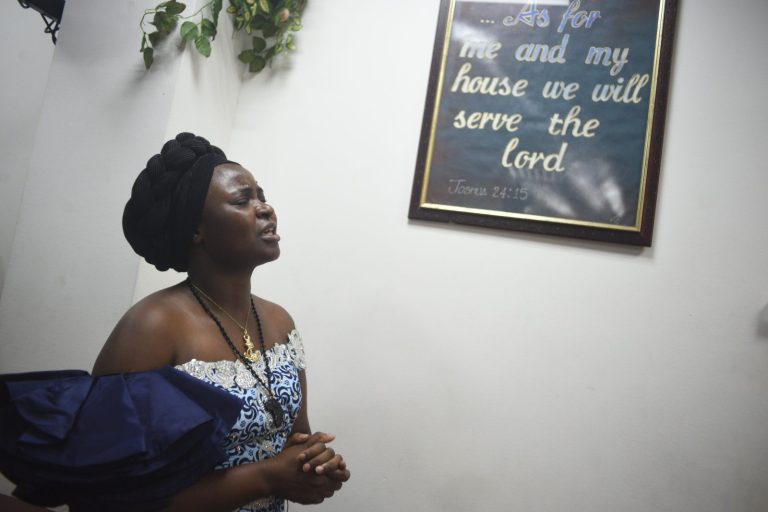
At the keyboard, 45-year-old Eze Chris Ute seems to hover as he accompanies his 35-year-old wife Abigail, who bends, overcome with emotion, before the cheap microphone, voicing the words of The Old Rugged Cross, written by a grieving preacher in 1912. “Where did you learn to sing?” I ask her. “The music comes from my heart, the words from John’s Revelation. I just follow,” she replies.
Photography by Maro Kouri
Both came from Owerri in eastern Nigeria after hardships at the borders. They met in Athens, fell in love, and now have two young children. “We hardly even remember what we endured from border to border. So many stories.”
Chris, a self-taught pianist, works as a cameraman and editor at weddings and baptisms. At dawn each morning, he sets out for Aspropyrgos, where he works in a supermarket warehouse. “We continue on the path our parents set. We want the same for our children,” he says. Beautiful Abigail Obou Eze works nights, from 9 p.m. to 6 a.m., preparing airline meals. “I chose this job to be with my children during the day,” she says. A mother, I think.
Since their new Chinese landlord evicted them to renovate their flat for Airbnb, they live in a tiny studio. Abigail asks forgiveness for human greed with her deep, jazzy voice, releasing us all from our thoughts.
Photography by Maro Kouri
I watch as, alongside Benny, a Filipina, she gently sets boundaries for the children in the tiny loft of the Sunday school. Together they watch a DVD of an animated film about the life of Christ. Humbly, the “Mahalia Jackson of Patissia” bids us farewell with homemade Nigerian snacks of breadfruit.
Faith in Every Corner
I meet an old friend, Pastor Akonda Samuel Oluwakayode. Disappointed, he tells me: “The police shut us down. The permits take forever. From thirty churches, only a few remain.” He laughs when he asks if I want him to be my driver, and we walk downhill to a new church in Sepolia.
Nana Boatema from Ghana, in a dress that could inspire any designer, smiles: “The church reminds me of home.” We enter a former mattress store — now packed to the brim. A woman lies prostrate on the red carpet in prayer, children run about, my camera clicks in rhythm with the bongos played by Joy, a seamstress from Uganda. I recall Soweto in 1998: a shack under a judas tree, sweat, vibrations, exaltation lifting you up.
Photography by Maro Kouri
Improvised mosques and Hindu temples prepare for their afternoon services. In a 1950s eight-story block on Sofokleous, almost every floor houses a church. In the basement, the imam chants so movingly that you imagine the DJ at the club next door pausing to surrender to the prayer.
On the first floor, over 400 Greek Pentecostals sing hymns in Greek. On the fourth, some 30 African evangelicals fill the building with gospel fire. Pastor Oyekmem Abraham, who also runs a travel agency in Kypseli, offers me communion in a plastic cup, while Stella from Uganda asks in flawless Greek: “Are you ready to receive the bread and the communion?”
Songs of Struggle and Hope
Jacqueline, 40, arrived last year from Sierra Leone, alone, by smugglers’ boats, to undergo surgery. Pain and hope shine together in her almond-shaped eyes. Every six months she comes down from the Ritsona refugee camp, if she can find €20 for a taxi. “I join services online through my phone. I want to leave the camp, to work, to live, to create,” she says softly.
George, disillusioned with a pastor on the first floor, came for the first time to the fourth-floor church. “But on Wednesdays it’s someone else, all heart,” he says. “They give me clothes, shoes. I’m homeless — I sleep in a parking space.” When he saw my camera, he disappeared. I felt sorry.
Beneath embroidered hangings with Bible verses, a 17-year-old seeks redemption: “I want to leave the circles that drag me elsewhere.” He kneels; the few faithful cry out to cast away evil. “In church we learn to love, to respect.” Someone says Trump “might help by overturning gay marriage.” But another reminds: “Christ said ‘Love one another.’ How do wars and racism help?” “How can you give love if you’ve never received it?” comes the answer to everything.
An Athens of Many Voices
In a basement church in Kypseli, Pastor Phoenix Grissim dances with sixty souls from Kenya, Nigeria, Ethiopia, the Philippines. Rent is €350. “When someone struggles, we all contribute.” He works at a beverage company; his wife cares for their employers’ children. “I feel they are my friends,” he says. And I feel joy. There are still people who look fear of the “other” in the face and, instead of hate, give care. Hallelujah.