“Wherever I travel, Greece wounds me,” wrote in 1936 the then young diplomat and later Nobel Prize–winning poet Giorgos Seferis. Almost a century later, after countless disasters and corresponding periods of reconstruction, our country resembles a complex puzzle—or better yet, a mosaic of multiple, diverse images—where zones of progress, prosperity, and evident decline coexist.
Traveling toward Northern Greece, one perceives the differences—the many influences of the economic geography shaped by the new modern highways—but also the distance separating the once-flourishing hinterland, now afflicted by population shrinkage, visible aging, and a lack of resources and income.
Industrial production lies on both sides of the new major national roads, mostly at the outskirts of expanding and developing urban centers, large and small. Villages located far from the road networks and modern cities seem like ghosts from another era—except for those nestled in the mountains that have preserved their traditional architecture and attract visitors, Greeks and foreigners alike, throughout the year.
The traveler feels the abandonment and retreat of purely agricultural regions—especially those that remained bound to traditional extensive cultivation of cereals and cotton, without turning to orchards and new crops. This transformation is visible at the exit of the Thessalian plain and the beginnings of Pieria, around the Vale of Tempi, where olive groves, pear and almond orchards, and extensive kiwi plantations now dominate.
In the Shadow of Olympus
Heading north, nature compensates you. The autumn colors are vivid—a delight to the eyes—and surprises abound. The archaeological park of Dion, a few kilometers from Katerini, beneath the imposing peaks of Mount Olympus, is unique. A vast, lush green expanse of hundreds of acres with running waters—once a place of worship for Zeus in ancient times and later a thriving Roman spa and resort—leaves one speechless. Still under excavation, it welcomes thousands of visitors who gaze in awe at the unearthed city, its magnificent mosaics, the sanctuaries dedicated to the Egyptian goddess Isis, the ancient theater, and of course the museum and archive that accompany the park and, among other treasures, house the Hydraulis—one of the oldest known musical instruments.

Just 7–8 kilometers from Dion lies Litochoro, a historic, distinct, and thriving town of 7,500 inhabitants built at the foothills of Olympus. Over time, it has become the base for mountaineers climbing the sacred mountain. Well-kept and clean, with the trails of the Enipeas Gorge capturing visitors’ attention as they lead toward Mytikas, it gives the impression of a prosperous and admirable place.
Yet only a few kilometers away, disappointment prevails. Choosing the inner provincial roads of Pieria, west of Katerini, to reach Vergina, the traveler encounters abandonment. There, where cultivated lands meet oak-covered mountains, stand purely rural villages—dilapidated and deserted. You can drive for miles without meeting a soul. The journey is painful, and only the golden leaves and the birds soften the sorrowful feeling.
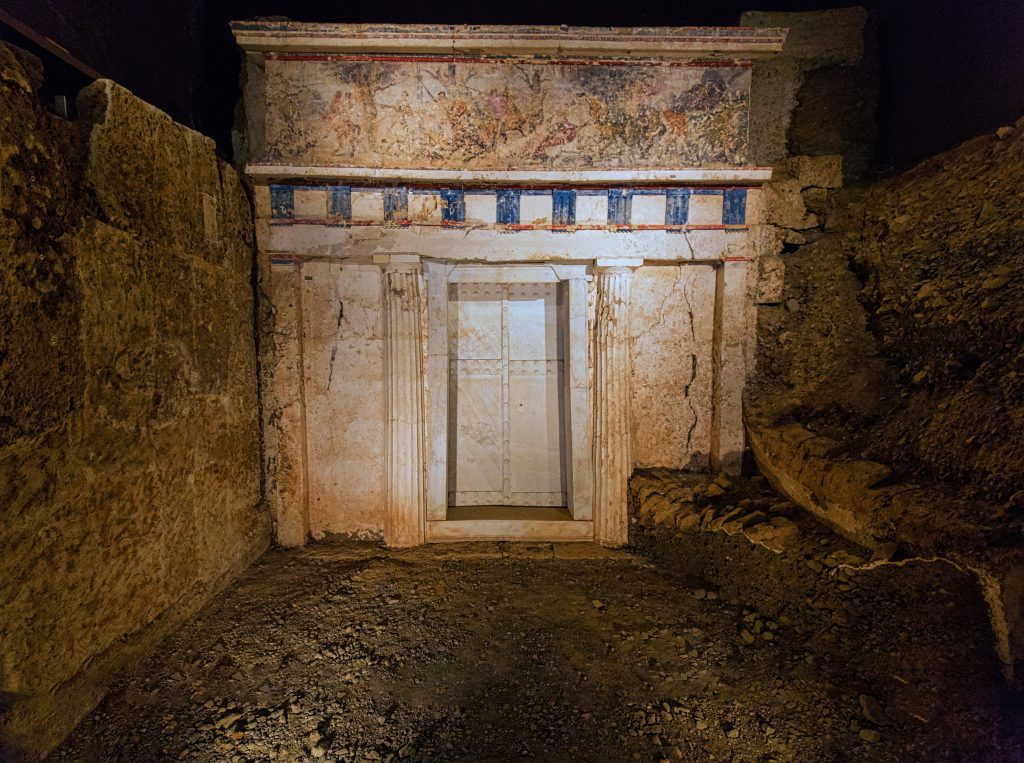
After nearly ninety minutes of driving along narrow, inhospitable roads, you reconnect with zones of progress, culture, and prosperity. The tombs of Philip II, the unique discovery of Manolis Andronikos, together with the rich Vergina Museum and the remarkable finds of the Macedonian dynasty, completely change the scenery. Visitors from around the world wander silently through the imposing tombs, feeling the grandeur and glory of Aigai, birthplace of Alexander the Great, and stand in awe before the elegant, artifact-filled white walls of the museum.
Tourism Instead of Fur
Continuing toward the Egnatia Highway, you pass through the peach fields of Imathia, encounter the Haliakmon Dam, and sense—if only from afar—the wealth of Veria.
The Egnatia Odos, through its vertical routes, offers quick access to Kastoria and Florina. Modern, enclosed, safe, and well-marked highways shorten distances. Kastoria, with its prized Lake Orestiada—a rich, active wetland year-round—quickly unfolds before you, ready to charm every traveler. Despite the decline of the fur industry, the city appears prosperous. Waves of visitors from across the Balkans, who enjoy strolling around the lake and visiting Doltso, the old town with its dozens of churches, splendid mansions, and fine Macedonian architecture, have clearly replaced much of the economic loss from the once-dominant fur trade.
From there, along wonderful autumn routes—either through the Vitsi forest, lush with beeches and ferns, or via Kleisoura and Sklithro—one descends into the Municipality of Aetos, bound for Nymfaio, the old Neveska, once a center of silversmithing and a stopover for the caravans of weavers from Ampelakia en route to Vienna in Ottoman times. The village of Yiannis Boutaris, Nikolaos Mertzos, Sossidis, and the Stafilopatis family, harmonizing with the alpine landscape, resembles a Central European settlement—an oasis of beauty and culture.
The inspiration of Yiannis Boutaris in 1993 to make it a center for the protection of abused bears revived the village. The Arcturos environmental park—70 acres that today host twenty former “dancing” bears—attracts thousands of visitors and has transformed the area.
Descending, however, toward Ptolemaida, one again faces abandonment. The now inactive lignite fields gape beside the road, and only the scattered vineyards of the distinguished Xinomavro variety in the wider zone between Amyntaio, Vegoritida, and Prespes point to noble and hopeful productive activity. Along the Egnatia’s vertical route from Florina to Kozani, the desolation and gloom sadden even the most optimistic traveler.
Contrasting Images
Rejoining the Egnatia Odos toward Grevena and Ioannina, the scenery changes once more. Built along the path of the ancient Roman road, the modern Egnatia is a marvel of Greek engineering—successive tunnels of many kilometers alternate with majestic valley bridges, overcoming the beautiful yet once-inaccessible Pindus mountain range. Grevena, the “city of mushrooms,” exudes culture; Metsovo and Anilio stand vibrant and popular along the great highway; and Thessaloniki now enjoys easy access to Ioannina, the fastest-growing city in the country.
Productive, technological, and tourist development make the capital of Epirus resemble a modern regional hub—perhaps a model for regional development across Greece.
It is hardly necessary to note the impressive spread of short-term rentals throughout the Greek countryside. The available houses are now numerous and directly competitive with hotels. Greece is now easily and safely traversable. And if one is lucky, descending toward Patras, one might even see a sea turtle strolling through the welcoming waters of the Ambracian Gulf near the quay of Amfilochia.
Different—and largely contrasting—modern Greek images: prosperity, revival, and decline succeed one another in a land so beautiful and verdant, despite the many summer wildfires.