The head of the Thessaloniki Appeals Prosecutor’s Office has ordered a preliminary investigation into the disturbances at the Aristotle University of Thessaloniki that left a police officer seriously injured and renewed scrutiny over campus security measures.
The inquiry will focus on three main questions:
- Whether university authorities were aware of the party that preceded the incidents.
- If a permit request was submitted for the event and whether it was approved.
- The role and response of the university’s security company during the disturbances.
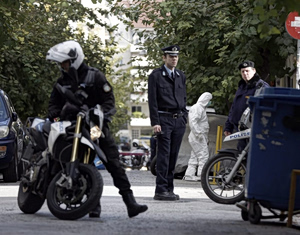
Simultaneously, the police have already launched an ex officio preliminary investigation. During operations that followed the incidents, 313 individuals were taken to the General Police Directorate of Thessaloniki for questioning. Authorities conducted detailed checks to determine if they were involved in any criminal acts.
Following the review of collected evidence, the Hellenic Police (ELAS) confirmed that no charges were found against those detained, and all individuals were released without prosecution.
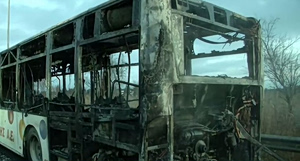
The Education Ministry has given the rectorate of Aristotle University a 48-hour deadline to provide explanations over the incidents, which involved masked individuals throwing Molotov cocktails after a party on campus. One officer suffered burn injuries and remains hospitalized.
The Unrest
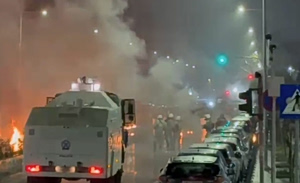
The unrest unfolded after a gathering in the university’s courtyard, according to available information. The rectorate said it was notified about the party at 7:30 p.m. on Friday and informed police, who deployed riot units to the scene. Clashes followed, with officers responding with tear gas as Molotov cocktails were thrown at them.
Images from the scene showed masked attackers targeting police lines, while students and other people inside the campus were reportedly trapped during the turmoil. The events have highlighted what officials described as confusion and gaps in how universities are guarded.
In a statement, the university rectorate raised the question of whether certain areas should have been sealed off while exams were taking place and suggested it may be time to immediately activate controlled access to university facilities.
Controlled access to Greek universities has already been legislated twice, in 2021 and again in 2025, but has never been implemented. The measures include mandatory ID-based entry for students and staff, installation of cameras — including in indoor spaces — perimeter fencing, and private security.
Meanwhile, police unions have pointed to the injured officer’s burned uniform as evidence of the risks officers face and have called for authorization to use plastic bullets and paint launchers during similar incidents.