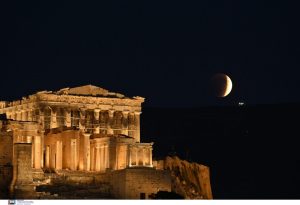
Skywatchers are in for a treat tonight, Tuesday, October 7, as the first supermoon of 2025, known as the Harvest Moon, rises in spectacular form.
This lunar event marks the largest and brightest full moon of the year, as the Moon reaches its closest point to Earth, known as the perigee.
It is the first supermoon since November 2024, and the beginning of a celestial trio — with two more supermoons expected on November 5 and December 4 — offering sky enthusiasts a series of dazzling night displays this autumn.
What Makes It a “Supermoon”?
Unlike a perfect circle, the Moon’s orbit around Earth is elliptical, meaning its distance from our planet changes throughout the year.
When a full moon coincides with the Moon’s closest approach — or within 90% of that distance — it’s called a supermoon.
The term was first coined in 1979 by astrologer Richard Nolle to describe full moons that appear noticeably larger and brighter.
According to astronomers, a supermoon can look up to 14% bigger and 30% brighter than an average full moon.
Some experts define a supermoon more strictly — as any full moon within 360,000 kilometers (223,700 miles) of Earth’s center — but by either definition, tonight’s Harvest Moon qualifies as an impressive sight.
The Meaning Behind the Harvest Moon
Traditionally, each full moon of the year carries a name linked to the seasons.
The Harvest Moon is the full moon that rises closest to the autumn equinox, which occurred on September 22 this year.
Named centuries ago, it refers to the time when farmers harvested crops under its extended light.
Because the Moon rises near sunset for several consecutive nights, it provided extra hours of illumination for late-season fieldwork.
Interestingly, this year’s Harvest Moon is one of the latest since 1987, appearing in October rather than September.
Why the Moon Appears Bigger and Redder
Many people notice that the Moon looks larger near the horizon than high in the sky. This is a visual illusion — the Moon’s actual size doesn’t change. Scientists believe it happens because our brains compare it to nearby objects like buildings or trees, making it appear unusually large.
As it rises, the Moon often glows reddish or orange, not due to its surface color but because of Earth’s atmosphere. When the Moon is low, its light travels through more air, scattering blue wavelengths and letting warmer tones dominate the view.
When and How to Watch
The supermoon will rise just after sunset and remain visible all night, weather permitting. Observers in both urban and rural areas will be able to see it without any special equipment, though a clear eastern horizon provides the best view.
For the most striking experience, watch it as it rises above the skyline — when it appears its biggest and most colorful.