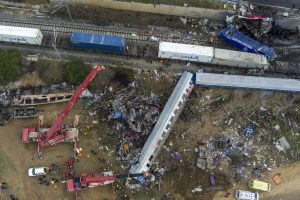
Senior judicial authorities in Greece have underlined that the trial over last year’s Tempi train crash—the country’s deadliest rail disaster—must move forward without further delay, calling it the only way to deliver justice to the victims’ families and hold those responsible accountable.
Speaking at a legal conference, Supreme Court President Anastasia Papadopoulou and Prosecutor Konstantinos Tzavelas addressed mounting pressure from relatives of the 57 people killed in the collision, including ongoing demands for exhumations and new investigations.
“They are trying to force me, outside the law, to reopen the investigation,” said Tzavelas.
The most recent appeal comes from Panos Ruci, the father of one victim, who is on hunger strike while requesting the exhumation of his deceased son’s body. He has asked for a new autopsy and toxicological tests of the remains, citing concerns about possible chemical substances linked to claims of suspicious cargo on the freight train involved in the crash, as well as for further identification purposes.
On the exhumation request
Regarding the demand by hunger striker Ruci for an exhumation, Papadopoulou explained the legal framework, noting among other things that:
“This exhumation is being requested within the framework of the investigation’s work. The investigation has been lawfully closed, and the case file is now with the president of the Appeals Court. In this case, the request concerns the examination of the bones for xylocaine and other substances. Such requests were made during the investigation and were answered, so we cannot return to them. Since previous requests have been answered, we cannot revisit them, and moreover these requests were not only rejected by the investigator but also with reasoned rulings by the judicial council.”
She further pointed out that the only other possibility would be “for an exhumation to take place in three years, but not within the framework of the investigation. What is being asked is for an investigative act to be performed, which must be requested from the President of the Appeals Court who now holds the file in Larissa.”
All requests in the trial
Papadopoulou then addressed the victims’ families directly: “No right is being lost at this stage. Everything can be raised in court.”
Finally, in a strongly worded statement, the Supreme Court President declared: “Let me address those who exploit this situation: the country has had other disasters, but never were such demonstrations made that exploit the pain of the relatives.”
And she concluded: “There are people who do not want the trial to begin… It is the right of the investigator to close the investigation. And when he did close it, there were people shouting at him that he could not. Where are we living? Do we live in a democracy? The relatives have not lost any rights and must not be led astray by those who appear supportive but pursue other purposes.”
Prosecutor of the Supreme Court: “I express indignation”
For his part, Tzavelas, referring to the extrajudicial notice delivered to him by victims’ families and public officials, did not hide his displeasure and irritation, declaring:
“Lawyers are trying to force me, as the supervisor of the investigation, to instruct the appellate prosecutor of Larissa and the president of the Appeals Court of Larissa to reopen the investigation. I express my indignation, because lawyers cannot speak to a lawyer and ask for things outside the law.”
He added: “An exhumation can be requested as an administrative measure by the legal entity that supervises the cemetery where the deceased has been buried. The request cannot be satisfied because it concerns the main investigation and has already been judged during the preliminary phase. The case file is now at such a procedural stage that only the President of the Appeals Court can decide.”