The disclosure of an official list of people and entities linked to the Predator spyware case has cast new light on the breadth of Greece’s wiretapping scandal, one of the country’s most serious recent crises involving privacy, surveillance and democratic accountability.
The list, obtained by TO BHMA , emerged in the wake of a recent ruling by the Single-Member Court of First Instance of Athens, which convicted four private individuals connected to the Predator software and sentenced each of them to 126 years and 8 months in prison. The ruling amounted to a judicial confirmation of the illegal activity that shook Greek public life.
The list compiled by Greece’s Hellenic Data Protection Authority (DPA) reveals the breadth of the Predator spyware scandal. While some of the names had already been publicly linked to parallel surveillance by Greece’s National Intelligence Service (EYP), the latest disclosure brings to light additional names included in the authority’s record. The full number of people targeted, however, remains unknown.
What the list makes clear is the scale of the operation. The reported targets included ministers and advisors in the government of Prime Minister Kyriakos Mitsotakis, lawmakers from the governing New Democracy party and their spouses, opposition figures, newspaper editors, business executives and people involved in local government.
The authority’s staff reportedly undertook a technically demanding investigation and carried it out quietly and methodically in order to establish evidence, not merely suspicions, of surveillance. After the inquiry was completed, the then President of DPA Konstantinos Menoudakos sent personal letters to the individuals on the list, informing them that their phones had received specific messages tied to attempted surveillance using the Predator spyware.
The disclosure also raises questions about why many of those who were formally notified chose to remain silent.
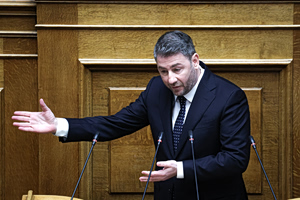
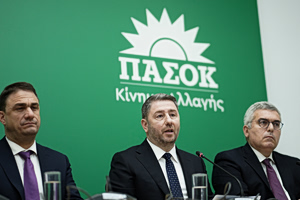
Only five people, including PASOK leader Nikos Androulakis, chose to turn to the courts and initiate legal action. That fact has fueled fresh scrutiny, especially after revelations during the recent trial and the reopening of the case file with instructions to examine even a possible attempted espionage offense, since foreign nationals are said to be involved.
The case also raises questions for the Greek state itself, including why the government did not appear in court as a civil claimant despite the seriousness of the allegations and their implications for public institutions.
The list itself underlines how widely the alleged targeting spread across political, institutional and media life. Among the names and entities included are Androulakis; former minister Christos Spirtzis; journalist Thanasis Koukakis; ministers and senior political figures such as Adonis Georgiadis, Niki Kerameus, Thanasis Plevris, Vasilis Kikilias, Kostis Hatzidakis and Olga Kefalogianni; as well as institutions and organizations including the Hellenic Parliament, the Presidency of the Government, the Ministry of Citizen Protection, the Ministry of National Defense, the Region of Attica, media companies and major businesses.
The inclusion of state bodies, political figures, media organizations and private companies in the same official record deepens the sense that the scandal was not limited to isolated cases. Instead, it points to a surveillance network whose reach cut across multiple centers of power and influence.
Yet, despite years of public controversy, key questions remain unanswered. Neither PASOK leader Nikos Androulakis nor any other known victim of the EYP–Predator surveillance system has been informed of the reasons they were targeted. Greece’s National Intelligence Service (EYP) has refused to implement a relevant ruling by the Council of State, the country’s highest administrative court. As a result, appeals have been filed with the European Court of Human Rights in Strasbourg, with a decision expected soon.
The case is also taking on a broader European dimension. The Athens court’s decision in the wiretapping case is set to be discussed Wednesday in the European Parliament, drawing renewed international attention to a scandal that continues to raise questions about transparency and accountability in Greece.
Find the full list here.