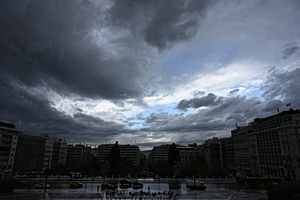
In today’s Attica — a region battered by violent storms, sudden cloudbursts and near-weekly flood warnings — the idea of declaring a “state of drought emergency” would once have sounded absurd. Yet the climate crisis now routinely delivers paradoxes that once belonged to the realm of the impossible. Even the recent downpours, dramatic as they were, barely made a dent in the wider picture: water reserves remain alarmingly low, the drought stubbornly persistent, and scientists warn that shortages are a very real threat for at least the next five years.
So it is no coincidence that Thursday, November 27, after a marathon session, the Hellenic Regulatory Authority for Waste, Energy and Water (RAAEY) approved the Athens Water Utility’s (EYDAP) request to declare the region of Attica under drought conditions — a situation comparable, experts say, to the last major water crisis of 1988–1994.
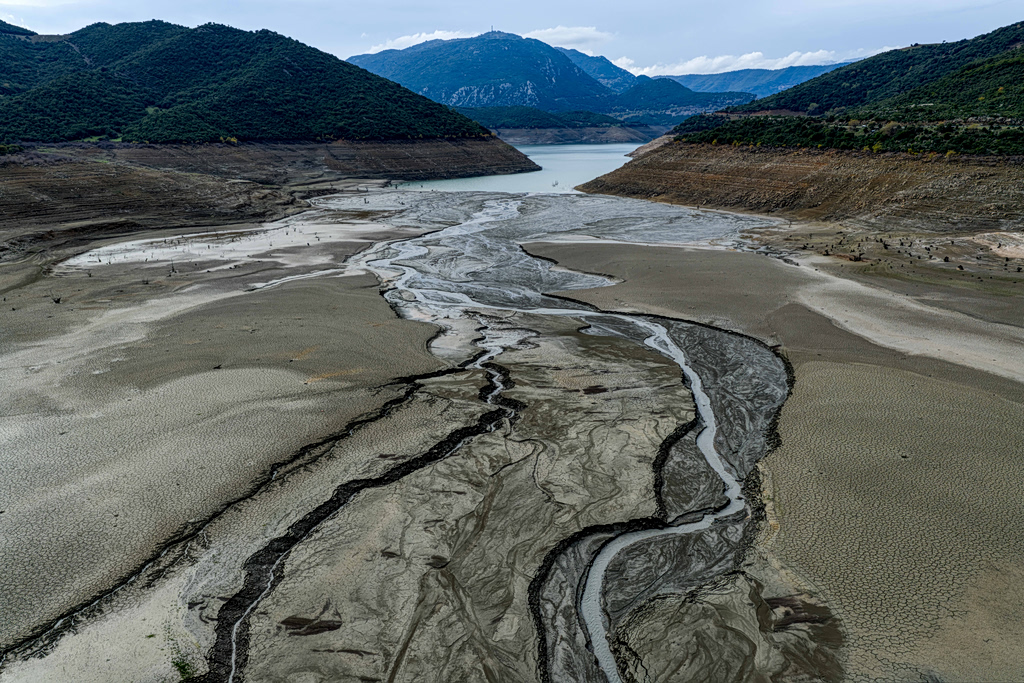
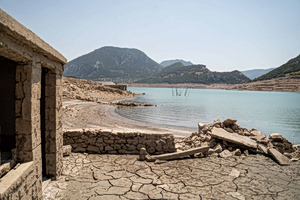
A drone photo captures the low water levels of the Mornos Dam, the main source of Athens’ water supply, November 2, 2025. Antonis Nikolopoulos /EUROKINISSI
The urgency is underscored by a technical opinion commissioned by RAAEY from Professor Christos Makropoulos, a specialist in Water Resources and Environment at the National Technical University of Athens (NTUA). His assessment is blunt: the improved rainfall of October and November cannot reverse the severe multi-year drought that has preceded them. The dryness of recent years, he stresses, is “remarkably long in duration” and fully justifies the heightened concern expressed by EYDAP.
Sources familiar with NTUA’s assessment told To Vima that the report warns of a clear risk of water scarcity for the next two to five years — a reality that demands vigilance, accelerated action and system-wide reinforcement, though not panic. It recommends close monitoring of the hydrological year and frequent reassessment.
On Friday evening, drawing on RAAEY’s recommendation, Environment and Energy Minister Stavros Papastavrou signed the official order: Attica is now formally in a drought emergency.
EYDAP’s Letter: A Stark Warning
To form its recommendation, the Authority examined both the NTUA opinion and a pair of letters sent by EYDAP’s CEO, Harry Sachinis, to the Minister and to RAAEY President Konstantinos Tsimaras. In them, Sachinis calls for the drought declaration as a means to fast-track critical medium-term infrastructure projects: a new pumping pipeline for the External Water Supply System, a desalination unit, and the revival of the “Evrytos” project — a partial diversion of the Krikeliótis and Karpenisiótis rivers toward the Evinos reservoir, intended to secure Attica’s water supply for the next 30 years.
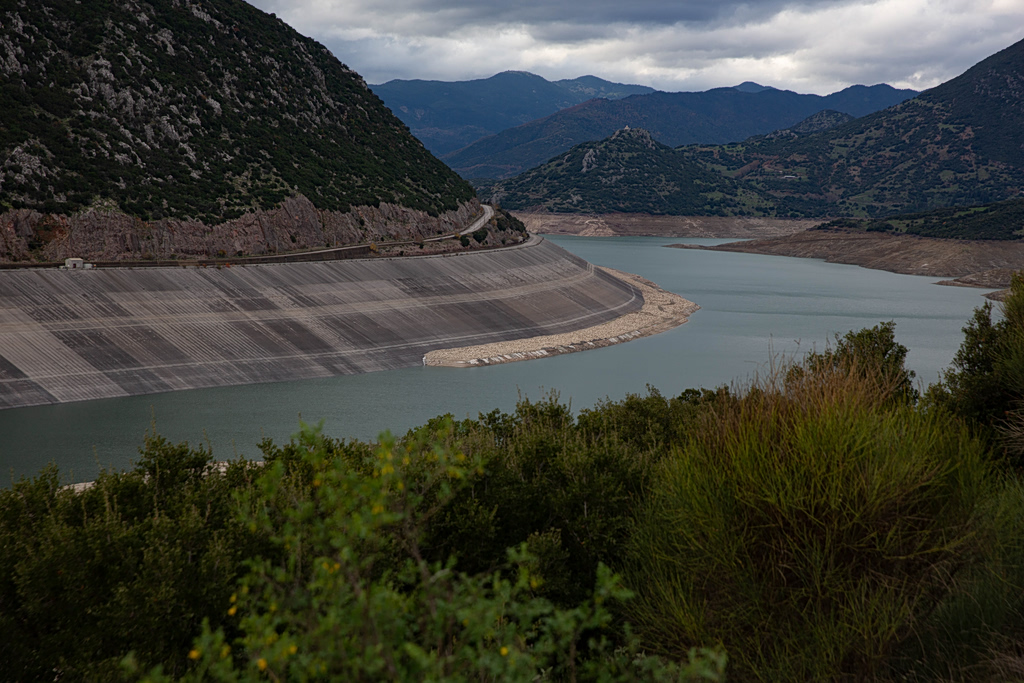
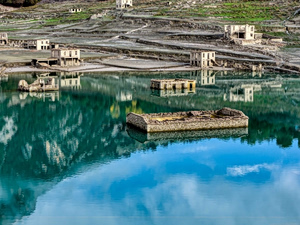
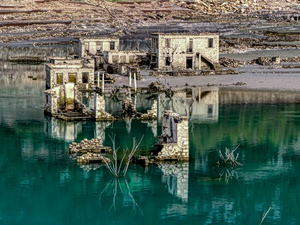
The water level of Mornos has dropped significantly as captured on November 2, 2025. Danai Davlopoulou /EUROKINISSI)
Sachinis also notes that global scientific confidence in rainfall-prediction models — particularly those based on 50 to 100 years of historical data — has been shaken. With climate patterns growing more erratic, predictions now carry “a very wide margin of uncertainty.” He even cites Prime Minister Kyriakos Mitsotakis, who recently remarked that “hope — meaning the hope for increased rainfall — is not a strategy.”
In his letter, Sachinis answers a series of questions posed by RAAEY and presents detailed data. On the sensitive issue of demand-management measures — including partial or total restrictions on water use for industry or agriculture — he states that EYDAP will analyse scenarios and await instructions from the Environment Ministry regarding possible regional shutdowns or usage limitations. NTUA’s report also recommends examining temporary irrigation cutoffs, where necessary, but only alongside substantial compensation for farmers.
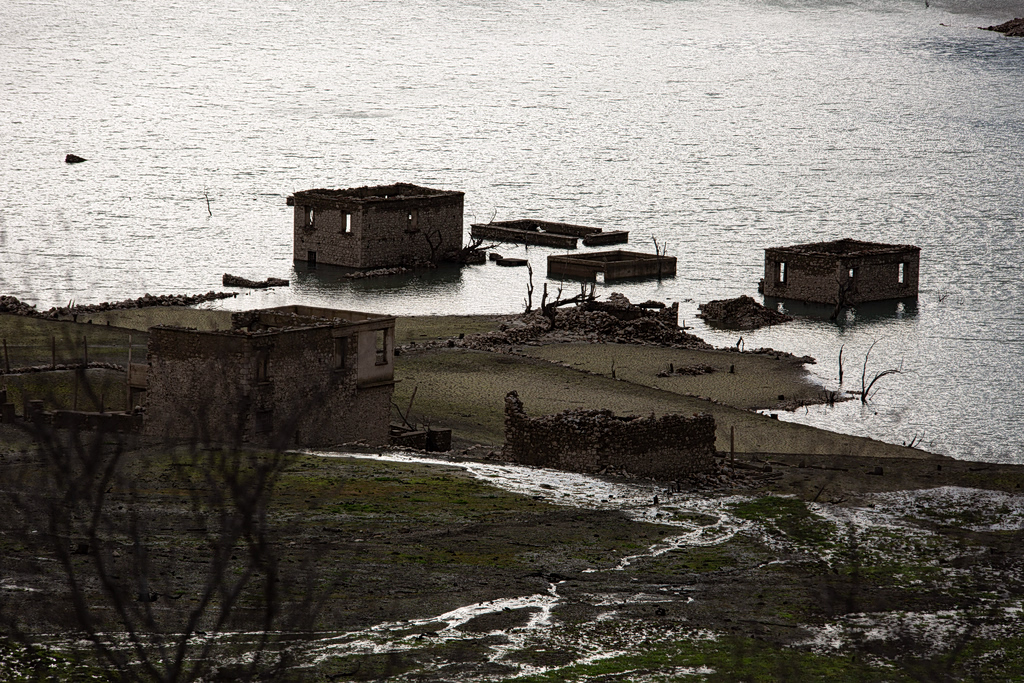
Mornos Lake, November 2, 2025. (Danai Davlopoulou /EUROKINISSI)
Drought by the Numbers
Despite the dramatic storms that dominate headlines, Attica’s reservoirs continue to shrink. As of November 11, storage levels in Evinos, Mornos, Marathon and Lake Yliki stood at 371 million cubic meters, a drop of 32.3 million since the start of the wet season on October 1. In practical terms, the region is losing 768,500 cubic meters of water every single day.
Over the past three years, net inflows into the reservoirs reached only 200 million cubic meters, when the system requires 450 million annually to remain stable. According to Sachinis, even if current inflows were to triple, it would still take six years to refill reservoirs to the levels recorded in 2021.
The message could not be clearer: Attica’s water system is under unprecedented stress — and time is no longer on its side.