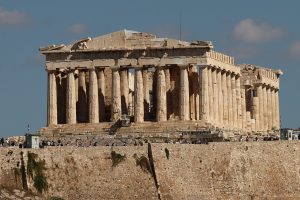
“You must understand what the Parthenon Marbles mean to us. They are our pride. They are our sacrifices. They are the supreme symbol of nobility. They are a tribute to democratic philosophy. They are our aspiration and our name. They are the essence of Greekness” (Melina Mercouri)
Most everyone knows that the greatest push to secure the return of the Parthenon Marbles (and other Acropolis sculptures like the also plundered Caryatid from the Erectheion) from the British Museum was fueled by the passion of Melina, as all Greeks call the famed actress and politician (culture minister in the 1980s).
Fewer know that the debate over the fate of the sublime sculptures began not long after Lord Elgin as British Ambassador to Constantinople ordered that they be hacked off the greatest monument of Western Civilisation in order to decorate his home.
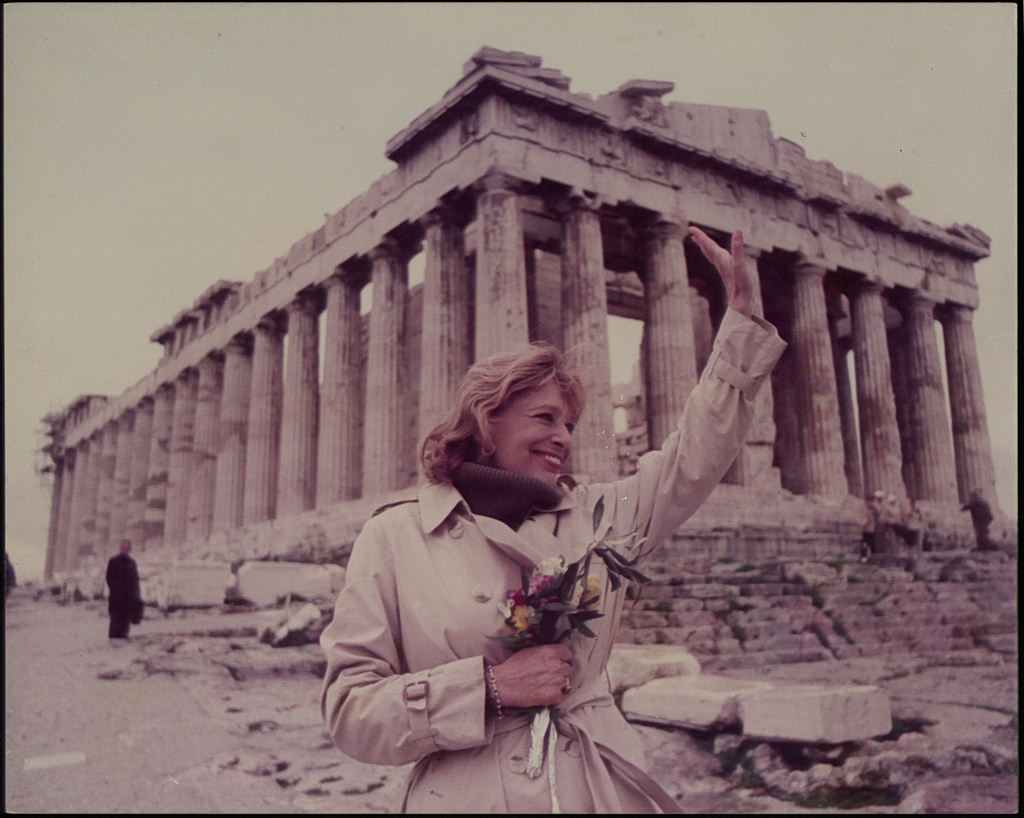
Melina Mercouri was a Greek actress, singer, activist and politician who served as the first female Minister of Culture and Sports and spearheaded a long campaign for the return of the Parthenon Marbles.
Oxford Professor of Poetry A.E. Stallings in her book Frieze Frame: How Poets, Painters and Their Friends Framed the Debate Around Elgin and The Marbles of the Parthenon (Paul Dry Books, 2025) leads one through a remarkable web of people and events that shaped the public view of the Marbles, from the great philhellenes Keats (most famously with his “Ode on a Grecian Urn”) and Shelley (“We are all Greeks” – referring to Western Civilisation) and the great Byron (who described Elgin’s act as a plunder and crime), to Cavafy.
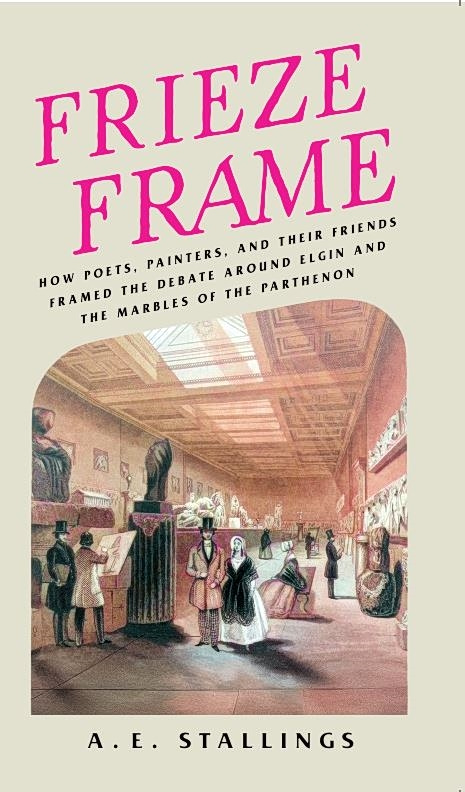
The author leads one through the many twists and turns of the debate, from the huge London pollution of the late 19th century that produced very public calls for the return of the Marbles, to the unconscionable “cleansing” – scrubbing down – of the Marbles in the 1930’s (destroying forever their patina – the sculptures had when created been covered with a coating of Hymettus beeswax).
Stallings’ dual capacity as a highly distinguished poet with five acclaimed collections published (she picked up Guggenheim and MacArthur Foundation fellowships along the way) and a trained classicist who has translated Lucretius’s The Nature of Things and Hesiod’s Works and Days (both for Penguin Classics) deeply inform a captivating narrative, peppered with the humour and at times sardonic wit of an excellent conversationalist.
Trustees of the British Museum, she notes, are well aware of her book. She has been invited to a number of events at the BM and has been commissioned in the UK to write a related poem.
“I think there is a positive desire for dialogue and for looking at the situation from new angles and attitudes. I’m glad to be part of the conversation and part of new ways of looking at this centuries-old debate,” she tells To Vima International in an exclusive interview.
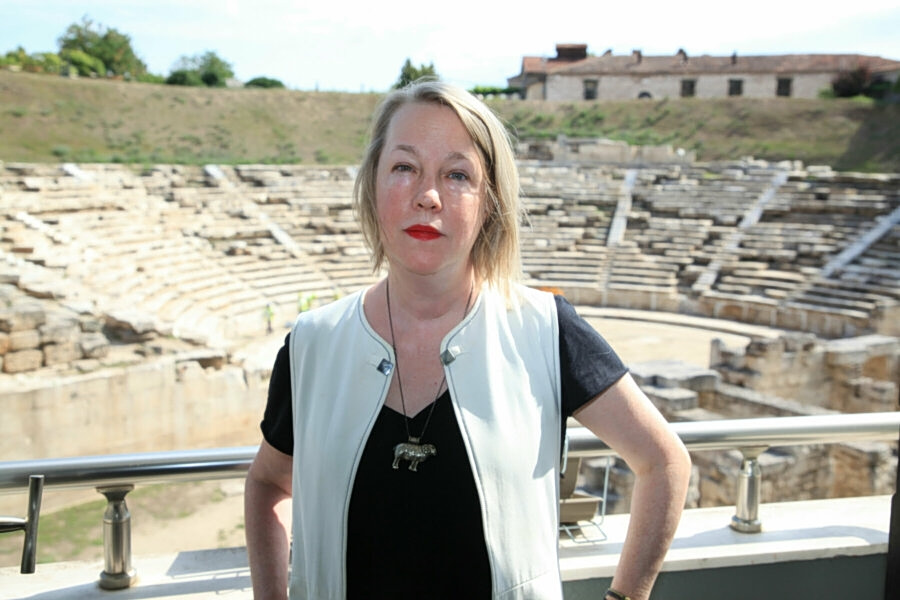
A. E. Stallings standing before the First Ancient Theatre of Larissa, central Greece. Photo by Kostas Mantziaris
How did the Greek Revolution of the 1820’s shape Europeans’ understanding of ancient and modern Greece, and what was the process leading to the emergence of the philhellenes shaped by that?
Western interest in Greece was often through the lens of ancient Greece, in part due to Western education which focused on ancient Greece. The publication of Greek folk songs in translation, for instance, was part of a way of trying to demonstrate a connection between the spirits of ancient and modern Greece. But there are more curious crossovers than one might expect or realize. Shelley’s “Hellas,” a reworking of the Persians, and containing phrases in the preface such as “We are all Greeks. Our laws, our literature, our religions, our arts have their root in Greece,” is dedicated to To Ηis Εxcellency Prince Alexander Mavrocordato. Mavrocordatos was Greek tutor to Mary Shelley (author of Frankenstein.)
How was the Parthenon viewed and treated by the Romans and thereafter, until the Venetian Doge Francesco Morosini blew it up in 1687 in the battle against the Ottomans, who used it as a gunpowder store? Presumably the temple at that time was not seen as significant enough as to stir any remorse?
At the time of the purchase of Elgin’s collection by the British Museum, many of the pedimental statues of the Parthenon were viewed by experts in England as potentially Roman, and from Hadrian’s time. Nero, of course, plastered his name on the temple in huge bronze letters, much as a certain US president has done with the Kennedy Center. But Nero puts his name up there because of the building’s cultural import. The Romans had a sense of that. A great deal of damage to the statues was done by early Christians, when the building was made into a church. The Ottomans repurposed it as a mosque considered one of the most glorious and beautiful of its time, but seem to have largely left the statues alone. The field officer who fired the “lucky shot” at the Parthenon did express remorse, but Morosini seems not to have. He caused further damage to the temple by trying to remove horses from it, in imitation of [Venetian Doge Dandolo] and the [Constantinople] horses from the 4th Crusade. But I don’t think there is any doubt they understood it to be an important building.
What did you learn about Lord Elgin that you might not have known? Who was he in fact – a man with a deep knowledge and admiration of Classical Greece or simply a greedy collector for whom the sculptures would be the supreme trophy? Could someone who truly appreciated the apogee of the ancient Greek spirit and aesthetics bring himself to hack off the sublime sculptures? Was it simply a reflection of 19th century British imperialist hubris or something more?
I don’t think he had a particularly deep knowledge or admiration of Classical Greece, beyond the usual for his class and era. His original plan for the marbles was just to use them to decorate his house Broomhall in Scotland for his new bride. I do think his attitude towards them shifted over time. He went to great trouble at least to keep the collection together, to salvage them from shipwreck, to keep them out of the hands of Napoleon (they might have ended up in the Louvre), and he bankrupted himself to do so. I almost felt a bit sorry for him by the end. He lost his nose and his wife. He had some bad ideas, such as having the marbles renovated, but at least didn’t have the money to carry that out. He’ll never be called a Philhellene in Greece, of course, but he was definitely pro Greek Independence.
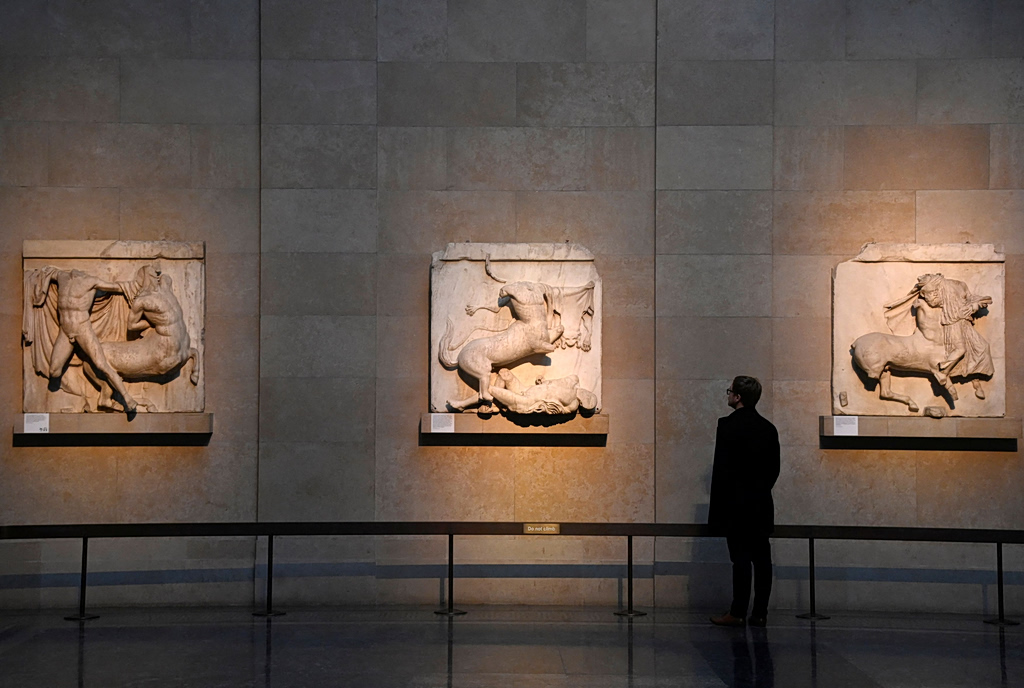
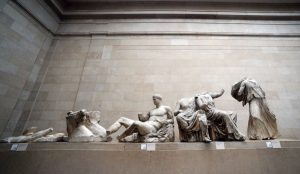
An employee poses as he views examples of the Parthenon sculptures, sometimes referred to in the UK as the Elgin Marbles, on display at the British Museum in London, Britain, January 25, 2023. REUTERS/Toby Melville
Byron and Keats are the most famous philhellenes who expressed adoration for ancient Greek culture and the Parthenon. What was Byron’s influence on the return debate, both in his time and diachronically?
I don’t think Byron was so obsessed with ancient Greece per se. He was interested in Greece as it was. His Childe Harold’s Pilgrimage was hugely popular (made him famous overnight) and essentially made Elgin’s name mud. Byron described what Elgin did as plunder and a crime. This greatly affected the debate. Byron never saw the Parthenon until after Elgin’s removals, but probably did see them in London, before they were in a museum. Byron alone almost among his class and time period was not interested in “collecting” ancient objects. He felt ruins should be left unmolested in situ.
Tells us about the great philhellene Keats’ vantage point and that of other poets, artists and painters whose stance you found most fascinating or amusing. Was their view simply idealised romanticism, or did some have a deeper understanding of ancient Greek culture, paideia, and the complexities of the historical context in which the monument was produced?
Keats had a different sort of education to Shelley and Byron: he did not study ancient Greek. He read Homer in translation. He experienced the sculptures in the British Museum, as separate works of art to the temple of the Parthenon. He would probably have been of the view that it was a great thing to have them in London where the (English) public could experience them. He visited Greece only in his imagination.
Tell us a bit about the painter Benjamin Haydon, who throughout his life was enthralled by the sculptures and first brought Keats to see them up close in London – how did he influence the understanding of Keats and others later perhaps?
Robert Benjamin Haydon was a terrible painter and excellent memoirist who was friends with Keats, Wordsworth, and lots of poets of the era. He was obsessed with the marbles and thought they were the greatest artistic production mankind had produced. His enthusiasm seems to have rubbed off on others. Remember, fragments at the time were not considered great in and of themselves. Largely, ancient statuary was restored. But he saw the greatness of the whole even in a fragment. He thought they could trigger a new renaissance in British art, a new school.
Around 1890, philosopher and historian Frederic Harrison published an editorial entitled “Give Back the Elgin Marbles”, in which he said that the Marbles are not statues but rather “architectural parts of a unique building, the most famous in the world…The Parthenon Marbles are to the Greek nation 1,000 times more dear and more important than they ever can be to the English nation – a [Greek] national symbol and a place of pilgrimage to civilised mankind”. Why did this simple and powerful argument not hold sway over British governments to this day, and was it shared by other European intellectuals?
This was partly due to a controversy over the polluted conditions of London and the damage this (plus cleaning) might be doing to the marbles. It did stir up a large debate, which is largely the debate as we see it today, with the response (Knowles’ “The Joke About the Elgin Marbles”) being, for instance, that giving them back would be a slippery slope, that the Greeks couldn’t properly care for the marbles, etc. So very much the sort of arguments you see in British papers today. This is when Cavafy weighed in as well, with his letter on the subject. He was responding to “The Joke About the Elgin Marbles.”
What might it take for British popular support for the return over recent decades to be heeded?
I think it will happen, sooner or later. The atmosphere of the debate has shifted, and I think there are already high-level talks going on.
Negotiations between Athens and London on the return of the Parthenon Sculptures have dragged on for years. As all British PMs have said a resounding No, is there reason for hope today?
Again, I’m optimistic. I think it will happen, and sooner rather than later. The British Museum is currently redesigning the Greek and Roman galleries, for instance, and there is an opportunity to change not only displays but narratives and attitudes. It’s a sign of not being entrenched and being more flexible. Consider the symbolism, for instance, of the (temporary) “return” of The Bayeux Tapestry. I think we are going to see more cooperation and less competition between museums.
Since politicians rarely read books, if a letter were sent to the British Prime Minister and the Trustees of the British Museum signed by A.E. Stallings, what would be its tenor and top arguments? Would you consider doing so now, given your meticulous research and prominent position in British Academe as Oxford Professor of Poetry?
The British Museum (and many of the Trustees) are aware of me and of the book. I’ve been invited to a number of recent events at the museum. I’m being commissioned to write a poem in the UK, and will have a BM curator show me certain Elgin-related objects in the collection, to that purpose. I think there is a positive desire for dialogue and for looking at the situation from new angles and attitudes. I’m glad to be part of the conversation and part of new ways of looking at this centuries-old debate.