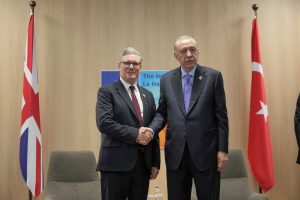
When Keir Starmer landed in Ankara earlier this week, he arrived not simply to talk diplomacy, but to strike a deal worth £8 billion: the sale of 20 Eurofighter Typhoon jets to Turkey.
Starmer called it “the biggest fighter jet export deal in a generation”. For Britain’s defence industry, the deal revives a fading production line, sustaining thousands of jobs. For Turkey, it represents military modernisation and geopolitical leverage.
But the political price is high. Turkey’s democratic backsliding and tense relations with Greece raise uncomfortable questions:
Is Britain arming a difficult ally at the expense of stability in the Aegean?
A lifeline for Britain’s defence industry
The Typhoon is built by a multinational consortium (UK, Germany, Spain, Italy), with BAE Systems in Lancashire responsible for a significant share of the work. Without this order, the line was heading for closure.
For Matthew Powell, Strategic and Air Power Studies Fellow at Portsmouth University, the stakes are clear: “This is a hugely significant deal for the UK’s defence industry as it will protect around 6,000 UK jobs and retain a highly skilled workforce that would be capable of designing and constructing the next generation of military airframes.”
The deal also allows Britain to maintain manufacturing momentum while awaiting development of the next-generation fighter, the Tempest/GCAP.
Ahmet Ozturk of London Metropolitan University calls it both industrial and symbolic: “The ~£8bn package for 20 Typhoons is billed by London as the ‘biggest fighter export in a generation,’ sustaining the UK-led Eurofighter line… Post-Brexit, the government is keen to show it can close marquee aerospace deals as a stand-alone commercial-diplomatic actor.”
Ron Matthews from Cranfield University is succinct: “For the UK and BAES, the sale will have been driven by hard economics.”
William Freer adds: “This deal is a win for European security. It keeps open one of the continent’s few production sites for modern combat aircraft and sustains the supply chain. Losing that capacity would have had serious implications for Europe’s defence industrial strength.”
A strategic reset with Ankara and a “worthwhile gamble”
If economics explains why Britain needs this deal, geopolitics explains why Turkey wants it.
Turkey was expelled from the F-35 programme after purchasing Russian S-400 missile systems.
Seeking to diversify its suppliers, it has alternated between courting Moscow and demanding hardware from NATO allies.
Prof Ali Bilgic of Loughborough University argues: “For Ankara, Typhoon procurement is a deliberate diversification after the F-35 rupture tied to the S-400… It restores deep interoperability with NATO munitions and data links.”
Dr Simon Bennett of the University of Leicester calls the messaging straightforward: “An entirely positive message. The deal ties Turkey firmly into the West’s military-industrial complex… Yes, there are concerns in the UK about Turkey’s authoritarianism under the current leadership. But then, there are also concerns in the UK about North America’s increasingly authoritarian domestic policies.”
Starmer may have prioritised “hard security outcomes over normative conditionality,” as Bilgic puts it.
Human rights criticisms exist – but economics and NATO unity appear to outweigh them.
Trevor Taylor, Director of the Defence, Industries & Society Programme, Royal United Services Institute, says: “So this is a long-term thing, which is seen as support for British industry, but also a worthwhile gamble by the UK government, that Turkey, which is a member of NATO, and we wouldn’t describe it as a valued ally. So it’s a risk judgement, but the government has clearly taken it.”
Where does Greece fit into all of this?
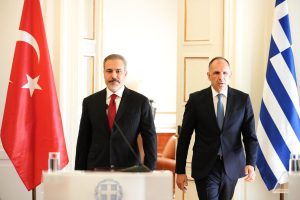
For a Greek audience, one question looms large: Does a stronger Turkey mean more tension in the Aegean? The answer is… complicated.
Jamie Shea, former NATO Deputy Assistant Secretary General, believes Athens is less alarmed than expected: “I think the recent rapprochement between the US and Greece with the F-35 deal and naval cooperation has made Athens more relaxed about Turkey’s military modernisation.”
His logic is that Turkey’s dependence on Western-rather than Russian or Chinese-technology gives NATO more leverage: “For Athens it is probably better to have Ankara dependent once more on US or UK supplied (rather than Russian or Chinese) military systems.”
Dr Simon Bennett argues that Turkey and Greece face a greater external threat: “This deal is good for Turkey and Greece… Yes, Greece and Turkey have political differences, but… these are overshadowed by the growing threat posed to both countries by Putin’s colonialist Russia.”
Yet Matthew Powell acknowledges inevitable friction: “There will, no doubt, be a degree of tension between Greece and Turkey… this will provide Turkey with a slightly greater level of influence within the alliance itself.”
The Eurofighter will give Turkey access to advanced Meteor missiles, extending its air combat reach.
Prof Bilgic says Athens will respond by pressing for even more advanced capabilities: “I would expect Greece to double down on its own Rafale/F-16V paths and to press Washington and Paris for sustained technological overmatch.”
Will Germany or Spain block the sale?
As the Typhoon consortium requires consensus, Spain or Germany could have vetoed the export.
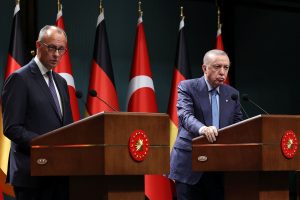
David Dunn, Professor of Political Science and International Studies, University of Birmingham, explained: “Germany would not have allowed this deal to be announced if it hadn’t already signed off. Greece’s concerns were considered – but ultimately outweighed by the need to strengthen Turkey’s air defence as a NATO member. Obviously, the antipathy between Greece and Turkey is long established. But actually, they will have been considered and discounted as ones that are secondary importance in terms of both the defence industrial policy, but actually, also making sure that Turkey is, as a NATO member, able to defend its airspace against increasingly erratic and aggressive Russia on NATO’s frontiers.”
Dr Simon Anglim of King’s College London warns of internal friction: “There might well be, particularly when considering what those Typhoons might be used for.”
But Powell notes: “Germany had opposed the sale… until recently when they changed their political position and acquiesced to such a deal being made.”
Jamie Shea is similarly confident: “Germany and Italy are major arms exporters and there is no reason to think that they will try to block the sale.”
A deal driven by necessity?
Christopher Hill, Emeritus Professor at Cambridge, frames the deal within a wider European context:
“Post-Brexit the UK has been returning slowly to its European destiny, for which Turkey still counts being, like the UK itself, on the critical margin of the EU as well as key members of NATO.”
Europe may worry about Erdoğan, human rights, or Cyprus. But Europe still needs Turkey inside NATO.
Hill adds: “Most European states producing arms export to Turkey. And the trade is a two-way street.”
So, is Starmer right?
There are three truths at play: Britain desperately needs the jobs and export revenue. Turkey strategically needs Western jets more than ever. Greece will watch carefully – but is far better placed than in the past. Maybe the real question is not whether Starmer is right to sell jets to Turkey.
Maybe it is this: Can NATO afford a Turkey that feels isolated? Or as Dr Bennett puts it: “The calculus is simple: If Europe’s free nations don’t collaborate and cohere, they will be devoured one by one by Russia.”
In the end, this deal is not just about jets. It’s about who gets to shape Europe’s security: the West, or its rivals.