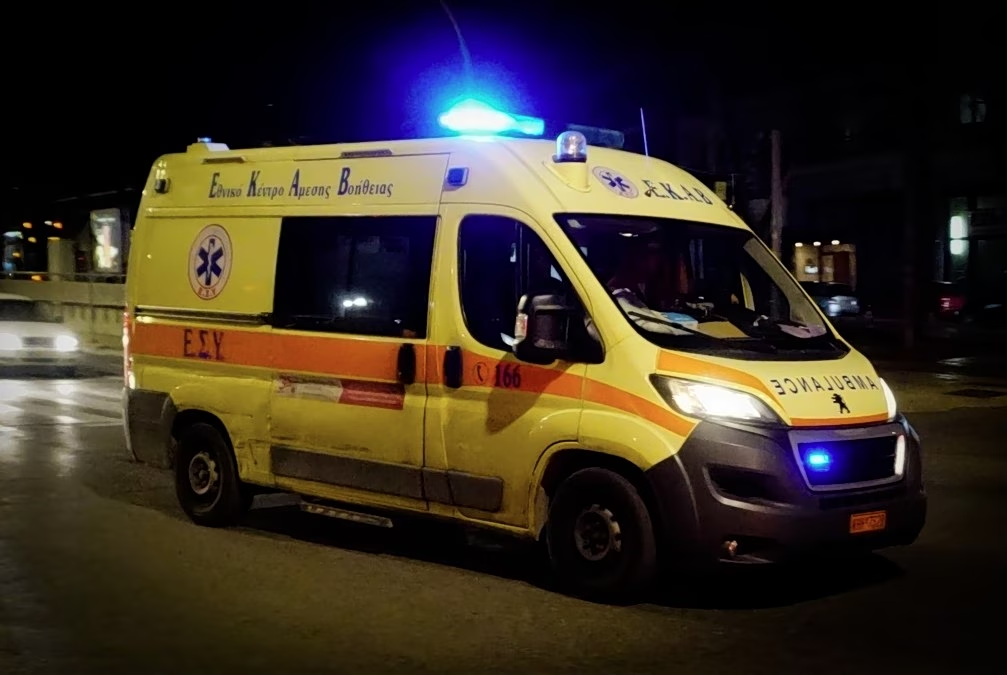
Inside the historic Quai d’Orsay in Paris—in the very room where Robert Schuman and Jean Monnet signed the Schuman Declaration, laying the foundations for today’s European Union—we met former European Commission Vice-President for Values and Transparency Věra Jourová on the sidelines of the Summit on Media and Democracy in Europe organized by Project Syndicate and the Meliore Foundation.
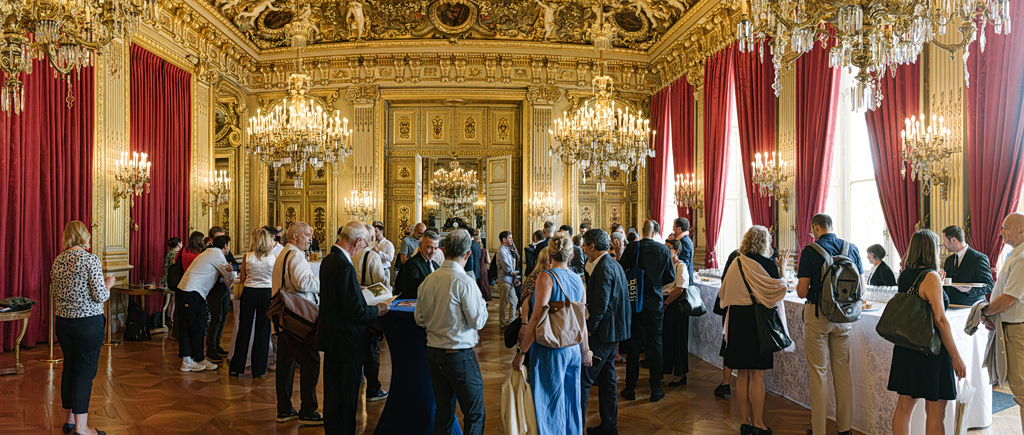
Networking at this year’s Summit on Media and Democracy in Europe.
Against this powerful historical backdrop, Jourová speaks candidly about what she considers the defining threats of our era: the unprecedented concentration of political, technological and economic power; the weaponization of artificial intelligence; the manipulation of elections through digital platforms; and the urgent need to safeguard Europe’s democratic institutions.
Reflecting on her years as the European Commission’s Vice-President for Values and Transparency, Jourová identifies her greatest frustration not as political resistance, but as the challenge of convincing citizens why democracy, the rule of law, and fundamental rights must never be taken for granted.
You said in an interview that Donald Trump frightens you still more than the challenges posed by the war in Ukraine, Russia, and even China. It left quite an impression on me.
Of course, I am very much afraid of Putin and his imperialistic plans, which have been obvious since the annexation of Crimea.
But when it comes to Donald Trump, I think there is now an unprecedented and absolutely monstrous concentration of political power, ideological power, technological power, and economic power.
We can do whatever we can at the European level and at the national level to protect democracy and make ourselves more resilient against populists. But when this enormous power comes from the global level—from Trump’s alliance with the technological giants—we are in a very disadvantageous position.
How do you think the rise of generative AI, and of deepfakes, is reshaping politics?
We don’t have much time to do everything necessary to ensure that AI does not dictate who becomes president or prime minister.
AI has enormous potential when it’s used to spread disinformation, manipulate public opinion, and influence elections.
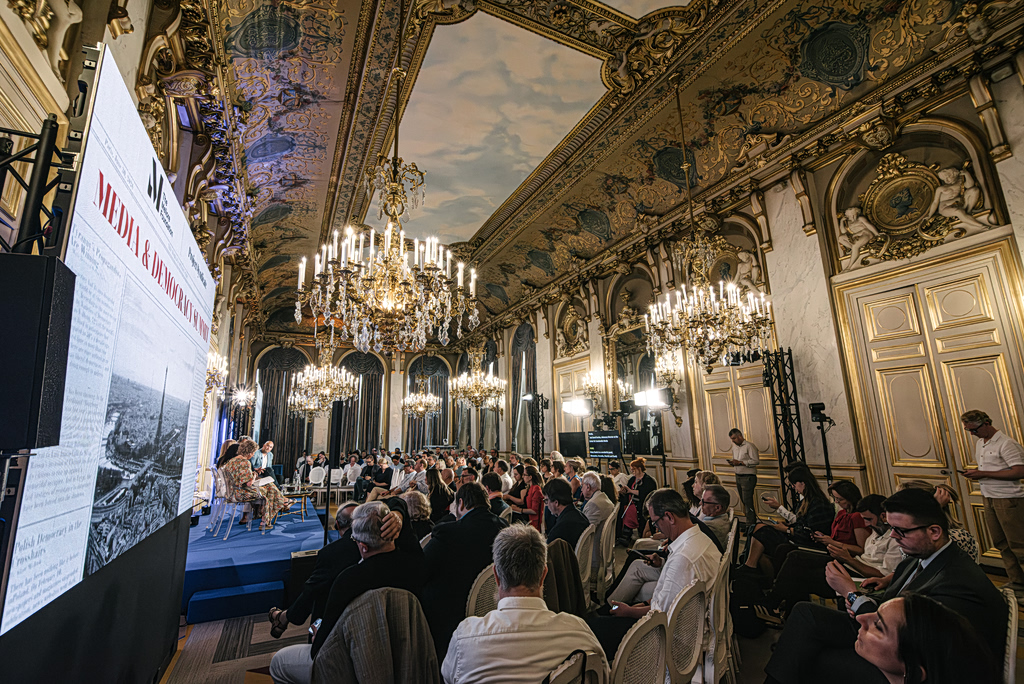
Summit on Media and Democracy in Europe—Media & Democracy panel discussion in progress.
First of all, the AI Act imposes obligations on online platforms to guarantee transparency. When voters see something that has been produced by AI—especially deepfakes—they should be informed that it is AI-generated.
It’s also essential to stay on the alert before elections; in Romania, for example, thousands of dormant accounts suddenly became active, which probably means that something is wrong, something designed to manipulate and mislead voters. This is called inauthentic behavior—it’s not normal for 5,000 sleeping accounts to wake up overnight and suddenly begin influencing public opinion—and the Digital Services Act also imposed an obligation on digital platforms to stop such operations.
Otherwise, we will never again be able to speak about elections in EU member states as fair competition among real people, with real identities, presenting their genuine political visions.
Where do you draw the line between regulating harmful online content and protecting free speech?
The line is absolutely clear.
If we extend the protection of free speech to bots and artificial intelligence, it will mark the end not only of democracy, but of society itself.
In the European Union, freedom of speech is, of course, a primary—almost absolute—principle. But it is the freedom of speech of real people, with real identities that’s protected together with free speech comes with a responsibility for what is said.
Even today, when I explain this, there are still a lot of surprised people who think I want to deprive AI of freedom of speech. Such a notion is nonsense and something we have to prevent.
What was your biggest frustration when dealing with member states that repeatedly violated EU values?
My frustration was simple. At being unable to convey to the general public why we need the rule of law, why we need fundamental rights, and why we need a democratic system.
People—and young people, especially—find it hard to grasp the threat, because they have lived their entire lives in democratic societies.
So my inability to issue a powerful enough alert to societies in different member states was very frustrating indeed.
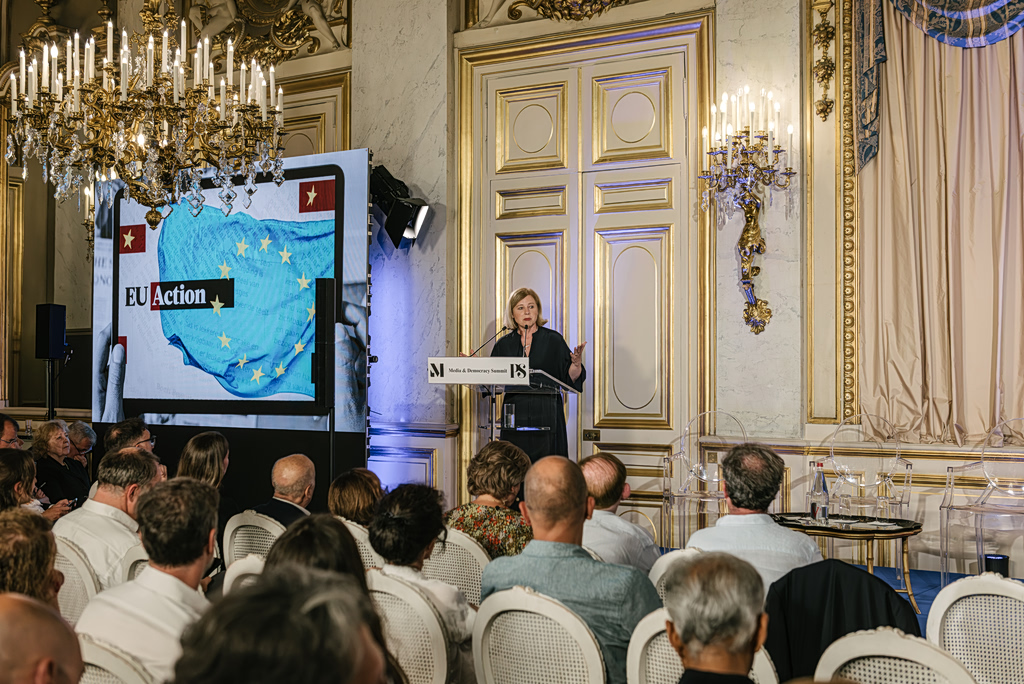
Věra Jourová speaking at the Summit on Media and Democracy in Europe, organized by Project Syndicate and the Meliore Foundation at French Ministry of Foreign Affairs.
Do you think things are becoming even more difficult now when it comes to alerting societies?
Yes, because people are increasingly manipulated online.
I will never blame digital companies for all our problems—that was never my intention. But they amplify harmful content, and they amplify the effects of disinformation. Which is wrong.
Do you believe that freezing EU funds is ultimately the most effective tool for enforcing compliance with the rule of law?
Indeed it is, and this became obvious in Hungary, when the nation was unable to absorb or use EU funds.
I think people in Hungary also understood that we cannot send EU money into a system that is so badly corrupted.
So, yes, I believe that withholding funds has proven to be an effective tool.
Given the rise of populist movements, how optimistic are you about the long-term cohesion of the European Union?
I am optimistic because the European Union is a very complicated project.
The Union has 27 countries, 24 official languages, and a very complicated and difficult history.
Yet, in times of crisis, the European Union tends to become stronger. I believe this will continue to be the case.