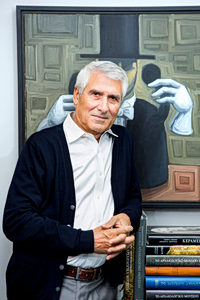
On the occasion of World Poetry Day, the Ianos Bookstore honors the multifaceted poet Vangelis Chronis — a creator who, through his deeply cohesive and contemplative body of work, has succeeded in encapsulating within his words the most precious concepts of human existence. Following eleven poetry collections, bilingual Greek–English editions, and an anthology of his work, Vangelis Chronis continues to stand as an enduring yet understated presence, both in Greek letters and in our collective consciousness. His poetry, with time, memory, the body, and Greekness as its principal thematic axes, brings forth the essence of that which remains unspoken yet constantly present.
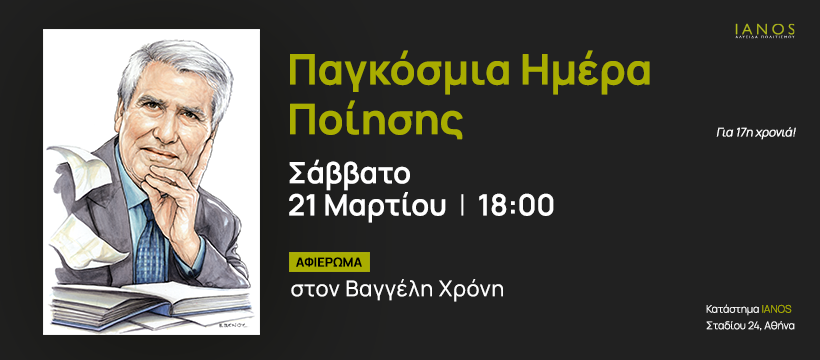
- Poster Reads: World Poetry Day, Saturday 21st of March, Dedication To Vangelis Chronis. Ianos
In the interview to To Vima, the poet speaks with sincerity and inwardness about time, memory, solitude, and the relationship between art and life, offering the reader a rare opportunity not only to approach his work, but also to listen closely to the poet himself.
On the occasion of World Poetry Day and the event held in your honor at Ianos, how do you feel when you look back at the trajectory of your poetry collections, from Symmachos Chronos (1999) to Efippi Psychi and Aeithalis Chronos? Is there a thread that you believe connects or runs through your work?
The “thread” that runs through a body of work becomes discernible when that work has reached completion, since a creator—regardless of whether the volume of their work is small or large—cannot know how much life still lies ahead for it, nor to what extent this continuation will prove fertile and revelatory, or will instead signal the “end” of their creative impulse. Speaking, however, of the “thread” as I observe it thus far across my eleven poetry books, I would say that it is a rendering of the relationships each of us maintains with the notion of “time.” Relationships that are, however, specified within the feeling and consciousness of a poet in such a way that past, present, and future, without losing their historical autonomy, are often united into a “whole,” with the inevitable consequence that even death is transformed into a source of life.
In many of your collections, memory appears as a central axis. What is memory to you? A place of return (an Ithaca), or a springboard from which we understand the present and set sail toward the future?
You know very well that, if we are able to manage, to a certain degree, our relationships with others, or the feelings that arise within us through these relationships, memory, for any human being—even for one who has lived a life not at all intense acquires dimensions that are difficult, if not impossible, to manage. To such an extent that one might say memory acquires an autonomous presence, so that precisely because of its uncontrollable nature, in regard to the moment it emerges within us, it is transformed into a driving, creative force—perhaps the most decisive among those available to human beings. Therefore, any attempt to “classify” it so that it may be characterized as a “place of return,” or a “springboard,” or a “voyage toward the future,” rather weakens it, since ultimately it can only be understood as a synthesis of these very essential characteristics you mention, as well as many others.
Time also runs strongly through your poetry—at times as an ally, and at others as a force that transforms everything. How do you yourself converse with time?
Without any kind of arrogance, allow me to say—or rather to observe—that even if one were to confine oneself solely to the titles, to all the titles, of my individual poetry books, there would emerge, I would say, if not a vivid, then certainly a very intense sense of my relationship with time—the manner in which I converse with it. For example, I would mention not the poetry books Symmachos Chronos or Neoi ston Adi, as one might expect, since their titles refer directly—if I may use the term to a novel perception of time, but rather the book Ta Agalmata kai oi Psyches. Would it ever be possible to separate the notion of the “statue” and the notion of the “soul” from the notion of time, when both seem to stabilize it, despite the terrifying fluidity that time itself possesses as a concept? It is, in any case, extremely strange, yet equally fascinating, that just as one may converse with time using such elevated notions as those of the “statue” and the “soul,” one may equally appropriate it and make it one’s own through words of far more limited scope, almost everyday in nature. I imagine—and hope—that this second version is perceived in my poems just as much as the one rendered through words of a purely intellectual order.
The body often appears in your poems as a bearer of experiences and emotions. Do you believe the body can function as a “second narrator” of life?
The “body” remains, under all conditions and in all eras, “the first narrator of life,” while the poet exists and can only exist as the translator of this narration, even if it has been produced through their own body. One might say that our “body” produces, unbeknownst to us, stories, so that our need to understand them transforms us automatically into narrators of a story that acquires value precisely because, while it concerns ourselves, it may also concern all others. A wondrous conjunction of life and art, which has the additional advantage that art does not constitute merely a source of pleasure, but also a regulating factor of life itself.
Loneliness is another strong element in your work. What does it mean for you and your poetry?
To be honest, I accept the term “loneliness,” in relation to my poetry, because I recognize that the freedom to which the reader is entitled may lead them to conclusions that the poet himself did not have in mind when writing those particular poems. Therefore, if there exists a kind of loneliness—and fortunately it does—it concerns the time during which a poem is written—a time that may be very long—or the time during which the poem is processed within the poet’s mind, a time without paper and pencil, which would be impossible to share with anyone else. A time that, even within the most devout atmosphere, could not exist as a confessed experience and therefore could not be transmitted. The success of a poem lies precisely in the moment when this non-transmissible time—through the immediate communication of two people—is revealed, in its full extent, to the reader across the poems.
In several of your poems, one can discern an element rooted in antiquity, whether in statues or historical figures. What does this relationship with antiquity mean to you?
Much has been said—and in many cases aptly—about both the knowledge of antiquity that characterizes my poems and the affinity for antiquity that distinguishes me as an individual. For one to attempt to analyze these two qualities, even as a Greek, would be like attempting to turn the self-evident into the incomprehensible. There is, however, one difference with regard to my poems. My relationship with antiquity is not so much characterized by a nostalgic return to our distant past, because the present seems to me (to us) unbearable or so trivial that it is not worth living. My relationship with the past is primarily connected to the prospects that this past creates for later centuries and, consequently, for our own time, so that the better we know it, the more we are able to broaden the purposes of our existence. We observe the notion of the “thread,” as you formulated it in your very first question, perpetuating itself beneficially in all areas of our lives, whether we strengthen this “thread” or attempt, in many ways that need not be enumerated, to weaken it.
Although you do not come from an island, the Greek islands, and particularly the Cyclades, often appear in your poetic universe. What is it that fascinates you so much about these landscapes?
There are so many things that fascinate me about the Cyclades that I would answer far more easily a question about what does not fascinate me about those islands. The curious thing is that, however much poetry allows you to express your feelings in an original way, when attempting something similar in response to such a question, you become unimaginably commonplace and awkward.
You began writing at a very young age, yet your first collection was published much later. What made you wait so long before publishing your work?
To be honest, I was never characterized by any kind of impatience for something that was, and remains for me, the most essential part of my strictly personal life, namely poetic expression. And I am pleased to acknowledge today that this long period of incubation and gestation of my poems was just as creative as the twenty-seven years that have passed since the publication of my first book. Thus, the time of waiting and the time of realization of my poetic plans seem to coincide in the magnitude of joy they offer, whether we speak of the period of gestation or of the years of the birth of my eleven poetry books.
You have now published both collections and your collected works up to 2020. How do you see your work today as a whole? Is there a collection you feel closer to your soul?
If there is something I recognize as closer—or rather identical to my soul, it is above all poetry itself, whose division into individual books serves mainly practical purposes and not moral or aesthetic ones, as is the case with poetry in its autonomous function. When you believe that without poetry you would feel mutilated, you do not cease to love and often to value your poems, as they connect you to the great and impetuous river of poetry as a timeless and unalterable concept.
Let us move to the section: Alekos Fassianos. Your collaboration with Alekos Fassianos was particularly close, to the point that many of your poems seem inseparable from his sketches and his visual universe. How did this relationship begin, and how did his visual perspective influence your poetic writing?
My friendship with Alekos Fassianos constitutes a major chapter of my life, and if I feel particularly fortunate, it is both for what we lived together over decades and for the creation of a multitude of works and drawings of his inspired by my poems. I preserve them with the reverence and awe that surround works of art when their creator has passed away, and I feel that our joint publication—concerning his visual creation and my poetic offering—realized by the Theocharakis Foundation, is registered as an important part of whatever legacy my purely personal work might form. Seeking the origins of this valuable friendship and collaboration, I would locate them in the fact that Fassianos, despite the breadth and vibrancy of his visual representations, was moved as a painter by concision, by synthesis, by economy of expression and it was precisely these elements, as he himself had acknowledged, that moved him from the outset in my poetry. I retain, as is natural, vividly alive the memories of our shared artistic and human journey, and I feel both those recorded in our texts and those unrecorded to haunt my soul and accompany me in every step of my life.
Very often, when reading your poems, I have the sense that your poetic style is followed by an intense philosophical tone, and vice versa—with the same mastery, sometimes even with irony—something one also encounters in the poetry of Constantine Cavafy. Please tell me about this. Is poetry, ultimately, for you a means of self-knowledge?
In relation to the dense meaning implied in your question, I would like to say that the “philosophical tone” of my poems coincides in many respects with the “poetic style”; they are not two concepts in which one differs from the other. As you know very well, nothing in poetry happens “by design”; that is, an intention, however conscious, operates beyond our control in regard to its results. And woe betide if, despite this decisive “beyond our control” in poetry—which, as it varies, also determines a poet’s talent—poetry, as each of us writes it, did not also function as a condition of self-knowledge, something that no other “means,” among those devised by the human intellect, can secure to such a high degree.
In today’s fast-paced era of digital communication, what do you believe is the place of poetry? Can it still function as a space for reflection for the modern individual?
It almost seems, from your question, that you expect an answer that would make you melancholic. Yet the exact opposite will occur if I assure you that I firmly believe—as Ernst Fischer substantiates in his book The Necessity of Art—that poetry will exist as long as humanity exists, whatever shocking, spectacular, or disruptive developments may follow. For the yearning will never cease for human beings to attempt to understand the reason for their coming into this world and why, having come, they must depart, and finally to understand that as long as they pose questions to themselves, others—those with whom they coexist rather than providing answers, multiply those questions. It is no coincidence that even a person who lives as a hermit was led to this decision through others. Therefore, poetry will not cease to exist either as a bridge to our inner world or as a condition for meeting and understanding others.
If you could return to the young Vangelis Chronis—both the poet and the person as shaped through his work—what advice would you give him today?
Without it being counted as arrogance, with great tenderness and a deeply moved love for all that this child has lived—whether due to conscious choices or to “coincidences,” as determined by others and by his time—I would advise him not to deviate from the purpose that seems, from the outset, to have been within him, but which required much work and much pain, once he became aware of it, to bring into reality.