If you are searching for a beach unlike any other in Greece, Louros Beach in Aetolia-Acarnania will not disappoint. It is a place known mainly to locals, but one that leaves a lasting impression on everyone who visits.
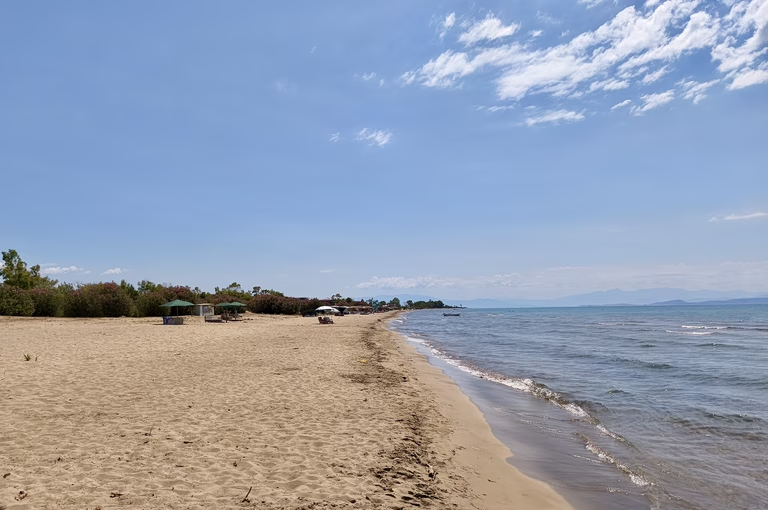
Stretching for approximately 17 kilometers, this endless sandy coastline at the southwestern edge of the regional unit offers an experience that combines natural beauty, ecological importance and complete relaxation.
It is considered one of the most impressive beaches on mainland Greece. Located about 20 kilometers from Neochori, it is washed by both the Gulf of Patras and the Ionian Sea. It is regarded as one of the largest beaches in Greece, if not the largest.
The beach stretches from the Acheloos River estuary to Messolonghi and is responsible for the formation of the Messolonghi–Aitoliko lagoon.
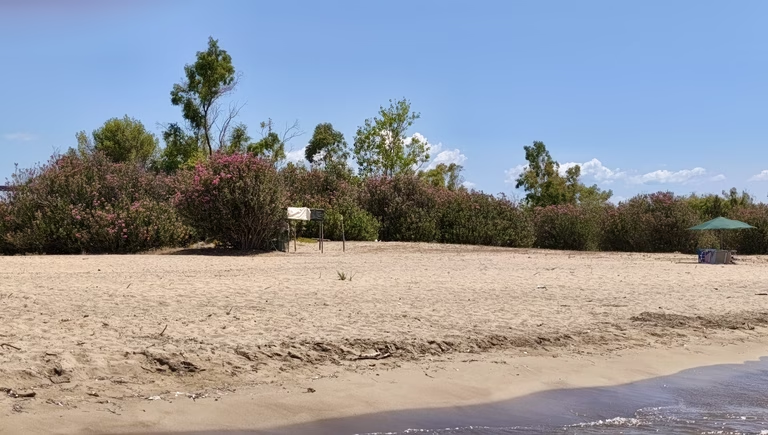
Arriving there via the recently paved road, the first impression is breathtaking. The beach unfolds before you like a golden carpet disappearing into the distance, with shallow, crystal-clear waters gently moving over the fine sand.
“It feels like you are on an island without having to take a boat,” says Alekos Papadopoulos, a local farmer who visits the area every year. “In the summer it fills with people, but because of its size, you can always find a spot. If you want more peace and quiet, you can move a little farther away from where the road ends and feel like you are alone in the world.”
Easy access
The beach can be reached by road from Neochori. In 2025, the road was fully resurfaced, with safety barriers and road markings added, making the journey much safer and easier than in the past, when potholes caused problems. There is also plenty of parking space.
Locals emphasize that the area has remained authentic, without excessive commercialization — something rare for such a beautiful and expansive beach.
At the organized sections, a few beach bars offer sunbeds, umbrellas, refreshing drinks and tasty food. The waters are ideal for families, as they remain shallow for a considerable distance from the shoreline, something children especially love.
Nature lovers can combine swimming with birdwatching or walks through the sand dunes. Its limited tourism development has led many to describe it as a “hidden gem.”
The beach resembles a long, narrow strip of land stretching toward the horizon. On one side, visitors can see the untouched island of Oxeia and, farther away, Kefalonia. When visibility is clear, Zakynthos can also be spotted in the distance. On the other side, there are views toward the shores of Achaia.
The vegetation on the dunes is dense, with tamarisks, cedars, eucalyptus trees and oleanders. During the summer, in the less-trampled areas of the beach, visitors can see sea daffodils blooming, filling the air with their intoxicating fragrance.
The light constantly changes. In the morning, the sea appears turquoise, almost tropical. At midday, it turns silver, while in the afternoon it takes on golden and pink hues as the sun sinks behind the distant hills. The air carries the scent of salt, iodine and the wild, sweet fragrance of freedom.
Protected area
Louros Beach is not simply a sandy coastline. It is a living wetland protected under the Ramsar Convention and included in the Messolonghi–Aitoliko Lagoon National Park, part of the Natura 2000 network.
Its flora and fauna create a unique ecosystem where the sea meets the lagoon, sand dunes and wetlands.
Depending on the season, visitors can observe hundreds of bird species, many of them protected. Among the most characteristic are pelicans, storks, pink flamingos and wild geese, as well as smaller birds such as goldfinches, blackbirds and nightingales. The area is an important stopover for migratory birds.
If you are lucky, you may also encounter herds of wild horses from the Pindos breed, or similar local populations, roaming freely between the beach and the Acheloos River estuary. They are resilient, calm animals with light-colored manes. Free-roaming cattle and pigs that live semi-wild in the area can also be seen, along with many foxes.
Louros offers a rare opportunity to experience nature in its most authentic form — not like a zoo, but as a living landscape where every plant and animal has its own role in an eternal balance.
The history of Louros is essentially the story of the interaction between humans and nature in the Acheloos Delta. The landscape continues to slowly change, just like the river that created it.
Louros is not simply a holiday destination. It is a place where history — it lies near the ancient town of Oiniade — meets modern ecological awareness. It is a place that invites visitors to walk, swim and reflect on the passage of time.
And when you leave, you carry with you the feeling that you are leaving behind a piece of the wildest and most generous side of Greek nature.