Iran’s leaders want to reach a nuclear deal with the U.S., but they are also rushing to prepare for war in case talks between the countries fail.
Tehran is deploying its forces, dispersing decision-making authority, fortifying its nuclear sites and expanding its crackdown on domestic dissent. The moves reflect its leaders’ belief that the survival of the regime itself is at stake.
Domestically, the Islamic Republic is more vulnerable than it has been in decades. Its leaders are facing widespread popular discontent over the worsening economic picture and the mass killing of protesters last month. Meanwhile, the U.S. has deployed two aircraft carriers and a host of other warships and jet fighters to the region in preparation for a possible attack.
“Iran is facing its worst military threat since 1988,” when the eight-year war with Iraq ended, said Farzan Sabet, an analyst on Iran and Middle East security at the Geneva Graduate Institute in Switzerland. “Iran is preparing for strikes by putting its security and political leadership on high alert to prevent decapitation and to protect its nuclear facilities.”
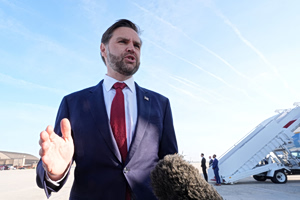
Iranian officials have presented some concessions in pursuit of a nuclear deal, but Vice President JD Vance said Tuesday the offers have fallen short of the red lines set by the U.S. , which wants Iran deprived of the ability to make a nuclear weapon. While Iran’s foreign minister publicly said the talks had made progress, the government now fears that the gap between what Tehran is willing to offer and what Washington is willing to accept may be unbridgeable, an Iranian official said.
Ali Larijani , the head of Iran’s National Security Council, said while Iran doesn’t want war, it is ready if one starts.
“We reviewed our weaknesses and addressed them,” he said in an interview aired Sunday on Al Jazeera. “If war is imposed on us, we will respond.”
Iran’s leaders are preparing for an attack that could disrupt its chain of command. The Islamic Revolutionary Guard Corps earlier this month announced plans to revive its so-called “mosaic defense” strategy, which gives commanders the autonomy to issue orders to their units. The strategy is designed to make the Islamic Republic more resilient to foreign attacks.
Military deployments
Iran is flexing its military muscle as best it can, sending the message that its armed forces have the capability of disrupting the global oil trade and of hitting U.S. interests across the Middle East.
Naval units of the paramilitary Revolutionary Guard were deployed this week to the Strait of Hormuz. The strategic waterway connects the Persian Gulf to the wider Indian Ocean and around a fifth of the world’s oil supply passes through it.
Footage aired on state-linked Iranian media showed cruise missiles being launched from trucks along the coast and from boats as an oil tanker sailed in the background. The waterway is now under constant surveillance, Alireza Tangsiri , the commander of the Revolutionary Guard’s navy, said in remarks published in state-run media on Monday.
A Russian warship arrived at the Strait of Hormuz and docked at the Iranian port town of Bandar Abbas ahead of a military exercise planned for Thursday, according to Iranian and Russian state-run media.
The exercises are taking place not far from the aircraft carrier USS Abraham Lincoln, which is sailing off the coast of Oman.
“More dangerous than the American warship is the weapon that can send it to the bottom of the sea,” Iran’s supreme leader, Ali Khamenei , said Tuesday.
Israel’s 12-day war in June exposed Iran’s military inferiority and the limits of regional militia allies such as Hezbollah in Lebanon. But it also gave Iran the opportunity to test and refine its war tactics, improving the hit rate of its longer-range missiles as the war went on.
Tehran has an estimated 2,000 midrange ballistic missiles that can strike as far as Israel. It also has significant stockpiles of short-range missiles capable of reaching U.S. bases in the Gulf and ships in the Strait of Hormuz, along with significant stockpiles of antiship cruise missiles and torpedo boats.
Iran has tested its air-defense systems in a recent series of drills focused on responding to possible drone and missile attacks on sensitive locations, including the nuclear sites, according to state-run media.
Tehran’s municipality has identified metro stations, parking lots and other locations that could serve as bomb shelters, Ali Nasiri, a crisis management official, told state media in late January. Iranians have criticized the government for failing to shelter them last June.
Hardening nuclear sites
Iran has also been conducting work at its nuclear sites to better protect them from strikes, according to satellite imagery published and analyzed by the Institute for Science and International Security, a think tank based in Washington.
The satellite images show that Tehran has been hardening and strengthening tunnel entrances at its Isfahan site—where Iran is believed to have kept much of its highly enriched uranium and which was heavily damaged by U.S. and Israeli attacks last June—and at a deep underground tunnel complex in what is known as Pickaxe Mountain.
The Pickaxe tunnels, which Western officials say Iran has been working on for years, weren’t targeted by the U.S. or Israel last summer. Western and Israeli officials believe Iran was developing the tunnels to carry out undeclared nuclear work, including possible enrichment of uranium. The images at Pickaxe show movement of vehicles including dump trucks, cement mixers and cranes at the site to pour concrete, rock and soil on the tunnel entrances.
The work is designed to “dampen any potential airstrikes and also make ground access in a special forces raid to seize or destroy any highly enriched uranium that may be housed inside difficult,” the institute said in a report.
The institute also found that Iran recently built a concrete shell over a building at its Parchin military site, where Iran had conducted nuclear-related work. Israel bombed the site in 2024.
Stifling dissent
Iran’s leaders want to rule out the possibility that U.S. strikes could trigger a new wave of disruptive antigovernment unrest.
The Revolutionary Guard and intelligence forces have set up around 100 monitoring points around Tehran to block potential insurgents or foreign forces, Guard commander Hossein Nejat said in comments published by the state-linked Tasnim News Agency, which is affiliated to Iran’s security forces.
Security forces are also continuing to hunt down people who participated in last month’s protests, including by searching for them in schools and by asking hospitals for health records with the identities of those treated for protest-related injuries, according to rights groups and residents.
Dissidents, including activists and reformist politicians who criticized the government’s bloody suppression of the protests, are being arrested. Political detainees have been subject to harsh treatment and often denied access to lawyers, according to rights groups. Among them is Nobel Peace Prize laureate Narges Mohammadi, who was recently physically abused in prison, according to the foundation run by her family members. Mohammadi was beaten and dragged on the floor by her hair, the foundation said.
More than 53,000 people have been arrested since the start of the protests, according to Human Rights Activists in Iran. The U.S.-based group has so far confirmed the deaths of more than 7,000 people since the demonstrations began in late December.
The killings have fueled a second wave of popular anger . Many Iranians shout antigovernment slogans from their windows at night. Traditional mourning ceremonies have become occasions for friends and families of victims to show their opposition to the regime.
In the central city of Abdanan, a large crowd on Tuesday chanted “Death to Khamenei” during an outdoor memorial ceremony at the local cemetery, according to footage verified by Storyful, which is owned by News Corp., the parent company of The Wall Street Journal. Security forces responded by opening fire on the mourners.
Write to Margherita Stancati at margherita.stancati@wsj.com , Laurence Norman at laurence.norman@wsj.com and Benoit Faucon at benoit.faucon@wsj.com