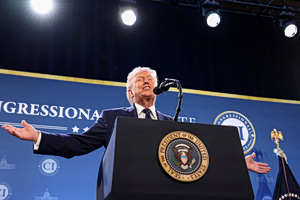
In a period of reshaping the European energy map, investment mobility, and geopolitical shifts, U.S. Secretary of the Interior and Chairman of the Energy Sovereignty Council, Doug Burgum, emphasizes in an interview with To Vima that “Greece is now at the center of energy developments,” as the agreements signed during the 6th Transatlantic Energy Cooperation Summit (P-TEC), held at Zappeion, “mark a new era of strategic cooperation with the United States.”
He stresses that Washington “serves as a connecting link,” bringing American LNG companies into contact with European buyers and infrastructure investors, while Greece is gaining a decisive role in the Vertical Corridor, which will transport American gas from Greece to Ukraine. At the same time, he predicts that “with the rise of artificial intelligence, Greece as an energy hub could attract significant capital.”
Mr. Burgum, what is the broader framework of cooperation between the two countries? Is it only commercial, or does it include other strategic or geopolitical goals?
“I believe this cooperation is guided by shared values and strategic objectives. Greece and the United States are democracies that value freedom and want their people to prosper. There is a common understanding across Europe that energy dependence on an adversary is a bad idea. Some countries have suffered more from Russia’s actions, like Ukraine. Others, like Bulgaria, saw gas flows interrupted. So the common goal is to sell and distribute energy—which means Greece becoming an energy hub, receiving and transferring energy to Eastern European countries to help them reduce reliance on Russian gas.
Moreover, with abundant and inexpensive energy flowing into Greece, all the capital following the development of artificial intelligence will come here. Today (Friday) is historic as it marks the start of the Vertical Corridor, which will allow 100 million people to reduce their dependence on Russian natural gas.”
Are you exploring other opportunities beyond the agreements already signed under P-TEC?
“Yes. In reality, we act as ‘connecting links.’ We are trying to connect American energy companies, especially LNG exporters, with buyers and infrastructure providers. The U.S. has dramatically increased its gas export capacity. We must, however, ensure there is the ability to receive gas on the other side of the Atlantic. There is particular interest in floating LNG reception terminals—so-called FSRUs—to match our export potential. This is one area of cooperation.
At the same time, discussions are underway regarding agreements on LNG, pipelines, FSRUs, and shipping, as well as support for the Vertical Corridor, which will help transform Greece into a true energy hub, receiving gas to be consumed domestically and sent northward.”
Have you estimated the total amount of U.S. investments that will flow into Greece?
“I don’t have an exact number, but I can say that I have never been to a conference where so many agreements were signed in a 24-hour period. It must be a record.”
There is mention of LNG prices. Do you think a reduction is possible?
“The only way to keep prices low is to ensure a stable and increased supply. One of the most important agreements signed today (Friday) (between DEPA, Aktor, and Venture Global) was the first long-term import contract for American LNG.”
Can you reveal the price of this specific contract?
“No, because it is a commercial agreement between two parties. However, I know that companies like Cheniere, Sempra, and Venture Global have different pricing depending on the contract duration—longer commitments reduce prices because long-term contracts stabilize the market. Another way to reduce prices is through agreements like the one signed by the six gas transmission system operators of the Vertical Corridor, which request their countries to lower transit fees, which increase the total cost of gas. Otherwise, costs become very high, and suddenly Russian gas appears cheaper since it crosses only one border.”