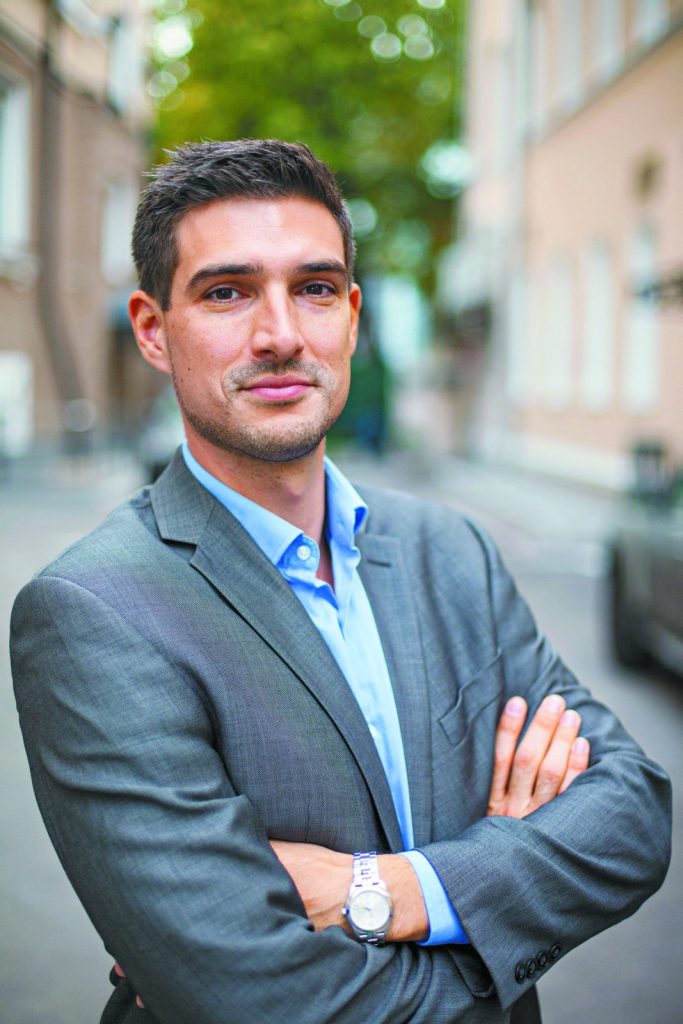
In the aftermath of the Trump-Putin meeting in Alaska and the meeting that followed at the White House with the participation of the Ukrainian president and European leaders, To Vima spoke with Igor Delanoë, an expert on Russian foreign policy, researcher, and professor at the French Institute of International and Strategic Affairs (IRIS) based in Paris, about Europe’s expectations from the meeting of the two leaders.
Trump floated that the United States could be involved in providing Ukraine security guarantees similar to NATO’s Article Five. What do you think about such a proposal and its risks?
There is no such thing as “NATO’s Article Five security guarantee”. Either you are part of the club, or you are not. In the case of fighting resuming in Ukraine, the guarantors can always hide themselves behind the “non constraining” aspect of the deal. At least, it is highly likely that the US will do so. The only case of non-NATO security guarantees that works is Israel. If Washington decides to provide Ukraine with the same level of security Israel has had for decades, then it would mean something. Otherwise, Russia will certainly consider the guarantees as empty words, unless the deal concluded extend to non-Western guarantors. If China, Brazil or Nigeria send “peace keepers” to Ukraine, it will certainly change Moscow’s risk calculus.
Probably we are going to see a bilateral meeting with Putin and Zelensky. Among Trump’s next objectives is to have a trilateral meeting with Zelenskyy and Putin. Can we expect something from those meetings?
As of today, I am very skeptical; frankly, I don’t see Putin shaking Zelensky’s hand in two weeks. Moscow still considers the Ukrainian President as non-legitimate. However, let’s imagine they meet. Nothing will be signed because Russia considers not only Zelensky but the Ukrainian Parliament illegitimate since their respective mandates have expired. So whatever could be signed, the documents could later be revoked by a future elected Ukrainian government, under the pretext they were signed by an unelected Ukrainian President.
In other words, a hypothetical bilateral or trilateral meeting, at this stage of the war, would be only a step on the road toward signing peace. It would be seen as a Russian concession, certainly in exchange, for instance, of a partial cancellation of some US sanctions, and the kick-off of a partial cease-fire. And perhaps, after this meeting, we could see elections happening in Ukraine, provided there is a cease-fire. The Russians will, in this scenario, sign a peace agreement, with the next Ukrainian President and the newly elected Rada would ratify it.
Trump has moved away from a ceasefire and now wants a total peace deal. Russia seems to accept some kind of guarantees for Ukraine and Zelensky says he will discuss territory with Putin. What’s the realistic outcome from all this, do you think there is any space for compromise and peace in the near future?
I think there is a space for compromise, but I am skeptical about the enduring and robust peace. There will be a compromise because Ukraine does not consider it has lost the war and because Russia has not been able to compel Kiev to capitulate. So the belligerents will have to find a compromise, meaning they both will be frustrated by the conditions of deal that will not meet their respective expectations. For Ukraine, it means de facto territorial concessions, no NATO membership, no international justice for Vladimir Putin etc. For Russia, it means no regime change in Kiev, no territorial control over the whole Eastern part of Ukraine and Ukraine’s Black Sea coast, only limited demilitarization of Ukraine… I don’t see Vladimir Putin inking a deal which endorse the deployment of NATO troops in Ukraine to enforce a potential ceasefire. This would contradict Russian officials’ discourse since the beginning of the war and the very reason why Russia triggered its “special military operation” in Ukraine.
As for the peace, the problem is that when you look at the track record of the ceasefire just in the Donbass between 2014 and 2022, you can see countless violations monitored by ICRC, from both sides. In the future, the ceasefire would span over a contact line of more than 1200 km, way longer than the previous one. Finally, I don’t see Russia signing a deal if it does not obtain the full control over the Donetsk region. This would suppose Ukraine withdrawing its troops from the Kramatorsk-Sloviansk urban fortress. As far as I know, it would be understood as some sort of capitulation by the Ukrainian public opinion…
After the events of the recent days there is a critique towards EU and European leaders, with some analysts even claiming that EU is cowering before Trump. Do you share this point of view?
Unfortunately, I tend to agree. European leaders came to Washington and tried to say “Yes, but…” to Trump’s plan, largely previously agreed with Vladimir Putin. Among the “but”, you find the preliminary ceasefire, put before by Chancellor Mertz and Emmanuel Macron, and the idea of a quadrilateral meeting, mentioned by the President of France. Both will likely be ignored. European leaders endorsed Zelensky’s announcement of $100 billion of US weapons supply to Ukraine, paid by the Europeans.
After the NATO summit in June, and Von der Leyen’s and Trump’s meeting earlier this summer, it is the third time the Europeans commit to pay tremendous amounts of money paid to the US, be it under the form of weapons orders, taxes or investments. This will have a concrete price for each EU citizen in the future, and I am not sure all EU countries can afford such expenditures for the sake of keeping Washington on board EU security. This money should be spent for Europe’s defense industry, not the US military industrial complex.