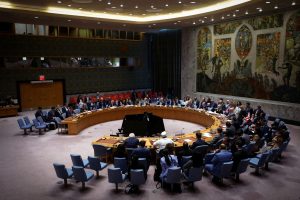
Sir Keir Starmer has indicated that the UK will recognise a Palestinian state at the United Nations General Assembly in September, provided Israel agrees to a ceasefire in Gaza and renews efforts towards a two-state solution.
The announcement drew a sharp response from Israeli Prime Minister Benjamin Netanyahu, who condemned the decision as rewarding “Hamas’s horrific terrorism.”
Prime Minister Starmer said: “I particularly listen to the hostages. Emily Damari, who I have spoken to, I’ve met her mother a number of times, and they’ve been through the most awful, awful experience for Emily and for her mother.And that’s why I’ve been absolutely clear and steadfast that we must have the remaining hostages released. That’s been our position throughout, and I absolutely understand the unimaginable horror that Emily went through.”

Emily Damari, a British-Israeli hostage who was kidnapped in the deadly October 7 2023 attack by Hamas, is pictured in this undated handout photo. Courtesy of Bring Them Home Now/Handout via REUTERS.
He added: “Alongside that we do need to do everything we can to alleviate the humanitarian catastrophe in Gaza, where we are seeing the children and babies starving for want of aid which could be delivered. And that is why I’ve said unless things materially change on the ground, we’ll have to assess this in September, we will recognise Palestine before the United Nations general assembly in September.”
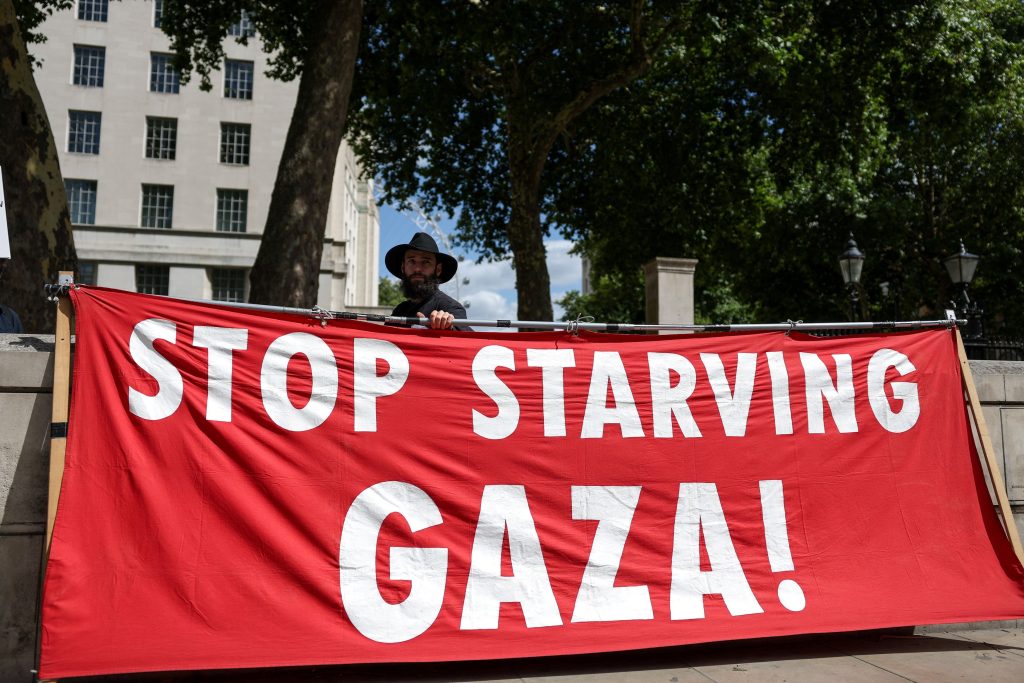
A man holds a placard during a protest to demand the immediate recognition of a Palestinian state and sanctions against Israel, as members of Britain’s Jewish community prepare to deliver a letter to British Prime Minister Keir Starmer, in London, Britain, August 5, 2025. REUTERS/Hannah McKay
For years, the UK said it would only recognise Palestine as part of a peace deal with Israel, in line with the Oslo Accords and US policy. In effect, this meant Israel had the power to block recognition by avoiding serious talks.
Now, Prime Minister Keir Starmer has signalled a shift. This comes amid growing public anger over the crisis in Gaza.
Protests across the UK and pressure from over 200 MPs, including many in Labour, have pushed the issue forward. Some senior ministers also see recognition as important for both moral and electoral reasons.
However, on Thursday, around 40 members of the House of Lords, including senior legal experts, wrote to Attorney General Richard Hermer to challenge the Prime Minister’s recent comments on Palestinian statehood.
The peers questioned whether Palestine meets the criteria for recognition under international law, including clear borders, a stable population, effective governance, and the capacity to maintain foreign relations, as set out in the Montevideo Convention of 1933.
Despite these concerns the UK government points to the fact that more than 140 countries have already recognised Palestine.
Responding to the letter sent by the 40 members of the House of Lords, Business Minister Gareth Thomas stated that the recognition of Palestine is a matter of political judgement. He emphasised that the government’s position aligns with the principles of statehood outlined in the Montevideo Convention of 1933.
TO VIMA contacted the UK Prime Minister’s office, which confirmed it fully supports the Minister’s comments.
Speaking to VIMA, Lord Turnberg – one of the forty signatories of the letter – said: “The letter was to ensure that the Attorney General was aware of the illegality of the proposal as it stems. That was the purpose of the letter, to bring to his attention the fact that he was supporting some sort of illegal and international law activity.
“I think the lawyers, I’m not a lawyer, but the distinguished lawyers on the letter explained that this was not internationally legal because it suggests that under the conventions, the idea that a new state should have recognised boundaries and borders should have a functioning government with the ability to rule and a population which supports it. At the moment, we have two different groups, the PA, Palestinian Authority, in the West Bank, and Hamas in Gaza, neither of whom are capable at the moment of leading a new state, and the two of them don’t get together.
“And the Hamas, while it’s there, is regarded as a terrorist organisation under the UK proscription, and so it’s very difficult to imagine how a new state can be produced. My own view is that a two-state solution is highly desirable. We do need a two-state solution, both for the Palestinians and the Israelis.
“But a Palestine that is so divided, that doesn’t know where its boundaries are, and which encourages Hamas to continue to keep the hostages, is not a position in which we should be recognising a Palestine in such a divided and divisive way. I think we could go to a Palestinian state if we had a potential government there that would recognise that Israel has the right to exist alongside it. Two states in peace with each other and recognising each other’s ability to exist is a prerequisite for two states.
“Israel would never want to agree to a state which is vowed to destroy it. That’s an impossible position. So I think at the idea that we should see a Palestine state recognised is completely against any realistic possibility.
“And I think while Hamas continues to hold the hostages, this idea simply encourages them to continue with their belligerent attitude and with their capacity to keep hold of the hostages. So for all those reasons, I don’t believe the moment is right to recognise a Palestinian state. I think if Hamas handed over the hostages and if Hamas was not considered to be part of any new Palestinian state, we could then begin to negotiate how it could happen.”
Lord Pannick who also signed the letter told TO VIMA: “Prime Minister Starmer has generally emphasised the need to comply with international law, but where – as here – political expediency dictates, he departs from international law.
“Under international law, recognition of a State is of a reality, not a gesture in favour of aspiration. There is currently no Palestinian State and therefore no basis for recognition.”
Professor of International Law Alexander Orakhelashvili, School of Law, University of Birmingham told TO VIMA: “Claims as though Palestine did not fulfil the Montevideo Convention criteria are ill-founded; therefore, recognition of Palestine would not contradict international law as the Lords’ letter claims it would; and at any rate it is not justified to consider UK Government’s approach to this problem as a sort of pick and mix approach that the Attorney General has earlier disapproved.”