Athens and Ankara continue to signal contrasting geostrategic priorities, even this week, amid an ever fluid situation across a vast region now extending from across far eastern Europe to the Middle East and Gulf, as military conflicts are ongoing.
For instance, the Athens daily Ta Nea on Thursday cites Greece’s participation in the French-led exercise “Orion 2026” as a notable development. For the first time, Athens deployed heavy military equipment — including Leopard 1A5 tanks and Marder 1A3 armored vehicles — over a distance exceeding 2,000 kilometers. The operation, involving naval transport and overland transport and maneuvering in France, is seen as a demonstration of both strategic reach and logistical capability.

The deployment followed closely after Greece’s rapid dispatch of naval and air assets to Cyprus in the wake of the US-Israeli attacks again Iran in a real-world operation, reinforcing what Greek officials describe as the armed forces’ ability to quickly project force beyond Greek borders.

Hellenic Air Force Mirage 2000-5 fighter jets from the 331 Squadron also took part in the French exercise, operating from Mont-de-Marsan air base, underscoring the deepening defense ties between Athens and Paris — a relationship that Greek officials increasingly frame as extending beyond standard alliance commitments.
By contrast, Turkey continues to invest in its geopolitical footprint in strife-plagued Libya, which it views as a key strategic foothold in the central Mediterranean. Ankara’s involvement in the “Flintlock 2026” exercise and its ongoing military cooperation with Libyan forces reflect a broader effort to consolidate its influence in North Africa.
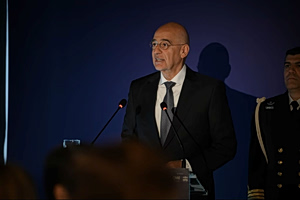
Turkey’s defense ministry recently revealed a long-range flight by an Akinci UAV to Libya, showing a map indicating operations within the framework of the Turkey-Libya “maritime agreement” — a deal Greece, the EU and other regional countries consider illegal and baseless. The timing of the announcement drew attention, as it came one day after a visit by Greek Foreign Minister George Gerapetritis to Tripoli, where he initiated a new round of contacts aimed at launching dialogue with the GNU government in the west of Libya ostensibly aimed at starting talks over maritime delimitation based on international law.
Turkey’s assembly has also voted to extend its military presence in Libya for an additional 24 months, until 2028, reinforcing Ankara’s view of the country as a strategic gateway to the central Mediterranean.
Greek military sources interpret the public disclosure of the Akinci flight as part of a broader effort by Ankara to advertise its operational reach and to apply pressure in areas seen as strategically sensitive for Greece.
Turkey has also objected to a planned Greek military exercise scheduled for May 5 near the northeast Aegean islands of Lemnos and Samothrace, reiterating demands for their demilitarization, something that Athens has flatly rejected, citing, among others, the various threats periodically aired by official Turkey.