The deadlock in US-Iran talks raises a fair question: could the world’s oil reserves offset the largest supply disruption ever recorded? The answer, according to a Reuters analysis, isn’t simple, since it depends on factors like how much oil remains in reserves and how much of that can actually be released.
Foreign analysts warn of distortion in the oil market, noting that current prices don’t fully reflect supply risks. The longer flows take to recover and the more available reserves shrink, the greater the risk the market crosses into a critical zone, with prices even at $120-140 a barrel back on the table.
Measuring the disruption
How long reserves will last can only be judged by measuring the scale of the current disruption. Saudi Aramco’s chief executive estimates the world has lost 2.6 billion barrels of oil since the war began, making it the largest supply disruption ever recorded in cumulative terms except for the 1979 Iranian revolution, according to Reuters calculations.
That works out to 25 full days of global consumption, based on pre-war global oil demand of 103 million barrels a day. However, China has cut demand in recent months, meaning the world is consuming less oil overall.
Most analysts estimate the daily supply shortfall at around 5 million barrels a day, even though Aramco says the world is losing 11 million barrels a day of Gulf supply. The shortfall may have widened in July after Ukrainian drones shut down Kazakhstan’s CPC pipeline, which pumped 1.8 million barrels a day.
Running dry after 180 days
The International Energy Agency (IEA) announced in March it would release 400 million barrels from emergency reserves, noting the global economy still holds substantial stockpiles and signaling it would release more if needed.
The IEA was founded in 1974 in response to another major oil crisis, the Arab oil embargo. Its reserves consist of government and commercial stocks totaling 1.5 billion barrels, enough to cover the current estimated 5-million-barrel-a-day supply gap for 300 days. The IEA doesn’t disclose the exact makeup of its reserves. However, it can’t order the release of commercial stocks, such as those refiners hold for operational reasons. That leaves only 0.9 billion barrels in government reserves, enough to cover the supply gap for 180 days.
US reserves at Reagan-era levels
Of the remaining government reserves, a third sits in the United States. Crude stocks in the US Strategic Petroleum Reserve (SPR) have fallen to their lowest level since January 1983, under President Ronald Reagan. The US Government Accountability Office warned in May that SPR infrastructure was deteriorating rapidly and that a quarter of its reserves are no longer usable. That means over 100 million barrels can no longer be released, according to Rapidan Energy analysts. If the US now has only 200 million barrels of accessible SPR reserves, that covers just 40 days of the current supply shortfall.
Diesel shortage
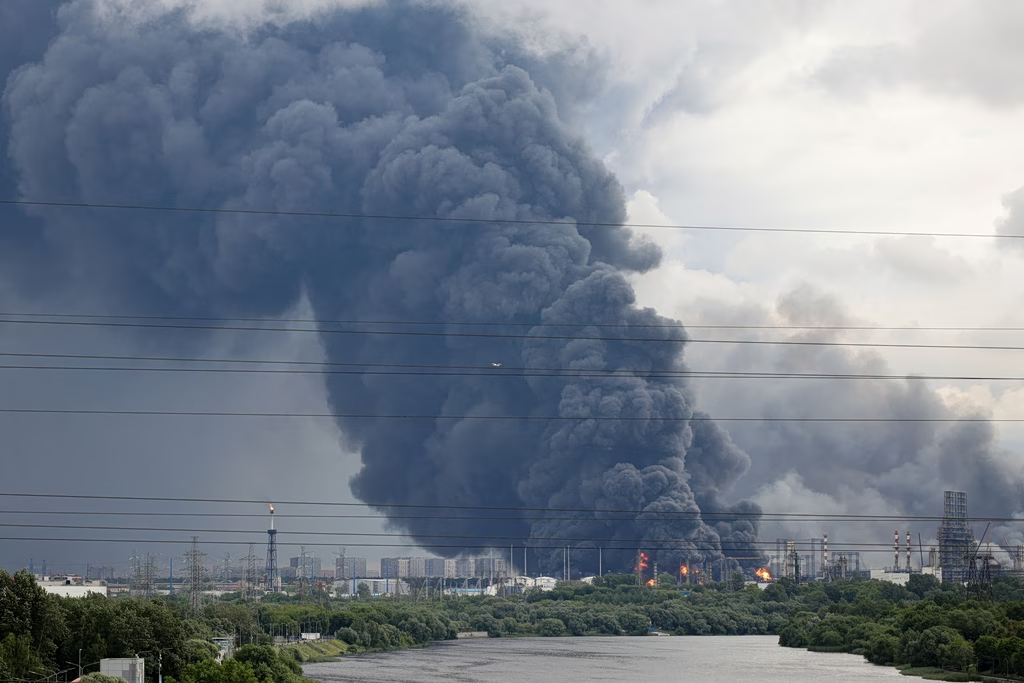
Depleted reserves have reduced the safety buffer against supply shocks, leaving the oil market vulnerable to sharp price spikes, according to Capital Economics’ Hamad Hussain. Per Morgan Stanley, global diesel and jet fuel stocks currently sit at the bottom of their five-year range. The wars have damaged refineries in the Middle East and Russia, hitting diesel and jet fuel especially hard, according to DBS Bank’s Survo Sarkar.
China holds steady
Total global oil stockpiles, including commercial reserves, the US SPR, Chinese reserves, and stocks held on tankers, look fairly comfortable overall, per the IEA. However, much of that isn’t a genuine safety buffer, since stocks “at sea,” for instance, often represent oil and fuel already sold and in transit. China doesn’t disclose its reserves, but Energy Aspects estimates it held nearly 1.7 billion barrels of crude in July, though consultancy estimates range from 1 to 1.7 billion. There are also unknown quantities of fuels and petrochemicals held in reserve. With 1.7 billion barrels, China could cover its pre-war imports through the Strait of Hormuz, roughly 5.5 million barrels a day, for nearly a year, one of the most comfortable positions among major economies, alongside Japan.
US and Iran both claim control of Hormuz
Iran and the US are making competing claims over control of the Strait of Hormuz, the shipping lane carrying a fifth of the world’s oil supply. The strait is “under Iran’s control and management,” the newly appointed head of Iran’s Basij paramilitary force said Thursday, a day after President Trump said the US has “total control” of the strategic waterway.
Hossein Taeb told Reuters that the US tried to undermine what he called the Islamic Republic’s popularity in the region by launching another war over the strait, but was defeated again, despite claiming Iran has neither an air force nor a navy. “Today you see that the Strait of Hormuz is under the management and control of the Islamic Republic,” Taeb said, according to the semi-official Fars news agency, adding that Iran continues on its path in complete security.
Senior military and political official Rasoul Sanaei-Rad said separately that Iran won’t reopen the strait unless the other side fulfills its commitments under the interim agreement, adding that reopening the waterway isn’t something the US can achieve unilaterally. Sanaei-Rad also warned Iran would respond more forcefully to any future conflict: “In a possible future war, we will stand firmer and adopt a more aggressive stance.”
Iran-US talks at a standstill
The deadlock between the US and Iran shows no sign of easing, with both sides still disagreeing over terms to end their five-month war and sending conflicting signals about Hormuz overnight.
Citing a senior Iranian government source, Reuters reported Wednesday that no progress has been made on reviving the interim peace deal reached in June. “One of the issues being discussed through mediators is the US returning to the interim agreement and setting a timeline for fulfilling its commitments.
There has been absolutely no progress on this,” the source told Reuters, adding: “There’s no talk of an extension, because… the United States violated the interim agreement 48 hours after signing it and withdrew from it days later.” The interview came after Turkey’s Anadolu news agency reported, citing Pakistani government sources, that the US and Iran had agreed to extend the 60-day ceasefire. Both sides have accused each other of violating the terms of the memorandum of understanding since it was signed, with President Trump declaring the deal “over” at last month’s NATO summit.