Billionaire populist Andrej Babis secured a decisive victory in the Czech Republic’s parliamentary election on Saturday, positioning his ANO party to form the next government and shifting the country’s politics toward Europe’s populist right.
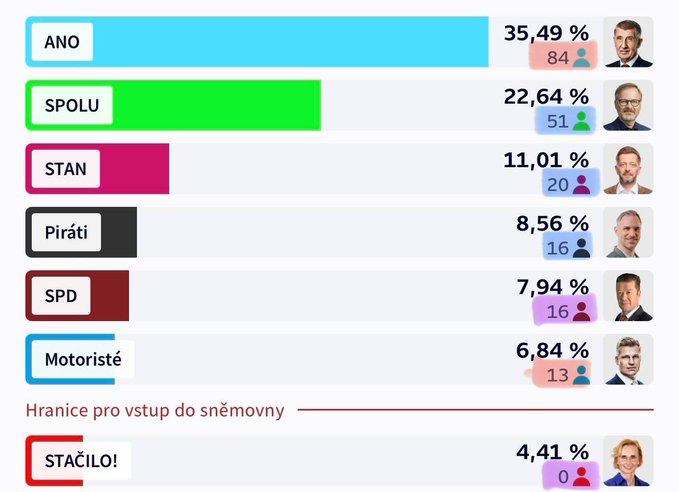
With nearly all votes counted, ANO led with 35.49%, well ahead of the ruling centre-right Spolu coalition on 22.64%, according to the Czech Statistical Office. The result sets up Babis — a former prime minister and one of the country’s richest men — for coalition talks as he seeks to return to power.
Babis seeks one-party rule with fringe backing
Speaking to supporters in Prague, an upbeat Babis said ANO would aim for a one-party government but would reach out to smaller movements for parliamentary support, including the far-right Freedom and Direct Democracy (SPD) party and the Motorists, who oppose the EU’s Green Deal.
“We want to save Europe … and we are clearly pro-European and pro-NATO,” Babis told reporters as repoted in Reuters, rejecting claims that his government would weaken Czech ties to the West.
SPD deputy chairman Radim Fiala said his party would be willing to back even a minority ANO cabinet, calling it a way to “end the government of Petr Fiala.”
Economic promises and political risks
ANO’s campaign centred on promises to raise wages and pensions, cut taxes, and reverse austerity — a message that resonated with voters facing years of inflation and stagnant living standards. The pledges, which would cost billions of euros, marked a populist turn away from fiscal restraint.
Babis still faces potential legal and political hurdles before returning as prime minister. He remains entangled in conflict-of-interest laws due to his vast business holdings and faces long-standing fraud charges over alleged misuse of EU funds — accusations he denies.
President Petr Pavel is expected to begin consultations with party leaders on Sunday before nominating the next prime minister. Early projections suggest ANO will win about 80 of parliament’s 200 seats, leaving Babis short of a majority.
Populist alliances and Ukraine stance
Babis has aligned himself with Hungarian Prime Minister Viktor Orban and other right-wing nationalists through the “Patriots for Europe” alliance in the European Parliament. Like Orban, he opposes the EU’s climate agenda and migration policies and has called for a “Strong Czechia,” borrowing from former U.S. President Donald Trump’s populist playbook.
While Babis has rejected SPD’s calls for a referendum on leaving the EU or NATO, he has pledged to scale back Czech support for Ukraine. He said Prague’s “Czech initiative” — which coordinated Western-funded ammunition deliveries to Kyiv — should be halted, arguing that military aid should instead be handled by NATO and the EU.
Pro-Russian parties performed poorly in the vote, with SPD gaining 7.8% and the far-left Stacilo! — built around the former Communist Party — falling below the 5% threshold for parliamentary entry.
The election result marks a clear shift in Czech politics, setting up complex coalition negotiations that could shape the country’s role within the European Union and its stance on the war in Ukraine.