The deal to supply Russian diesel to international markets, announced by Donald Trump after his phone call with Vladimir Putin, is turning into a new point of friction between Washington and Kyiv. The US president accuses Volodymyr Zelensky of blocking a peace agreement and has gone so far as to argue that Ukraine needs new leadership. For his part, the Ukrainian president warns that easing sanctions on Russia could strengthen its war effort.
Behind the public clash, however, a broader question is taking shape: Is this an effort to bring down energy prices, or a new balance of pressure, with Moscow gaining additional room to maneuver and Kyiv being asked to adapt to the priorities of the US administration? Analysts appear skeptical about whether the announced fuel quantities can meaningfully affect the market, while the timing of the deal also gives the matter a clear political dimension.
Trump: “It’s Time For Ukraine To Get A New President”
Speaking to reporters at the White House on Saturday, Donald Trump argued that Vladimir Putin wants the war to end, unlike Zelensky, whom he accused of rejecting opportunities for a deal.
“Russia would like to make a deal, but for whatever reason, Zelensky doesn’t,” the US president said, referring to his phone conversation with his Russian counterpart on Friday. He added that Putin strongly wants a settlement of the conflict.
His criticism, however, was not limited to the peace talks. Trump openly raised the issue of a change in Ukraine’s leadership, saying the country needs a president who could reach an agreement with Moscow.
“I suggest they get a new leader who can make a deal,” he said, arguing that Zelensky had repeatedly had the chance to reach an agreement with Russia but did not do so.
The US president also criticized the fact that no elections have been held in Ukraine since the start of the Russian invasion in 2022. The country, however, is under martial law, which does not allow national elections to be held under the current conditions.
Trump’s intervention adds yet another source of pressure on the relationship between the two presidents, at a time when contacts are underway to find a formula for ending the war.
“I think it’s time for Ukraine to get a new president,” President Trump said Saturday, slamming Ukrainian President Volodymyr Zelenskyy for targeting Russian diesel refineries after Trump made a deal with Russian President Vladimir Putin to supply more than 300,000 tons of diesel.
“He can do whatever he wants, but he can’t do that because we have a world problem,” Trump said. “And the problem is caused by the lack of refineries for diesel fuel… He’d better damn well stop.”
— CBS News (@CBSNews) October 10, 2026
Diesel, Sanctions And The Message To Kyiv
The new clash came after Trump announced that he had secured Putin’s commitment to supply additional quantities of Russian diesel to international markets, with the aim of easing pressure on fuel prices. According to the US president, the initial quantity exceeds 300,000 tons, with another 500,000 tons expected to be made available in November.
Trump said further supplies would follow, depending on the condition of Russian refineries. The announcement is linked to the US administration’s effort to reduce energy costs at a time when geopolitical tensions are weighing on international markets.
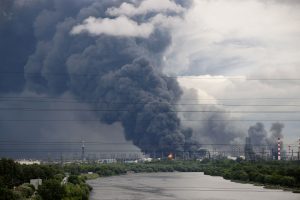
However, the deal takes on particular significance because it comes as Russia faces Ukrainian attacks on its energy facilities. According to a US official cited by CNN, Washington had repeatedly asked Kyiv to stop attacking Russian refineries, without success. The same official linked these attacks to Trump’s decision to move forward with the deal with Putin.
The US president accused Zelensky of worsening the situation in the global fuel market, saying he had warned his Ukrainian counterpart not to strike the refineries. At the same time, the US temporarily eased restrictions on Russian fuel exports.
For Kyiv, however, this move is not simply an energy arrangement. Ukraine has long argued that revenue from exports of oil and petroleum products is a major source of funding for the Russian war machine.
Zelensky’s Response And Doubts About The Deal’s Effectiveness
Volodymyr Zelensky described the deal as a “weak decision by strong allies,” arguing that easing sanctions sends the wrong message to Moscow. He also criticized the timing of the announcement, which came while a Ukrainian delegation was in Florida for talks with US officials.
“While our team is talking with the American side in Florida, the US president is talking with the leader of the Kremlin, the leader of this war and this aggression,” the Ukrainian president said.
He linked the diesel decision to the Russian attack in the Zaporizhzhia region in southeastern Ukraine, where, according to local authorities, 20 people were killed, including three children. He argued that easing restrictions on Russian fuel exports could be seen by Moscow as a sign that international pressure is weakening.
The doubts, however, are not limited to the political consequences of the deal. Energy market analysts question whether the announced quantities are enough to bring about a meaningful and lasting drop in prices.
Dan Pickering, founder and chief investment officer of Pickering Energy Partners, estimated that the additional supply could amount to an increase of about 5% to 6% by the end of the year. He described the deal as helpful, but not enough to decisively change the picture in the global diesel market.
At the same time, former US officials expressed doubts about whether Russia actually has the quantities Trump cited, given the pressure its refineries are under from Ukrainian attacks.
Russia had banned diesel exports in early July, following attacks on refineries and fuel shortages at home. This had removed about 800,000 barrels per day from the global market, at a time when supply was already tight.
Diesel futures prices fell about 4% at the close of trading on Friday. This, however, is not enough to show that a similar drop will follow in the prices consumers pay.

The Political Dimension And The Midterm Bet
Trump’s effort to reduce energy costs is also linked to the political challenges he faces at home. High fuel prices are weighing on households and businesses, while Republicans head toward the November midterm elections.
The US president has presented the deal with Putin as a development that could help lower prices, arguing that his moves on energy supply will have quick results. Analysts, however, point out that the impact on the market depends on whether Russia can deliver the agreed quantities, on the course of its exports and on wider geopolitical developments.
At the same time, the deal also drew criticism in the US. Former Vice President Mike Pence described the decision as a blow to the legacy of Republican Senator Lindsey Graham, who had supported strengthening US backing for Ukraine. “America should not be offering a lifeline to Putin’s war machine,” he wrote in a post.
Concerns are also being raised about the message being sent to Moscow. Richard Nephew, a former senior State Department official responsible for sanctions policy, said the decision has significant consequences for the broader system of restrictions against Russia.
The Florida Talks And The Next Step
The diesel deal was announced while talks were underway in Florida between Ukrainian, European and US officials, aimed at finding a joint proposal for ending the war. According to CNN, US envoys Steve Witkoff and Jared Kushner had informed Ukrainian officials that Trump wanted the attacks on Russian refineries to stop and that he was preparing the decision on supplying Russian diesel.
This development leaves open the question of whether the energy deal will serve as a limited measure to bring down prices or whether it will have a broader effect on the negotiations over Ukraine. Putin appeared willing to supply international markets with oil and petroleum products, expressing the view that the move would have a positive effect on the global economy.
For Kyiv, on the other hand, the key issue is whether the additional economic breathing room for Moscow will come with real commitments to end the hostilities. For Washington, the bet is twofold: to show tangible results on energy costs and to keep alive the prospect of an agreement on the war.
Whether the deal proves to be a meaningful step toward de-escalation or a temporary arrangement with a greater political than economic impact remains an open question.