The U.S. Navy’s newest and largest aircraft carrier, the USS Gerald R. Ford, has moved into the Latin America region, U.S. officials confirmed on Tuesday, and first reported by Reuters, a step that marks a sharp escalation of military pressure around Venezuela and the wider Caribbean.
The deployment — ordered last month by President Donald Trump — joins a U.S. force that already includes eight warships, a nuclear submarine and F-35 aircraft operating in the area. Pentagon officials said the carrier group’s role is to help “disrupt narcotics trafficking and degrade and dismantle Transnational Criminal Organizations.”
The Gerald R. Ford, commissioned in 2017 and carrying more than 5,000 sailors and over 75 aircraft when fully embarked, is supported by a battle group of surface combatants including a guided-missile cruiser and several Arleigh Burke-class destroyers with anti-air, anti-surface and anti-submarine capabilities.
Rising tensions and recent strikes
The carrier’s arrival comes amid an intense U.S. campaign of maritime strikes against suspected drug vessels. U.S. military actions in recent weeks have included at least 19 strikes in the Caribbean and off Latin America’s Pacific coast, killing at least 76 people. Washington says these operations target narco-trafficking networks; critics and some governments raise legal and escalation concerns.
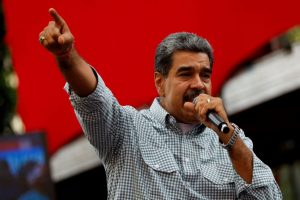
Venezuelan President Nicolás Maduro has accused the United States of aiming to drive him from power. Caracas is preparing for the possibility of U.S. air or ground action, according to sources and planning documents cited by Reuters, and has signaled plans for a guerrilla-style resistance and other measures of “prolonged resistance” that would rely on dispersed small units and sabotage. The Venezuelan government has also touted militia training, while acknowledging its armed forces suffer from shortages of trained personnel, low wages and aging Russian-made equipment.
Regional and diplomatic fallout
The U.S. military is reported to be upgrading a former Cold War-era Caribbean base — a move that suggests preparations for sustained operations in the region — and Washington has imposed sanctions on Colombian President Gustavo Petro, further straining regional relations.
France has publicly expressed concern about U.S. military operations in the Caribbean. French Foreign Minister Jean-Noël Barrot said the strikes risk violating international law and could destabilize areas where France has overseas territories and citizens, urging de-escalation to avoid wider instability.
Venezuelan defense posture and limitations
Reuters-sourced planning documents portray a Caracas strategy based on two complementary options: a decentralized guerrilla resistance using more than 280 locations for sabotage and small-unit action, and an “anarchization” plan using intelligence services and pro-government actors to foment street disorder if foreign forces intervene. Yet sources also stress the Venezuelan military’s material and logistical shortcomings. Analysts quoted in the reporting note that Venezuela’s vintage Russian jets, helicopters, tanks and shoulder-fired missiles are limited compared with modern U.S. capabilities.
President Maduro has displayed confidence in national resolve, saying portable air-defense missiles and militia forces are deployed broadly across the country. Moscow, meanwhile, told Reuters it is prepared to respond to Venezuela’s requests for assistance, while cautioning against escalation.
What the U.S. says
U.S. Defense officials framed the Ford deployment as part of an effort to strengthen detection, monitoring and disruption of illicit drug trafficking networks that affect the United States. Pentagon spokespeople emphasized the carrier’s sensors, radars and air wing as key assets in those missions.