Europe is now caught somewhere between war and peace.
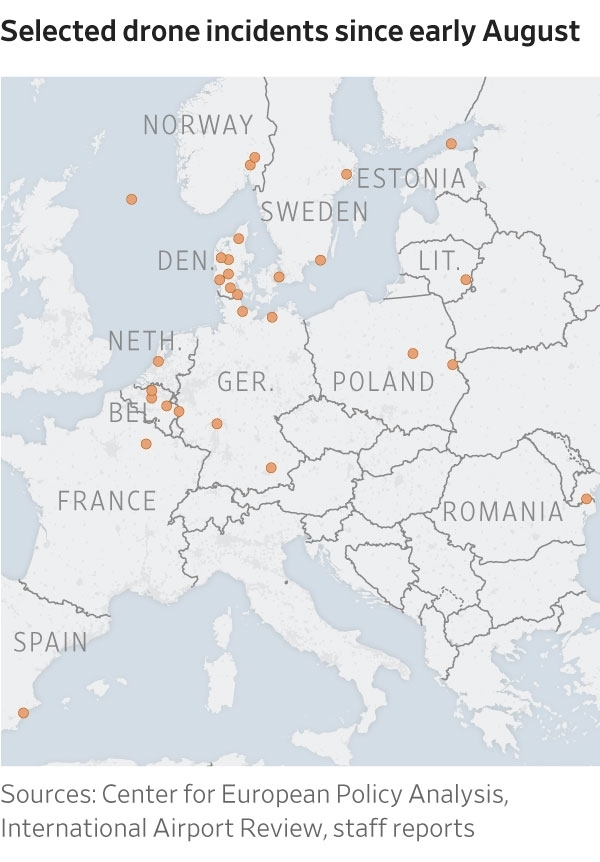
In recent weeks, drones appearing mysteriously above airports and halting flights have made headlines. Those are just the tip of the iceberg.
Germany alone has three drone incursions a day on average—over military installations, defense-industry facilities and critical infrastructure points—according to a previously unreleased tally by German authorities.
Drones are part of an intensifying barrage that European leaders suspect Russia is directing at the continent over its support for Ukraine. It includes sabotage, cyberattacks and disinformation campaigns.
“We are not at war” with Russia, German Chancellor Friedrich Merz said recently, “but we are no longer at peace either.”
For Russia and the West’s other adversaries, including China, Iran and North Korea, small-scale action can yield big payoffs. Moscow is bogged down militarily in Ukraine and so would struggle to engage members of the North Atlantic Treaty Organization in conventional combat. Instead, malicious activities that are often dubbed hybrid war or gray-zone conflict let the Kremlin challenge its adversaries without overt hostilities.
“Our adversaries have calculated that they can hide behind ambiguity and deniability to violate sovereignty, ignore national laws and international norms, and engage in activities such as political coercion, sabotage, and even assassinations without triggering an armed response,” Dave Pitts , a former senior official at the Central Intelligence Agency, said at a security conference in Sarajevo, Bosnia and Herzegovina, recently.
The drone incursions follow a string of ambiguous maritime incidents last year involving commercial ships with connections to Russia and China cutting or damaging undersea cables and pipelines in European waterways. No clear link to Moscow or Beijing was established. NATO in January launched a policing operation, Baltic Sentry, and no damage has since been reported.
Similarly, suspicious fires and explosions have occurred along European railroads and at facilities ranging from shopping malls to a German defense executive’s property.
Western governments have long suspected Russia of waging a hybrid war as a way of destabilizing them and eroding their support for Ukraine. Several individuals across Europe have been arrested, indicted and convicted of planning or carrying out sabotage acts on behalf of Russia.
The Kremlin has repeatedly denied any involvement in acts of sabotage or drone incursions in Europe. Kremlin spokesman Dmitry Peskov rejected recent allegations. “All these accusations against Russia are completely baseless and unsubstantiated. They cannot be taken seriously,” he said.
Russia’s gray war isn’t just physical. The British government in July accused Russian military intelligence of deploying malware for espionage. Other governments have leveled similar charges against Moscow, which denies the accusations.
Intelligence analysts also see the West’s adversaries working to amplify unsettling news, seeking to erode social cohesion and trust.
Google Threat Intelligence, an arm of Alphabet that monitors online dangers, noted a jump in online pro-Russian “influence actors” promoting narratives—a positive image of Russia and weakening international support for Ukraine—following recent drone incursions into Poland .
European politicians, who once hesitated to point fingers at Moscow, are increasingly vocal. After drones recently appeared near Belgian military bases and airports, scrambling commercial air traffic, Defense Minister Theo Francken said some drones were “deliberately mapping infrastructure” at military bases.
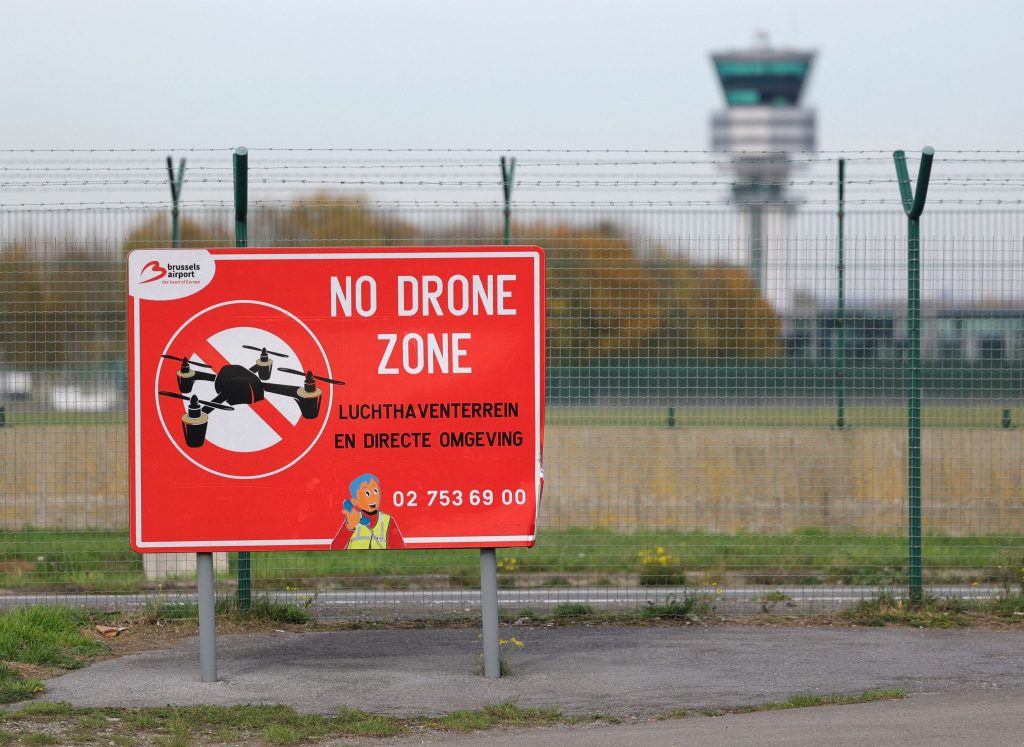
FILE PHOTO: A “No Drone Zone” placard is seen at Brussels international Airport in Zaventem on the day of an emergency meeting of Belgian government officials and experts, following drone sightings that closed Brussels Airport, in Zaventem, Belgium, November 6, 2025. REUTERS/Yves Herman/File Photo
“That’s espionage, likely carried out by professional pilots on behalf of countries like Russia,” Francken told a local news program.
Germany said on Friday it had sent a military counterdrone team to assist Belgium in fending off the incursions. Berlin had dispatched a team to Denmark in early October to help secure a European Union summit after the country became a focus of drone activity.
German Defense Minister Boris Pistorius said the increase in sightings over Belgium might be linked to a push by EU members to use seized Russian state assets to fund Ukraine’s military. Belgium holds the bulk of these reserves and securities, de facto giving it a veto over the plan.
Germany itself is one of the countries most affected recently. Its air-traffic safety agency said pilots and air-traffic controllers had reported 172 drone sightings in protected airspace this year through September—more than recorded for any full year since at least 2019. Drones caused Germany’s two largest airports, in Frankfurt and Munich, to shut last month.
Even that record number represents just a fraction of the total. Germany’s Federal Criminal Police Office, or BKA, the equivalent of the FBI, has logged thousands of drone incidents this year.
In a classified report titled “Crime Weapon: Drone,” the BKA has documented unauthorized drone incursions over military installations, defense-industry property and critical infrastructure, including airports. The tally is based on sightings by the BKA’s regional offices and the military.
A spokesman for the German Interior Ministry told The Wall Street Journal that the total is “a low four-digit number” of incursions this year—at least three incidents a day on average.
The drones have ranged from toy-sized commercial crafts to ones flying in close formations of up to 15, pointing to a state actor, security officials say.
The BKA report is now being updated every two weeks, instead of quarterly, as part of an increased effort to combat spying and sabotage, according to a German government official. The findings will remain classified because authorities weren’t able to attribute sightings to any particular actor in most cases, the person added.
Most drones don’t pose a physical danger to the public, but ones near airports can. Passenger planes aren’t certified to withstand collisions with drones or other hard objects such as weather-balloon payloads.
Unlike a bird, even a small commercial drone could penetrate a cockpit windshield or fuel tanks, said Moritz Bürger , a pilot and official at the German Cockpit union who had a close call with an unidentified object while approaching Zurich airport earlier this year. Hard objects pose a threat even at relatively low takeoff or landing speeds of above 100 miles an hour.
“At that speed, you really only have a chance to spot such a small object at the very last moment, and then it is simply too late to take evasive action,” he said. “These things also tend to happen during approach and departure, when we are very busy with the aircraft.”
Governments across Europe have so far been largely unable to do much about the issue. Most drone incursions go unsolved. Just a handful of drones have been shot down or their pilots detained so far across the region.
“It looks like right now, the state isn’t in control of its airspace, and that’s a very precarious situation,” said Christian Mölling , director of Edina, a research project about the future security of Europe partly funded by the German Council on Foreign Relations. “We urgently need to change this perception and that means we need much better situational awareness.”
One difficulty is technical. Detecting slow-moving, low-flying craft that are often no bigger than birds and not always visible on radars is hard. Such detection requires layers of different sensors, including radio receptors, video cameras and acoustic sensors.
“This can get expensive, and because it isn’t always clear who is responsible for what, there is no agreement about who should pay for such systems: The airport? Air-traffic authorities? The police?” said Bürger, the pilot.
Shooting drones down once they are located is equally difficult and ridden with legal complications. Authorities have sought to avoid shootdowns in densely populated areas.
In Germany, like most of Europe, the military is responsible for intercepting drones that fly over military areas. Federal Police, the equivalent of the U.S. Border Patrol, are responsible for airports. Outside those boundaries, responsibility falls to state police, which is rarely equipped for the challenge.
Even within airports, responsibility is divided. Asked about the latest incidents in Berlin, the Federal Police’s Berlin office said they were only responsible for drone defense while the airport itself and the air-traffic safety agency were responsible for drone detection.
A spokeswoman for the airport, however, said the Federal Police was responsible for all drone matters, and a spokeswoman for the air-traffic safety agency said pilots were only responsible for signaling sightings to the police.
The German Interior Ministry and the Federal Police declined to comment on their drone-defense tactics and equipment.
Write to Bertrand Benoit at bertrand.benoit@wsj.com and Daniel Michaels at Dan.Michaels@wsj.com