Greece is looking to persuade foreign investors to buy into a revival from its debt crisis, its finance minister said, as uncertainty about the reshaping of the global economy remains despite a relatively soft blow from President Trump’s tariff storm.
Other European nations that rely on exports, such as Germany and Ireland, saw much slower economic growth in the second quarter of the year, after the early part of 2025 got a temporary boost from U.S. importers who rushed to stock up on goods ahead of proposed tariffs.
Greece, by contrast, saw economic growth accelerate in the second quarter, having already outpaced the European average in 2024. Like the rest of the European Union, the country now faces a 15% tariff on its goods exports to the U.S. after a trade deal agreed on in late July. Greece had a trade deficit in goods with the U.S. last year.
Uncertainty, rather than trade policies, has been the primary headwind to the global economy, Finance Minister Kyriakos Pierrakakis said in an interview.
Greece’s first preference was eliminating tariffs on goods trade with the U.S., he said.
“But as a second best, we wanted a deal rather than no deal because we felt that we should eliminate or limit uncertainty to the maximum extent that we could.”
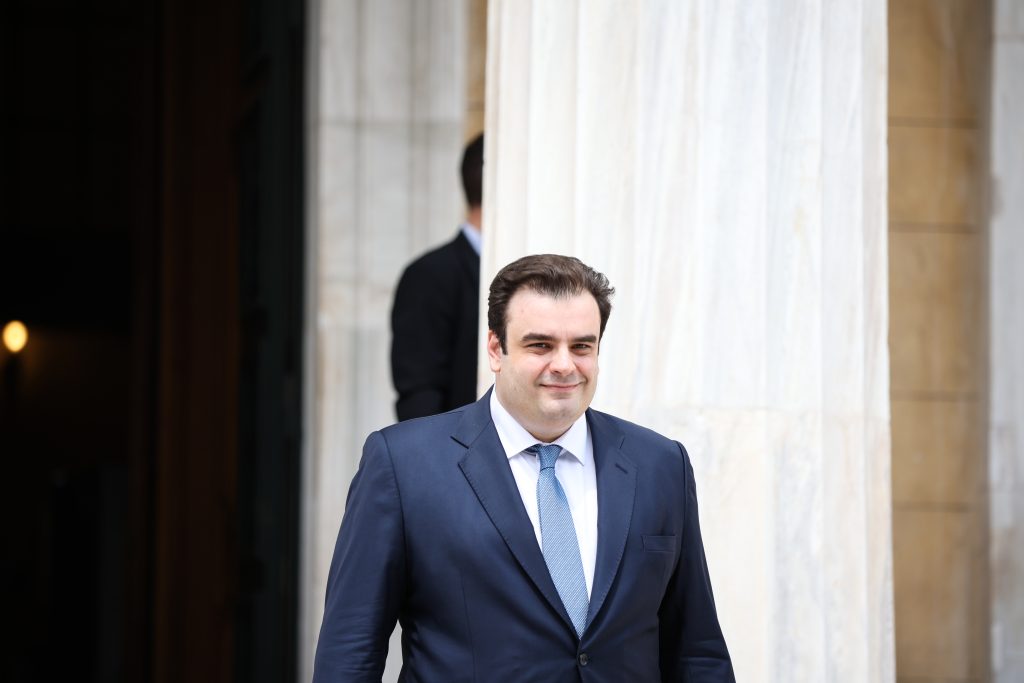
Greek Finance Minister Kyriakos Pierrakakis.
While Greece has a large shipping sector, its economy has been powered in recent years by a booming tourism industry and huge grants from the EU’s post-pandemic recovery fund. But that comes after one of the largest economic slumps ever suffered by a developed economy, which saw its economy contract by around a quarter amid a bruising sovereign-debt crisis.
After 10 years in an existential crisis, Greece isn’t planning to lose economic momentum, Pierrakakis added.
At a time when many economies are looking inwards amid rough geopolitical terrain, Greece is making a renewed push for foreign investment. The government this week launched a new innovation and infrastructure fund with help from BlackRock to attract as much as 1 billion euros, or $1.18 billion, in private investment in the next few years.
“We need to mobilize private investment in order to be able to grow the economy,” the minister said. “We’re hoping to unleash our full growth potential”.
As investors fret over the debt loads of larger nations like France—whose credit rating was last week downgraded by Fitch—Pierrakakis pointed to Greece as an example of leadership. In March, Moody’s became the last major ratings agency to upgrade Greek bonds to investment grade after more than 15 years as junk.
But challenges remain in the wreckage of a lost decade. Greece has the highest debt-to-gross domestic product ratio in Europe and the second-lowest GDP per capita in the EU after Bulgaria when adjusted for purchasing power, according to Eurostat data. In international league tables, its math and reading scores rank alongside Kazakhstan and Mongolia.
Greeks complain of stagnant wages and rising costs, and catching up with the rest of the continent will take time. Greece’s GDP per capita could reach the EU average around 2040, said Dimitri Vayanos, a professor at the London School of Economics who co-authored a 2020 government-commissioned growth plan. But even that projection requires economic growth and productivity improvements that outstrip Greece’s recent record.
The Greek government’s pitch to investors comes after a series of business-friendly reforms, including the digitization of much of its administration, streamlining tax collection and incentivizing workforce participation through the tax system, Pierrakakis said. Exports represented just 20% of GDP in 2019. Now, they account for 40%.
International investors are taking note of Greece’s improved credentials. Amid a shift in asset allocation toward Europe earlier this year, the country is increasingly popping up on investors’ radars thanks to its macroeconomic story, said Christos Megalou , the chief executive of Athens-based Piraeus Bank after a recent roadshow in the U.S.
“Since the beginning of 2025, we have seen flows from U.S. funds into Europe generally and Greece in particular—and Piraeus also as a proxy to Greece,” Megalou said.
After years of structural improvements and cleaning up massive portfolios of bad loans, Greek banks are regaining investor trust. Last year, they resumed dividend payments after a 16-year drought. Since late 2023, the government has accelerated the wind-down of its remaining stakes in banks that it bailed out during the crisis.
Greek authorities have welcomed foreign investment in the sector at a time when government interference in Italy, Spain and Germany threatened to scupper banking mergers. In recent months, stock market operator Euronext acquired the Athens bourse and Italian lender UniCredit’s raised its stakeholding in Alpha Bank .
Greece has now bitten the bullet and realized the key to prosperity and opportunity for its citizens is attracting investment from abroad, said Andrea Orcel , the chief executive of UniCredit—now Alpha Bank’s largest shareholder.
Write to Elena Vardon at elena.vardon@wsj.com and Ed Frankl at edward.frankl@wsj.com