A disclaimer in Jeffrey Epstein’s email signature was a provocation as much as a warning: The contents of this message “may constitute inside information.”
For Epstein, the line between social networking and securities law wasn’t just blurred, it was part of the way he conducted business. The Epstein files show how easily the sex offender collected confidential information from his well-connected associates .
Epstein received board minutes from Ehud Barak about a tech startup where the Israeli politician was chairman. JPMorgan Chase executive Jes Staley emailed details about an M&A deal that his bank was secretly working on. A key adviser to Bill Gates passed along information about biotech startups his billionaire boss was investing in.
Epstein sometimes used the tips cultivated from his network to invest for himself, whether his associates or the companies knew it or not, according to a Wall Street Journal review of the files. Other times there is no public record that Epstein acted on the information he amassed, some of which came his way as a wealthy individual with connections to billionaires, hedge funds and other investment firms.
A representative for Barak told the Journal that Epstein was an investor in a partnership and entitled to receive information about the startup. Boris Nikolic , the Gates adviser, said what he shared was public information or material he was authorized to share. Staley and his lawyer didn’t respond to requests for comment.
The Epstein files also show how willing Epstein’s associates were to share private material beyond financial information. Andrew Mountbatten-Windsor, the former Prince Andrew, is under investigation for potentially sharing confidential U.K. government reports with Epstein. So is former British diplomat Peter Mandelson .
Mountbatten-Windsor has denied wrongdoing in relation to his dealings with Epstein. Mandelson has said he regretted his association with Epstein. Neither man responded to requests for comment.
Trading wasn’t the source of most of Epstein’s wealth , which came from advising billionaires like Leon Black and former Victoria’s Secret boss Les Wexner . His estate was worth at least $577 million, including his private island and properties, according to court papers filed after Epstein’s death. He was arrested in 2019 on federal sex-trafficking charges and died while in custody.
The scientist
Nikolic, Gates’s longtime science adviser, emailed Epstein about Foundation Medicine, a molecular diagnostic testing company, in late 2012, around the time Gates took a significant stake in the startup.
At that time, Nikolic—a physician and investor—advised Gates on tens of millions of dollars in investments in healthcare and biotech companies, according to people familiar with his work and documents he later shared with investors that were reviewed by the Journal.
Gates—and his representatives—received access to confidential financial information as a major early investor in Foundation Medicine. Nikolic, in turn, sent some documents discussing the investment to Epstein.
“I never shared material, non-public information (MNPI) with Epstein,” Nikolic told the Journal. He said the Foundation Medicine material he shared was public or included in the company’s prospectus. “If Epstein invested, he did so on the public markets when anybody could invest.”
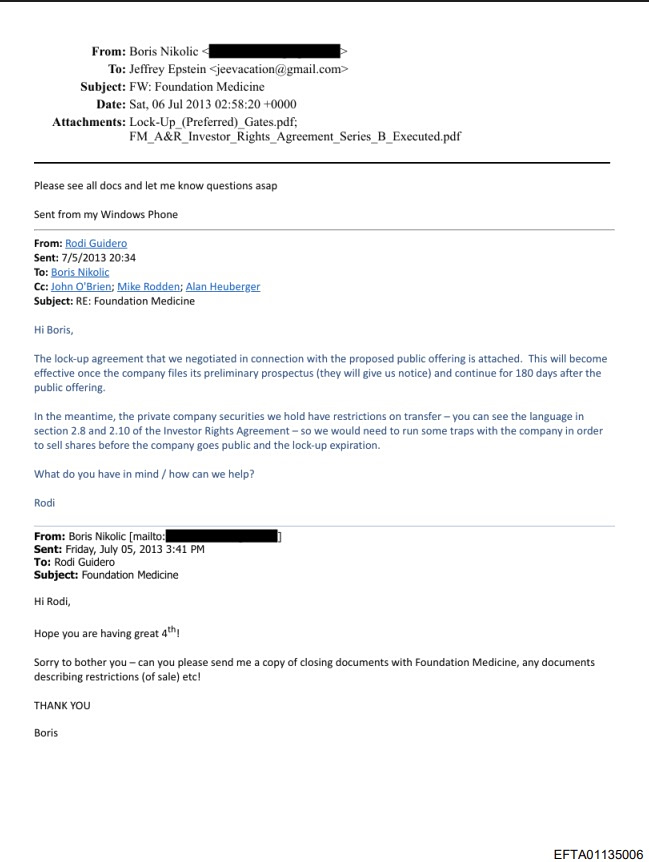
In July and August 2013, Nikolic forwarded to Epstein emails discussing Gates’s investment in the startup and attached some documents about information rights and financial terms of the investment. “Please see all docs and let me know questions asap,” he wrote.
Around that time, Epstein was helping Nikolic negotiate his separation from Gates’s private office. Nikolic said he was authorized to share the materials to negotiate his exit. A spokesperson for Gates didn’t respond to requests for comment.
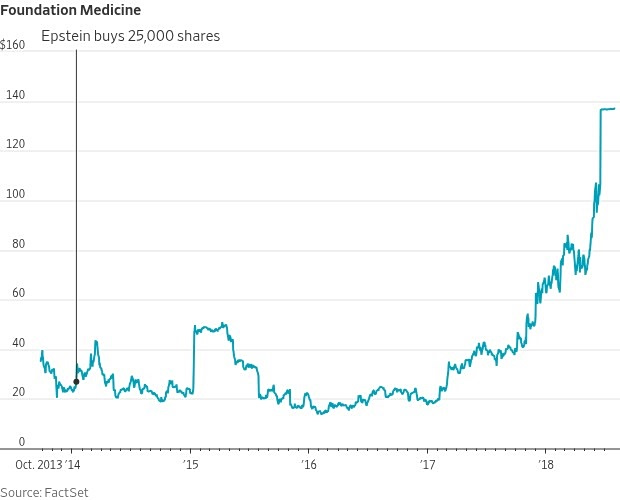
Foundation Medicine went public in September 2013 at $18 a share. Epstein bought 25,000 shares on Jan. 13, 2014, paying $27.51 per share.
Two days later, Nikolic emailed Epstein : “Did you see Foundation Medicine?…You probably made around 30% in last two days! The company is coming with a number of new products. l do think it might hit post IPO 42 again—soon.”
A few months later, Nikolic sent Epstein analyst research about Foundation Medicine and told Epstein that he expected “greatly increased revenues—FMI was doubling its revenue for 3-4 years in the row and it will continue,” according to an April 2014 email.
In January 2015, Swiss drug giant Roche paid $50 a share for a roughly 56% stake in Foundation Medicine—a 109% premium.
In July of that year, one of Epstein’s bankers emailed about Foundation Medicine, noting that Epstein was long about 50,000 shares at an average price of about $25.38. It isn’t clear when Epstein purchased other shares or how long he held on to his stake.
In June 2018, Roche said it would buy the remaining shares in Foundation Medicine—at $137 a share.
Epstein also invested in Editas Medicine, a gene-editing company where Nikolic served on the board and Gates was a major investor through Nikolic’s fund.
On Feb. 3, 2016, the day Editas went public, Nikolic wrote to Epstein : “We were 6x oversubscribed which is a miracle considering HORRIBLE markets.”
Weeks after the public offering, Epstein purchased 3,200 shares of Editas for $31.93 apiece. Two days after the purchase, Epstein emailed Nikolic, referencing Editas. Nikolic responded: “So far so great.”
Epstein’s accountant emailed Epstein in December 2018 to notify him that Nikolic was stepping down from the board. It is unclear how long Epstein held his position in Editas, which traded around $25 when Epstein died.
The banker
One of Epstein’s most valuable insider sources, according to the Journal’s review, appeared to be Staley, who was a senior JPMorgan executive until 2013. He had a close relationship with Epstein and they exchanged hundreds of emails over the years, the files show.
In December 2009, Staley shared with Epstein internal JPMorgan compensation deliberations, including that 34 people were expected to earn more than $10 million that year, and CEO Jamie Dimon’s perspective on pay issues amid a public backlash.
Epstein in 2010 bought JPMorgan preferred stock and his financial statements show he held it for years, owning at least $5.7 million worth in early 2019.
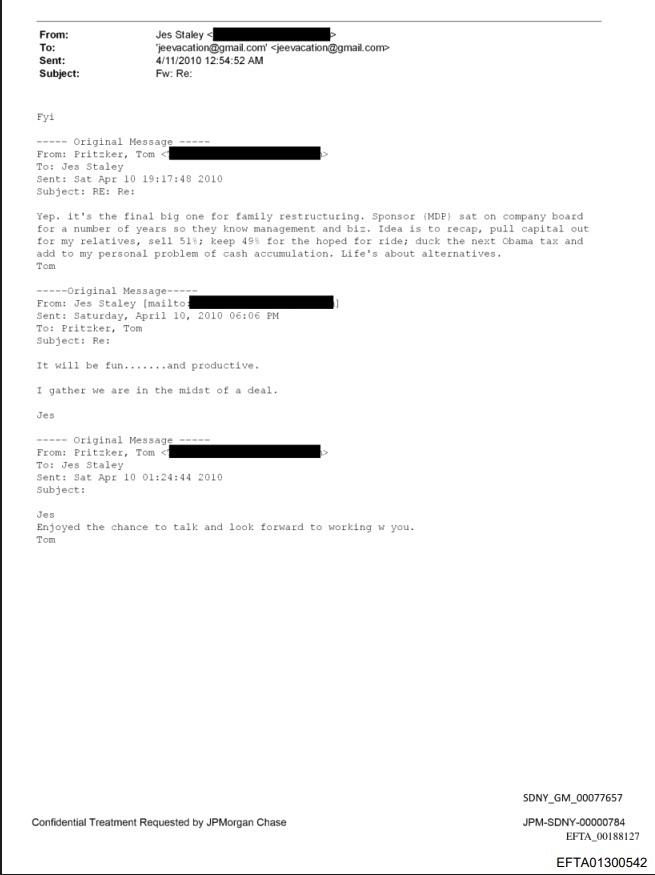
Staley also sent Epstein insider information about other matters. In 2010, as the wealthy Pritzker clan was nearing the end of a process to split up the family empire among warring cousins, it planned to sell a chunk of credit-reporting agency TransUnion, which the Pritzkers controlled.
Thomas Pritzker, a senior family member who also was in close touch with Epstein, sent an April 10, 2010, email to Staley. Pritzker discussed a deal to sell 51% of a company to Madison Dearborn Partners, a private-equity firm, while keeping 49% for the family and adding “to my personal problem of cash accumulation.”
Shortly after, Staley, whose bank JPMorgan was advising Madison Dearborn, forwarded Pritzker’s email to Epstein , writing: “Fyi.”
Less than three weeks after Epstein got this private information, TransUnion announced on April 29 that the Pritzkers were selling a 51% stake to Madison Dearborn while retaining 49%.
A JPMorgan Chase spokeswoman said it wasn’t aware of Staley sharing confidential information with Epstein until after he left the bank. Pritzker declined to comment, as did Madison Dearborn.
The politician
Barak, the former Israeli politician, met with Epstein dozens of times and traveled to his private island. In 2015, Barak invested in and later was named chairman of Reporty, an Israeli startup.
The Epstein files reveal that Epstein was much of the money behind Barak’s $1.5 million investment in the technology company. Epstein loaned $1 million to an entity formed by Barak for the deal, and later converted the loan into a partnership interest, the documents show.
Epstein received a string of inside information about the company from Barak.
In January 2016 , Barak sent an email to Epstein, where he shared the minutes from a Reporty board meeting. The minutes showed the board had authorized the CEO to contact venture capitalists to raise $10 million. “Moving forward very well,” Barak wrote.
In an email, a spokesman for Barak’s office said Reporty was a private, untraded company, and that Epstein, as an investor in Reporty through a partnership run by Barak, was entitled to receive certain information.
“All of Barak’s business activities, including re Reporty, were conducted under careful legal advice and according to the law,” his spokesman said.
Reporty changed its name to Carbyne in 2018 and later that year raised additional funds. In 2020, the company said that Barak was stepping down from its board.
Carbyne was bought by Taser stun gun maker Axon for $625 million in November 2025. It’s unclear how long Epstein held the investment in the company.
The client
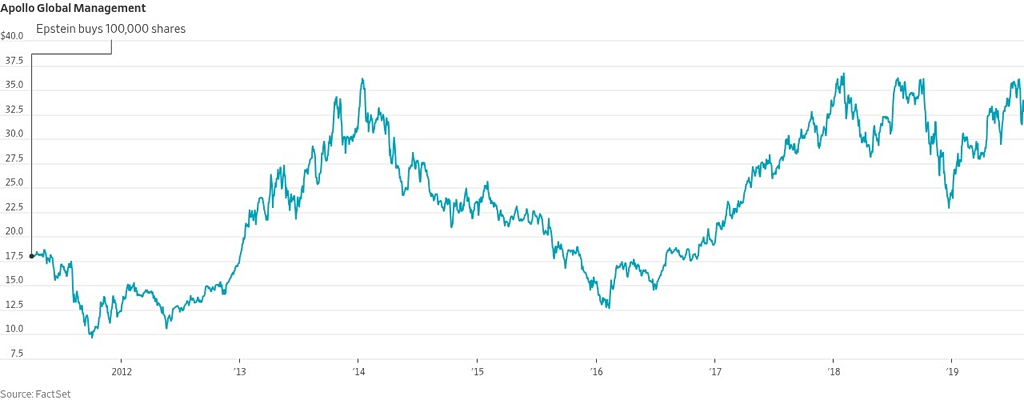
Epstein was also an investor in Apollo where he got some confidential information from his close ties to Black , the private-equity firm’s then-CEO. Epstein invested in Apollo’s 2011 IPO and owned more than 250,000 shares purchased at a cost basis of about $5 million, the files show.
Epstein knew Black since the 1990s and provided tax- and estate-planning advice to Black from 2012 to 2017. Epstein signed an agreement in 2013 to keep confidential any material he received in providing those services.
In March 2015, Epstein received an email marked “Confidential. Material non-public info” from the finance chief of Black’s family office.
The email projected, among other things, that Apollo’s cash distribution—equivalent to a dividend—for the first quarter of 2015 would be about 34 cents per share. When Apollo announced its quarterly earnings two months later, the cash distribution turned out to be 33 cents per share.
A spokesman for Black said Epstein provided tax and estate planning services for Black’s family office and was given information about his holdings in Apollo for these purposes.
The value of Epstein’s stake in Apollo as of February 2019, shortly before he died, was about $7.7 million, showing a gain of about $2.7 million.
Write to Emily Glazer at Emily.Glazer@wsj.com and Mark Maremont at Mark.Maremont@wsj.com