TOWNSVILLE, Australia—In the rugged hills outside this coastal city, Japanese and Australian artillery crews fired in tandem on a distant target. They were assisted by U.S. Marines, who were embedded with the Australian gun teams.
The live-fire drill was the culmination of Southern Jackaroo, an expanding annual exercise in the Australian bush in which the three nations’ forces practice working together as allies.
Although top officers didn’t call out any foe by name, troops taking part said it was clear that they were training to fight China.
As Beijing’s military steadily expands its forays in the Pacific, U.S. allies in the region are realizing they could easily be drawn into a conflict with China . They are responding by bolstering their forces and increasing joint drills to ensure they can work together seamlessly.
A primary goal of the combined displays of force is to complicate Beijing’s planning and convince the Chinese leadership that it would be too risky to use military force to assert territorial claims.
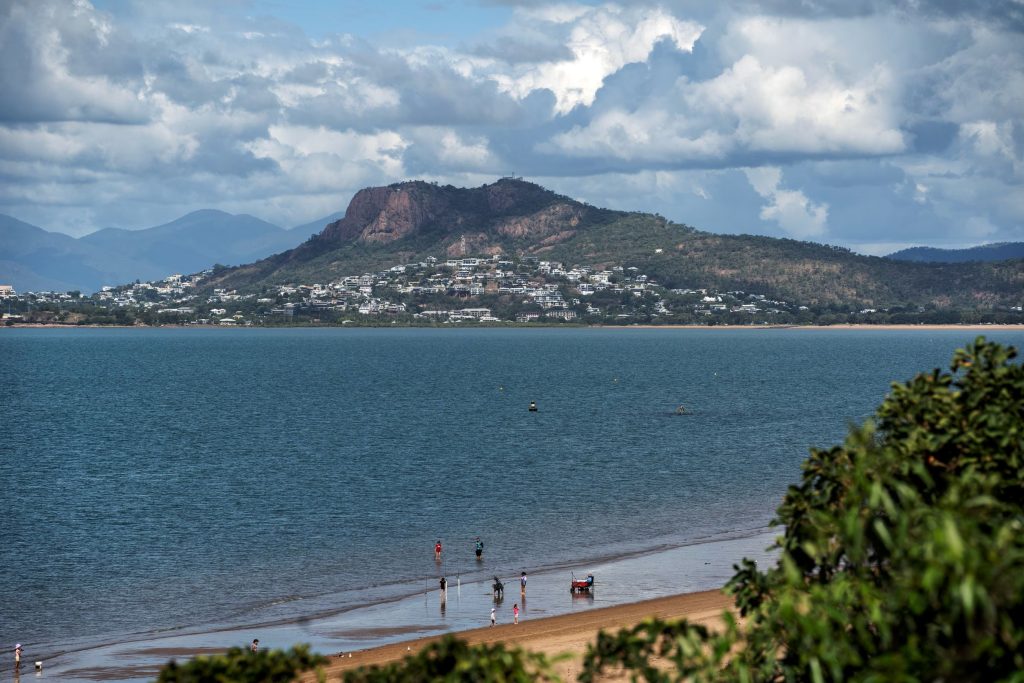
The annual exercise took place outside Townsville. | Photographs by Ioanna Sakellaraki for WSJ

Troops fire artillery during Southern Jackaroo. | Photographs by Ioanna Sakellaraki for WSJ
Australia and Japan, both of which have security pacts with the U.S., have emerged as essential U.S. partners in the Pacific. If a war were to erupt, Washington would want Tokyo to sign off on the U.S. using its Japanese bases to confront China and for Australia to send aircraft, ships and troops to Japan to help the fight, some defense analysts say.
“If there’s any argument to be made for a collective approach to deterrence in the region, it’s these three countries,” said Jeffrey Hornung, the Japan lead at Rand, a think tank.
On Friday, the U.S., Japan and Australia further bolstered their cooperation with a new naval logistics agreement that covers activities such as refueling and reloading missile systems, which could be vital to improving their defenses.
Australia is also gearing up to host the three-week Talisman Sabre exercise opening Sunday. The exercise will involve 19 nations, including the U.S. and Japan, and more than 30,000 personnel.
Multinational maneuvers are the new normal as the U.S. and its allies prepare for a possible confrontation with China over Taiwan, the self-governing democratic island that Beijing claims as its territory.
China has spent years building up its military—it now has the world’s largest navy—and is using that extra heft to expand its influence, including in areas beyond the “first island chain,” which includes Japan, Taiwan and the Philippines.
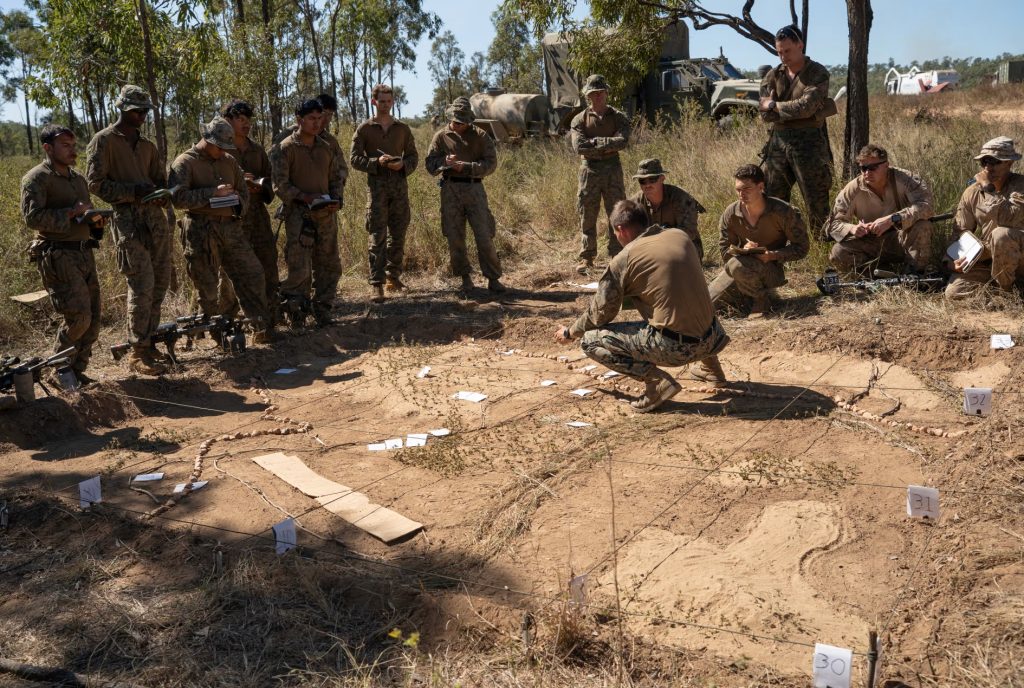
Marines are briefed before a live-fire exercise during Southern Jackaroo. | Photographs by Ioanna Sakellaraki for WSJ
China sent an aircraft carrier group to waters east of Iwo Jima, a remote Japanese island, for the first time in June, prompting alerts from Tokyo . In another foray this year, China conducted naval drills near Australia .
At the same time, Beijing has continued to send its armed forces into the waters and airspace around Taiwan. It has expanded its operations in the disputed South China Sea near the Philippines and is increasing its activities in the Yellow Sea , a strategic area between mainland China and the Korean Peninsula.
“The Chinese are stretching their legs,” said Kelly Magsamen, who was chief of staff to U.S. Defense Secretary Lloyd Austin in the Biden administration. “Their military modernization has been at a pace that is pretty astounding. And then once you create a military, you start using your military, and you start pushing further and farther afield.”
Beijing has accused the U.S. and its allies of spreading false accusations about the threat from China, and it has denounced the drills as provocations that disrupt peace and stability.
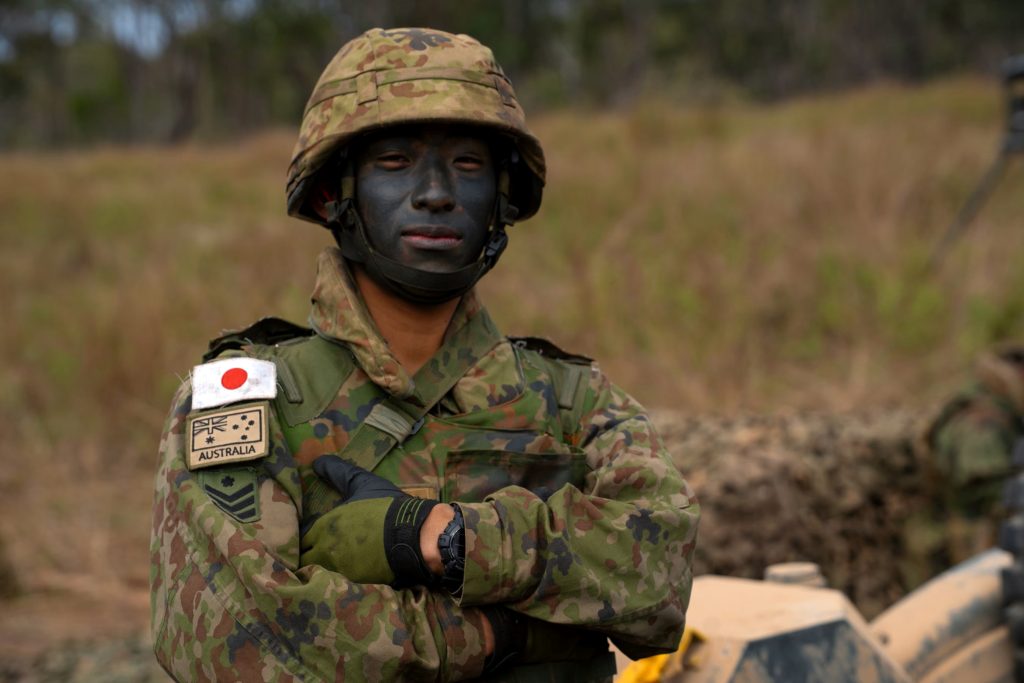
Australia and Japan have emerged as essential U.S. partners in the Pacific. | Photographs by Ioanna Sakellaraki for WSJ
Training is picking up all over the region. In one recent exercise, U.S. tilt-rotor Osprey aircraft carried Marines and Philippine troops to beaches and a nearby airfield where they practiced repelling an adversary. In another, F-35 jet fighters from the U.S., Japan and Australia trained together for the first time in Guam, a U.S. island territory with an expanding military role .
About 3,000 troops took part in this year’s Southern Jackaroo, the most since the exercise started in 2013.
Australia and Japan are longtime U.S. allies that host American troops and have militaries that can complement U.S. forces with missiles, surveillance assets and logistical support. They rely on the region’s waterways for trade, so maintaining stability and access is crucial. A paper published by Australia’s defense department in 2015 said that 54% of the country’s trade passed through the South China Sea on its way to northeast Asia.
“There’s such a commonality between our three countries,” said Scott Morrison, the former Australian prime minister who ramped up military cooperation with Japan and the U.S. during his 2018-22 tenure. “When it comes to the things that really matter, it goes pretty deep.”
In Australia, the U.S. is investing in air bases in the north. Marines are stationed in Darwin for part of the year and U.S. submarines are slated to begin rotations through a naval base in Western Australia in 2027.
In Japan, which permanently hosts tens of thousands of American troops, the U.S. is establishing a so-called joint force headquarters, which will have more operational responsibility and work more closely with its Japanese counterparts. An island-fighting regiment of Marines was recently formed in Okinawa and Tokyo is planning to deploy new Japanese missiles.
There are points of friction among the three nations. The Trump administration is pressuring allies to lift military spending, arguing the U.S. has shouldered an unfair share of the cost of keeping them safe. It also hasn’t spared America’s traditional friends from new tariffs.
Last month, the Pentagon began a review of the $240 billion plan that involves selling nuclear-powered submarines to Australia. Officials in Washington say they want to ensure that the U.S. builds enough submarines for itself.
Then there are the challenges of learning to work together, as troops taking part in the exercise discovered.
In one drill, the Marines used Ospreys to act as an air assault element—much as they would when island-hopping in a conflict in the Pacific—while troops from the three countries seized and cleared terrain.
The language barrier was the most obvious obstacle, with Japanese troops relying on a small number of English-speaking interpreters. The Marines, who don’t bring personal devices with translation apps to most field training because of security concerns, said using visual aids such as maps made it easier to communicate.
There are also different operating procedures. At the artillery drill, the Japanese were more inclined to use hand-held flags to communicate, while the Australians favored sending commands digitally.
Some officers said the troops would benefit from even more complex scenarios. Capt. Jolie Brakey, a U.S. Marine artillery commander at the exercise, wants to practice more amphibious operations with the Japanese.
“I know we’re good inland,” she said. “But what does it look like embarking on one of their naval vessels? What are those procedures and how do we work those out ahead of time?”
Brig. Ben McLennan, commander of the Australian brigade at the exercise, already knows what he would like next year: armored vehicles fighting together on a maneuver range and infantry fighting in trenches.
Over time, the exercise “has achieved an extraordinary level of integration,” McLennan said. “That’s something to double down on. And that’s what we’re going to be doing.”
Write to Mike Cherney at mike.cherney@wsj.com