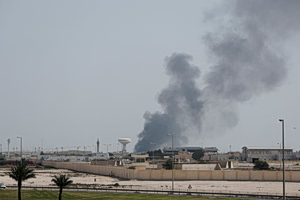
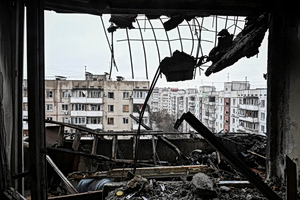
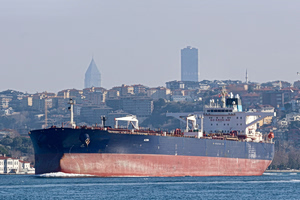
Video clips released by Iranian-backed Iraqi militias this week looked eerily familiar to anyone who has followed the war in Ukraine.
Drones piloted by fiber-optic wires that render jamming useless cruised above an American base in Baghdad. Then, the first-person-view drones, also known as FPVs, dived to strike their targets: an American Black Hawk helicopter on the ground and an air-defense radar system.
It is a new way of war, and it has come to the Middle East.
President Trump has dispatched thousands of U.S. troops to the region. Should his latest diplomatic outreach falter, he is considering ground and naval operations to reopen the Strait of Hormuz and compel Iran to a cease-fire. If these Marines and soldiers come ashore in Iran, they would face a drone-dominated environment that has little in common with past U.S. campaigns in Iraq and Afghanistan, where the main threat came from small-arms fire and buried, improvised explosive devices.
“Any U.S. boots on the ground or warships in the Gulf will be ‘close in’ targets, and FPV drone use will be part of both sides’ capabilities,” said Martin Sampson , a retired Royal Air Force air marshal, a rank equivalent to a three-star general. He heads the Middle East branch of the International Institute for Strategic Studies, a think tank.
Other than jammers, U.S. forces heading to the region don’t seem to possess antidrone equipment on their vehicles or landing craft, which has become commonplace in Ukraine, Sampson said. “Iran has to have anticipated this weakness and gained understanding from Russia on what this means and how it can be exploited,” he added.
The Pentagon declined to comment on the matter and referred questions to the Central Command, which oversees U.S. military operations in the region. A Central Command spokesperson declined to comment on how Iran was adopting lessons from the war in Ukraine .
FPV drones aren’t the only technology that has transformed the way wars are fought. Ukraine, whose conventional navy, like Iran’s, has been largely destroyed, has used naval drones to target Russian warships, decimating the Russian Black Sea Fleet. Kyiv has since ensured that the western part of the Black Sea, including the shipping lanes to its main port, Odesa, has become a no-go zone for the Russian Navy.
Iran’s naval drones don’t seem to be as sophisticated as Ukraine’s, according to military experts, and they lack such features as Starlink-enabled navigation. Yet, in a narrow waterway like the Strait of Hormuz, they could prove lethal to warships—and tankers.
The FPV drones with a fiber-optic wire that were used this week by Iraqi militias in Baghdad—and are possessed in greater numbers by Iran’s Islamic Revolutionary Guard Corps—indicate a worrying development because they can’t be stopped with existing electronic countermeasures.
Russia pioneered the use of these wire-guided drones to devastating effect in its campaign to retake the Ukrainian-controlled part of the Russian region of Kursk in late 2024. It has also upgraded and modernized the long-range Shahed drones that were originally designed by Iran, and has been closely cooperating with Tehran on military technologies, sharing the lessons learned in Europe’s bloodiest war in generations, according to Western and Ukrainian officials.
“Russia and Iran have an alliance, and as allies they are actively collaborating, before and now, exchanging expertise, intelligence and technologies,” said Andriy Zagorodnyuk , a former Ukrainian defense minister who chairs the Center for Defense Strategies, in Kyiv. “As true allies, the Iranians are absorbing the lessons of the war, and will try to absorb more.”
The question is to what extent the U.S. military has changed its doctrine to adapt to a new kind of battlefield that it is likely to face if Trump orders ground operations to seize islands or coastal areas of Iran to ensure freedom of navigation in the Persian Gulf region. “Iran had a good teacher in Russia, and was eager to learn from this war,” said a Russian academic who follows the topic. “I haven’t seen the same willingness in the U.S.”
Snubbing Kyiv’s offer of help, Trump said this month that the U.S. military has no use for the Ukrainian expertise. “We don’t need their help in drone defense,” he told Fox News. “We know more about drones than anybody.”
The U.S. Marine Corps has started experimenting with FPV drones in recent months, training its first FPV teams. These are only baby steps, according to analysts.
“We are still in the early phases writ large in the U.S. military units trying to understand the FPV technology, how it impacts the force, and its implications for the current tactics, techniques and procedures,” said Michael Kofman , a senior fellow at the Carnegie Endowment for International Peace in Washington. “If you look at the defensive capabilities that are available, we have a long way to go to get to where Ukraine is at this stage.”
Senior U.S. and North Atlantic Treaty Organization commanders long discounted the relevance of the drone revolution in Ukraine, arguing that the Western militaries would prosecute a different kind of war because of their ability to suppress the enemy with overwhelming air power and precision strikes.
“There is still this wall of arrogance, including at the top of NATO, because we have much more advanced systems,” said Fabrice Pothier, chief executive of Rasmussen Global, a geopolitical advisory firm, and NATO’s former director of policy planning. “But in fact what you want to do is to be much more Ukrainian. What is happening with Ukraine, and with how Iran is dealing with the air campaign against them, is a wake-up call.”
The U.S. and Israeli air campaign against Iran that began Feb. 28 has so far failed to stop missile and drone barrages against the Persian Gulf states or Israel, or to reopen to free navigation the Strait of Hormuz, through which a fifth of the world’s oil used to pass.
In the war between Russia and Ukraine, FPV drones account for most of the battlefield casualties, with a drone “kill zone” extending more than 20 miles on each side of the line of contact. Many, if not most, of these drones are now piloted with a fiber-optic wire. Some models can spool this wire as far as 30 miles, which is about the breadth of the Strait of Hormuz at its narrowest point.
“The best option developed in Ukraine for countering fiber-optic FPVs is to locate and kill the drone teams before they can launch them,” said Rob Lee, a former Marine Corps infantry officer who is a senior fellow at the Foreign Policy Research Institute and frequently visits the Ukrainian front line.
These drone crews could be suppressed using the U.S. military’s superiority in longer-range weapons and in intelligence, reconnaissance and surveillance systems, said Michael Knights, head of research at Horizon Engage, a strategic-advisory firm in New York. “If we are going to do a Hormuz operation, we are going to have very intense cover over Hormuz. If you have the world’s most capable electronic-warfare military focusing on an area of 30 miles by 30 miles, it is probably a lot more difficult to make effective use of FPV drones.”
Ukrainians aren’t so sure. “No armed forces are prepared for this challenge, not the Americans and not the Europeans,” said Pavlo Klimkin, a former Ukrainian foreign minister. “Not technically, not mentally and not experiencewise.”
Write to Yaroslav Trofimov at yaroslav.trofimov@wsj.com