VAN, Turkey—Hüseyin Aşan, the 32-year-old manager of Queen Festa, a nightclub in this Turkish border town that caters to Iranian tourists, sits drinking a glass of tea on a black-glass table in a room of black mirrors as his customers start to file in around midnight.
Couples arrive, and entire families arrange themselves at tables around a central dance floor. A group of men sits together on a sofa as bartenders place bottles of Chivas Regal in buckets of ice. A DJ takes his position behind the decks and starts playing pounding music—Persian and Turkish songs all blended into one playlist.
“Morale is a bit better now,” Aşan said.
Days into a shaky ceasefire agreement with the U.S., Iranians crossing into Turkey near the mountain town of Van expressed relief at the pause in the conflict, and bewilderment with an unprecedented six months of political violence and war that shook their country.
Just a few months ago, during the height of the American-Israeli bombing campaign, the Kapikoy crossing point in a mountain pass was one of the few ways in or out of Iran for civilians fleeing the bombing or rushing back home to check on relatives trapped in a war zone.
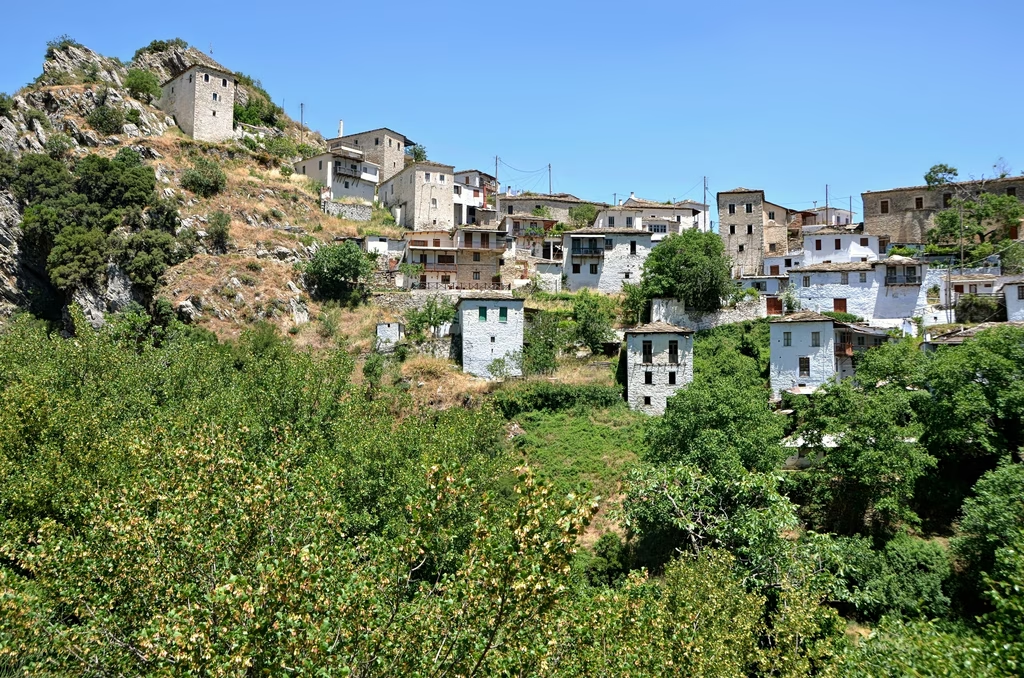
Now, it is beginning to return to something resembling its prewar normal as a gateway for traders taking goods to and from Iran and tourists on their way to the city of Van, a Kurdish-majority town in eastern Anatolia where Iranians shop for brand-name clothes barred by sanctions at home, relax by a nearby lake or party in nightclubs that their government wouldn’t allow.
“We just came from a war, so we’re going to have some fun,” said a 30-year-old social media manager from Tehran who stood in the sun outside the border crossing awaiting a car that would take her and a friend to Van for a week of shopping and clubbing.
Aşan, who was born in Van to a Kurdish family with ties on both sides of the border, said the club is the largest in Turkey serving Iranians. Before the war, it would host about 350 partyers, mainly tourists from Iran. Business dropped by 70% during the war, but it is now coming back, he said.
His club’s DJ called out for requests. The crowd at the tables shouted back: Azeri! Azeri! The DJ put on an Azerbaijani song, playing to the crowd from northwest Iran.
“In Iran there’s no dancing in restaurants,” Aşan said. “There’s something inside of them screaming out to dance.”
Trump signed a preliminary deal last week to wind down the war. While the truce is fragile—the U.S. launched strikes on Iran on Friday after Iran fired on a ship in the Strait of Hormuz—it promises Iranians a chance to exhale after a year of economic disaster, political repression and conflict.
A pathologist from Tabriz was on her way to the Mediterranean resort town of Antalya for a week’s vacation. The trip used to be possible by air, but flights are still recovering from the fighting. “We hope the war is over,” she said. “We don’t know what tomorrow will bring.”
In January, Iranian government forces shot dead thousands of their own citizens to crush antigovernment protests set off by the country’s spiraling economy. Then came months of war in which U.S. and Israeli bombing jolted them from sleep.
One man headed toward the border terminal under harsh sunlight, limping and struggling with two suitcases. The 58-year-old had lived abroad but had returned to Tehran during the war to make sure his elderly mother was safe.
While he was there, a bomb struck his building just one floor up, caving in the ceiling, breaking his arm and injuring his back and leg. Despite his injuries, he said he didn’t blame the U.S. or Israel for the bombing.
“Not like this, not war, but something should have happened. They were killing people,” he said of the regime.
He said he fought in the Iran-Iraq war as a teenage volunteer, and expected the country’s political turmoil to continue. “It’s not over,” he said. “The youths’ blood is boiling.”
The trauma of the regime’s January crackdown and the U.S. and Israeli bombing campaign has deepened Iran’s political divide. Supporters of the Islamic revolutionary regime are triumphant after Iran’s hard-line leaders held out under thousands of airstrikes, shut the strategic Strait of Hormuz and forced Washington to make difficult compromises to secure last week’s deal.
Opponents are bitterly disappointed that the war didn’t topple the regime, one of the aims initially put forward by Trump and Israeli Prime Minister Benjamin Netanyahu when they launched the bombing campaign on Feb. 28. Air war alone has proven ineffective at pushing regimes from power, but American and Israeli aspirations to overthrow Iran’s theocratic leaders gave some Iranians hope nonetheless.
Off to the side of the road leading to the crossing point, Resul Khurbani, a 51-year-old mechanic from the city of Tabriz, sat in a tent with his family waiting for their ride into Van. He said he volunteered to join Iran’s reserve forces during the war.
“Iran won the war. Iran put America’s nose in the dirt. Iran is not Venezuela. It is not Iraq. It is not Afghanistan. It is not Gaza. It’s our land,” he said. “We are very happy that we didn’t let Americans set foot in Iran.”
Another traveler, the manager of a Tehran shoe store, said she was disappointed.
“Trump promised to help the Iranian people, but he didn’t keep his word,” she said. “What is the point of starting a war and then stopping suddenly?”
A 58-year-old fitness instructor and tour guide with a whistle on a lanyard around her neck was making the trip with her first tour group since the beginning of the war in February.
“It was a very difficult year,” she said. “Iranians want freedom like anyone in the world. We want to speak freely. Right now we can’t.”
The ceasefire agreement signed by Trump and Iran’s president ushers in a new era in Iran in which the country’s theocratic regime not only survived but expanded its influence in the Middle East and pushed the U.S. to lift its maritime blockade and roll back sanctions that have been in place for years.
The agreement will bring oil revenues flowing back to the state and with it some relief to Iran’s struggling economy. The war also shifted Iran’s centers of power. Israeli airstrikes killed the country’s longtime supreme leader, Ali Khamenei, and a raft of other top officials, ushering in a new version of the regime that is more heavily dominated by the security elites of the Islamic Revolutionary Guard Corps.
Now, Revolutionary Guard troops and paramilitary Basij enforcers are everywhere in the streets, Iranians at the border said. The regime has relaxed enforcement of the requirement that women cover their hair, but has intensified its clampdown on perceived critics, stepping up executions of political prisoners .
At the train station in Van, couples and families with children arrived in taxis and unloaded their suitcases before boarding the 9 p.m. train that would whisk them overnight to Tehran. Tanned and relatively relaxed from their vacations in Turkey, they spoke fearfully of what they would find upon returning home.
A 27-year-old medical lab technician from the Iranian capital said he was relieved the bombing was over, but had little confidence the ceasefire would hold.
“I don’t know who won the war, but the people lost,” he said.