A former sheriff pushed Kerr County commissioners nearly a decade ago to adopt a more robust flood-warning system, telling government officials how he “spent hours in those helicopters pulling kids out of trees here (in) our summer camps,” according to meeting records.
Then-Sheriff Rusty Hierholzer was a proponent of outdoor sirens, having responded as a deputy to the 1987 floods that killed 10 teenagers at a camp in nearby Kendall County. He made the comments in 2016, after deadly floods ravaged a different part of Texas the year before.
“We were trying to think of, what can we do to make sure that never happens here?” Hierholzer, who served as Kerr County sheriff from 2000 to 2020, recalled in an interview Sunday with The Wall Street Journal. “And that’s why we were looking at everything that we could come up with, whether it be sirens, whether it be any other systems that we could.”
That suggestion, from him and others, was never adopted.

People look at the Guadalupe river, following flash flooding, as they gather after receiving a SMS alerting on potential floods in the area, in Kerrville, Texas, U.S. July 6, 2025. REUTERS/Marco Bello
Officials in Kerr County, where nearly 70 people are dead from floods , and many others are missing, including girls from Camp Mystic, have debated the use of outdoor warning sirens since at least 2016, even as other Texas cities and counties adopted them to sound loud alerts ahead of floods and other natural disasters, according to a review by the Journal. Minutes of their public meetings showed an inability to get state and federal funds has been a delaying factor.
These outdoor-warning sirens have been installed in other flood-prone Texas counties, including Comal and Kendall, which also sit along the Guadalupe River. Sirens went off in the Kendall County community of Comfort when floodwaters approached there after inundating Kerr County early Friday.
In hard-hit Kerr County, where families of the missing wait and hope, many people are asking whether more could have been done to protect people from the devastating floods in Texas Hill Country.
At a March 2016 meeting of the county’s commissioners, the officials debated whether to follow the lead of many other Texas counties by installing sirens to warn people along the Guadalupe River and other low-lying places of impending floodwaters.
Then-Commissioner Tom Moser noted other Texas locations had these “state of the art” flood-warning sirens, but they weren’t used locally, “even though this is probably one of the highest flood-prone regions in the entire state,” according to the meeting minutes.
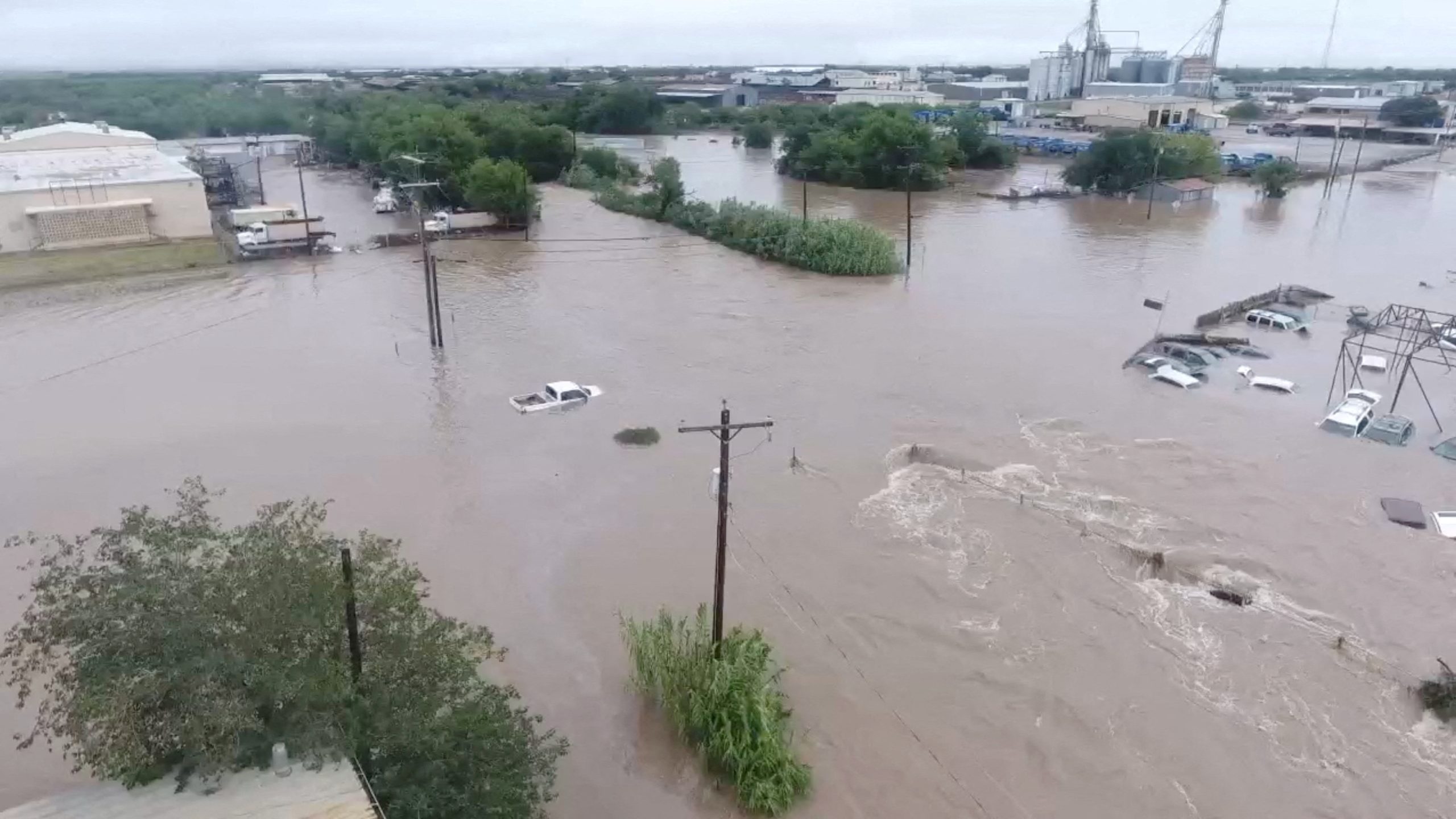
A drone view of vehicles partially submerged in flood water following torrential rains that unleashed flash floods along the Concho River in San Angelo, Texas, U.S., July 4, 2025, in this screen grab obtained from a social media video. Patrick Keely/via REUTERS THIS IMAGE HAS BEEN SUPPLIED BY A THIRD PARTY. MANDATORY CREDIT. NO RESALES. NO ARCHIVES. REFILE – CORRECTING NAME OF RIVER FROM “GUADALUPE” TO “CONCHO” AND MONTH FROM “JUNE” TO “JULY”.
W.B. “Dub” Thomas, then Kerr County’s emergency-management coordinator, said summer camps and RV parks along the river weren’t all connected to a wireless alert system the county had relied on. “I think an audible system located at strategic points along the river would give those folks (the) needed information when they need to know to get out,” he said then.
Hierholzer said at the time that the county needed sirens in addition to its CodeRED system, which sends alerts to the public using prerecorded telephone calls, text messages and email. Some people didn’t get the phone alerts during the 2015 flooding in South-Central Texas, he said. “So yes, you need both,” he told commissioners.
Moser in 2017 again emphasized the need for a better warning system. “The big challenge, I think, the many times that we’ve met on this subject has been how do you get the information to the public…If we don’t get that information to the public in a timely way, then this whole thing is not worth it.”
In 2018, Moser said the county had applied for a $1 million grant for a flood-warning system but didn’t get one. “That application was not selected, OK. That’s the bad news,” he said at a meeting.\
Moser said in an interview Sunday that Kerr County considered picking up the tab itself but didn’t include the cost in the annual budget. “It was probably just, I hate to say the word priorities,” he said. “Trying not to raise taxes.” Officials took other steps, he said, such as adding barriers over low-water crossings and flood gauges.
“We just didn’t implement a sophisticated system that gave an early warning system,” he said. “That’s what was needed, and is needed.”
Meanwhile, a bill introduced earlier this year in the Texas Legislature to create a statewide program to help fund the use of outdoor sirens and other emergency alerts died in committee.
Thomas, who is still county emergency manager, didn’t return a request for comment. Officials of the Texas emergency agency also didn’t respond to a request for comment.
After the recent disaster, a woman whose friends nearly lost their children to floods at Mystic and other camps along the Guadalupe started a petition to get a flood-warning system set up.
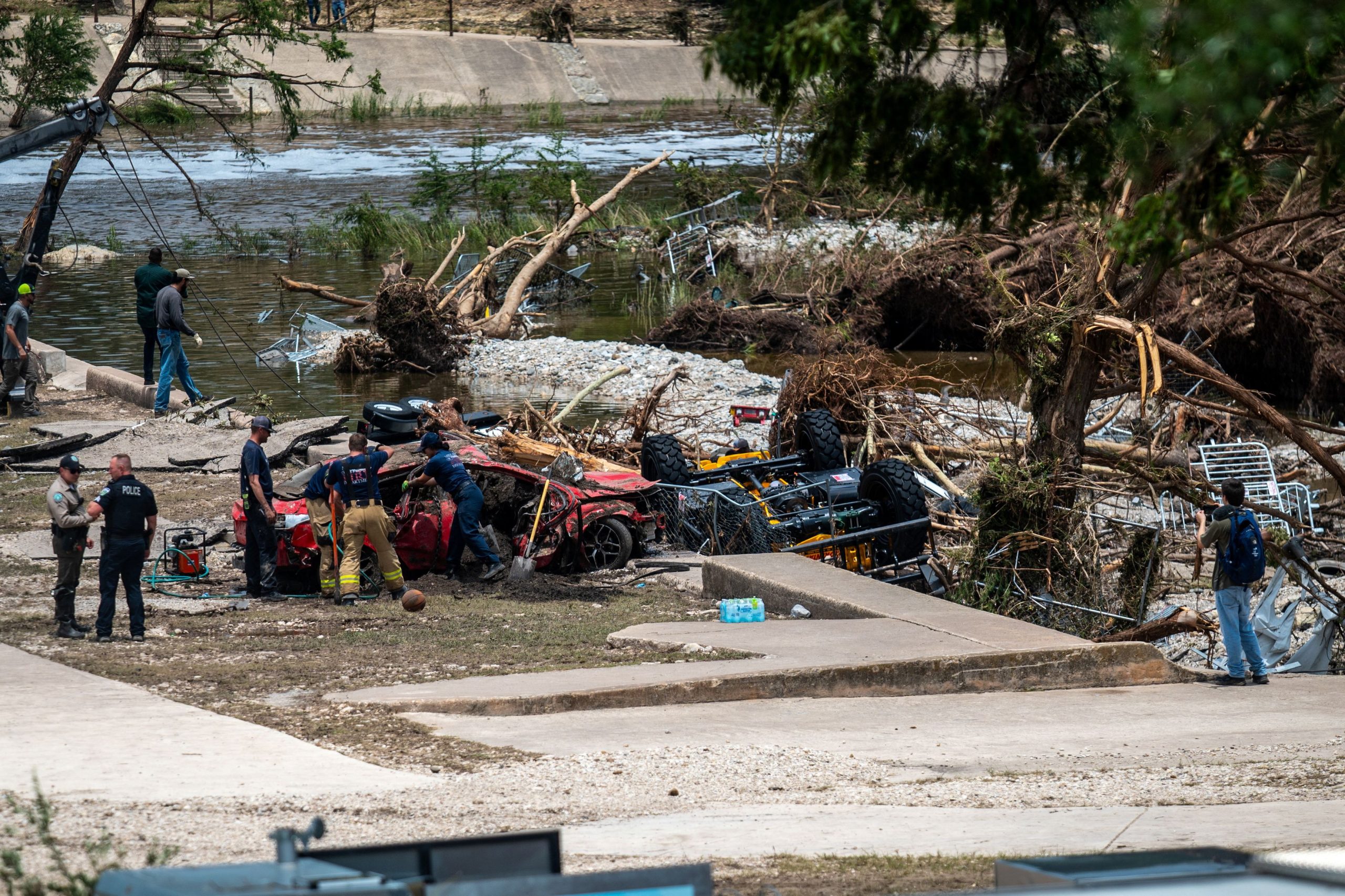
First responders attend to a vehicle pulled from the water in the aftermath of deadly flooding in Kerrville, Texas, U.S., July 6, 2025. REUTERS/Sergio Flores
In a news conference on Saturday, Rep. Chip Roy, (R., Texas) said, “There’s a lot of people saying, ‘why, and how,’ and I understand that, and I understand why parents would be asking those questions.” He also called it a “once-in-a century flood,” and pointed to the “heroic efforts” of camp leaders who saved lives.
Camp Mystic owner Dick Eastland died while trying to drive several girls to safety and the vehicle was swept away by floodwaters, according to people familiar with the matter.
Roy, who typically spends the Fourth of July at a big celebration in Kerrville, said in an interview with the Journal on Sunday that the area’s long experience with floods probably colored the camp’s response to the warnings.
“I think what happened was they went to bed. They knew there were flash flood warnings. There was a lot of rain, but it was generally considered to be in the ‘concerning, pay attention, but we get this in Texas’ range,” he said. “When you start trying to evacuate people, that can get really messy fast. In the past they’ve done that and they had a situation where a bus got swept away. So they’re cautious about how they do that.”
So it appears that a decision was made to ride out the storm, he said. “And then you had a massive rush of water at the worst possible time—a holiday, 4 a.m. to 6 a.m., that moment in time, dark, it’s just brutal.”
Hierholzer said he isn’t second-guessing the emergency response. “I think they’re all doing, and all did, everything they could possibly do,” he said.
Write to Scott Calvert at scott.calvert@wsj.com , John West at john.west@wsj.com , Jim Carlton at Jim.Carlton@wsj.com and Joe Barrett at Joseph.Barrett@wsj.com