MINNEAPOLIS—For months, Jacob Frey , the Minneapolis mayor, felt a growing dread watching the number of federal immigration and Border Patrol agents swell from dozens to hundreds to thousands, all deployed to his city to carry out President Trump ’s promise of the largest deportation of illegal immigrants in American history.
“We’ve seen constant, constant, escalation,” Frey said. “The [police] chief and I were both publicly and privately expressing deep concern of the possibility, even likelihood, that somebody was going to get seriously injured or killed.”
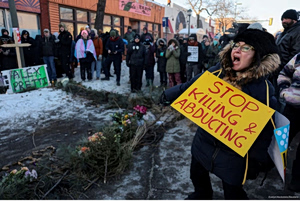
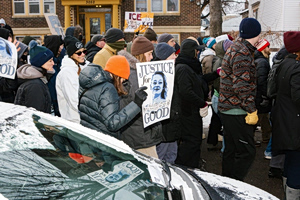
Then Renee Good , a 37-year-old mother, was fatally shot in the head on Jan. 7 by an Immigration and Customs Enforcement agent during one of the many protests erupting in the city against the actions of federal agents. On Saturday, it happened again.
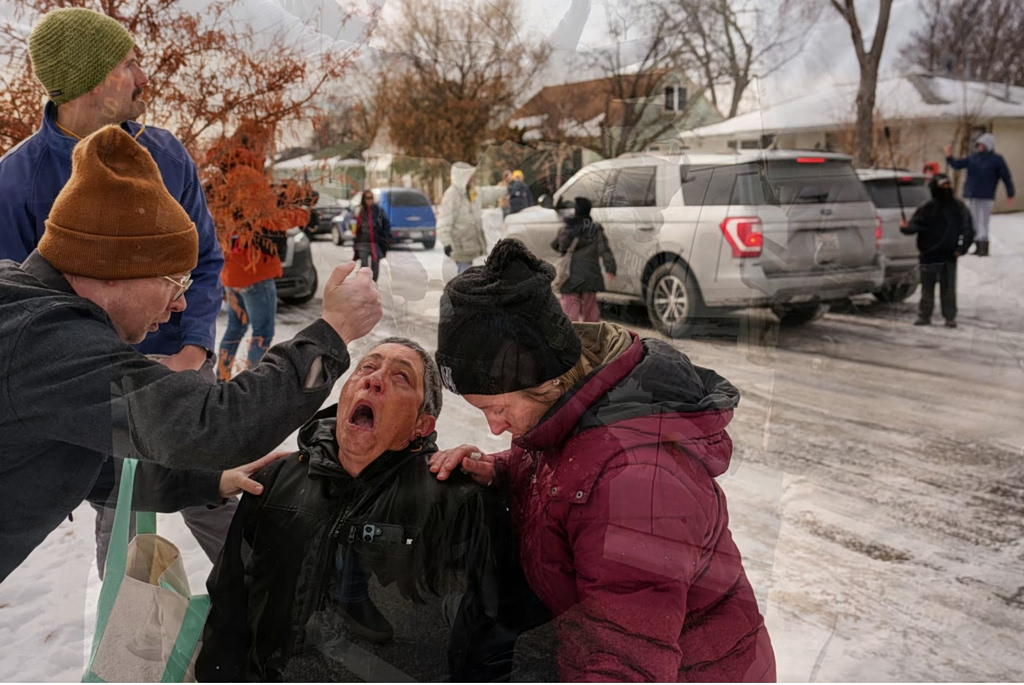
Scenes from Operation Metro Surge in Minneapolis from the past two weeks./ WSJ
Alex Pretti , a 37-year-old nurse at the Minneapolis VA Medical Center, was shot with 10 rounds and killed by a Border Patrol agent after a group of officers wrestled him to the frozen ground in front of a doughnut shop where he died.
Those fatalities, in a span of little more than two weeks, marked a new and alarming phase in a two-month confrontation between the residents of an American city, carrying phones and whistles, and armed officers of the U.S. government. It has yielded jarring images that, to many outside of Minneapolis, seem from a foreign land—unmarked vehicles of masked men prowling city streets, and the martial scowl of Gregory Bovino , the uniformed lead of Operation Metro Surge, tossing a chemical grenade at protesters.
Broadly, the conflict reflects the nation’s split views of immigration policy, an issue that helped carry Trump to the White House a year ago. To many Minneapolis residents, it has become a fight against an occupying army bent on subduing their progressive city.
In both killings, the details are contested, subject to partisan interpretations of shaky amateur videos. Good was said to be in her car either driving at an ICE agent who fired in self-defense, as the Department of Homeland Security contends—or just a woman trying to leave the scene of a lawful protest with her wife. Kristi Noem , the DHS chief, called her a “domestic terrorist.”
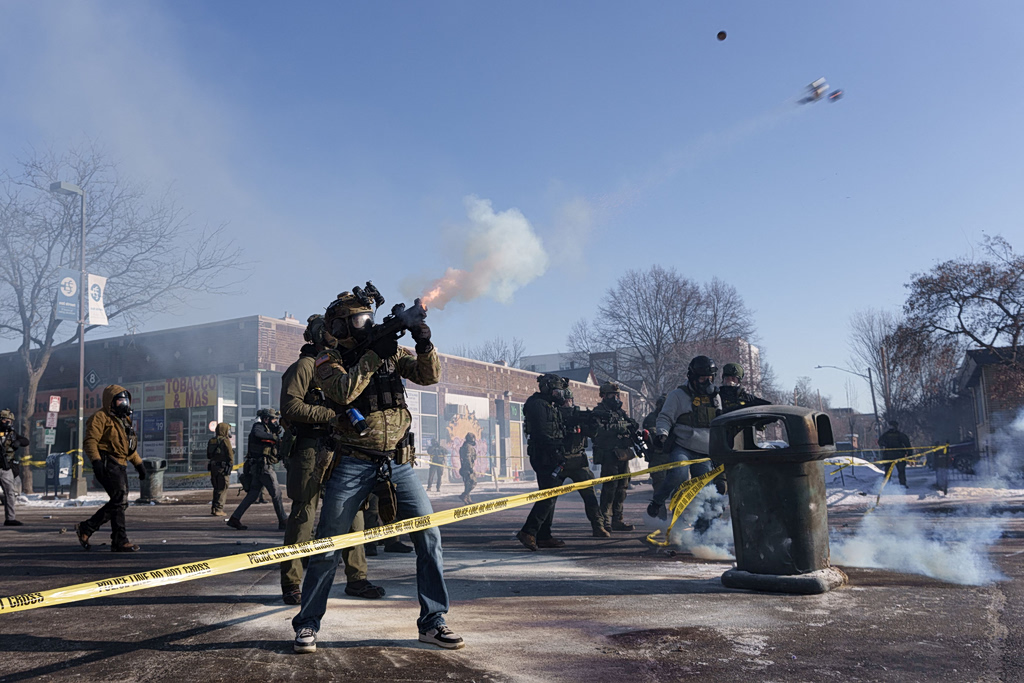
A federal agent fires a munition toward demonstrators near the site where a man identified as Alex Pretti was fatally shot by federal agents trying to detain him, in Minneapolis, Minnesota, U.S., January 24, 2026.REUTERS/Tim Evans
Pretti, who worked in the VA’s intensive care unit, had been carrying a legally permitted 9mm handgun when he was killed. The DHS said he had “violently resisted” disarmament before agents fired “defensive shots.” A video analysis by The Wall Street Journal suggests otherwise.
“Never in a million years would I have thought our federal government would be invading our city in these numbers,” Frey said in an interview the day before Pretti was killed. The 44-year-old mayor, married with two young children, spoke in his third-floor office of Minneapolis’ granite City Hall whose entrance features a statue of native son and liberal champion Hubert Humphrey .
“Never in a million years,” he added, “would I have thought that this kind of conduct would be taking place on our streets. And at the same time, it’s happening.”
Frey, a northern Virginia native, fell in love with Minneapolis while running the 2006 Twin Cities Marathon and moved there after law school. He has tried to walk a tightrope, commending citizens for exercising their right to protest but urging them not to “take the bait” by crossing into violence.
“The Trump administration is looking for any excuse to further deploy troops to Minneapolis,” the mayor said.
‘Uncharted territory’
Operation Metro Surge in Minneapolis has stood out from other ICE and Border Patrol operations for its scale. In Chicago, a city of some 2.7 million people, the Trump administration dispatched a few hundred federal agents this past fall.
In and around Minneapolis, a city of about 430,000 people, the federal government sent about 3,000 agents. DHS called it the largest operation yet.
Images from the operation have spread across social media and news outlets nationwide: A protester being pepper sprayed while on the ground; a 5-year-old boy detained; a legal resident escorted from his house barely dressed on a cold morning.
Leaders at DHS have expressed frustration that the purpose of their mission has become lost and that the public doesn’t care that federal agents are working in what they view as an excessively hostile environment, according to current and former officials familiar with their thinking.
Widely circulated videos of Pretti’s fatal shooting on Saturday have left officials feeling more queasy than after Good’s killing, which most top DHS officials viewed as justified, according to people familiar with the matter. Homeland security Secretary Kristi Noem and Stephen Miller , Trump’s top immigration adviser, immediately defended Pretti’s shooting, but officials below them have called for a full investigation, the people said.
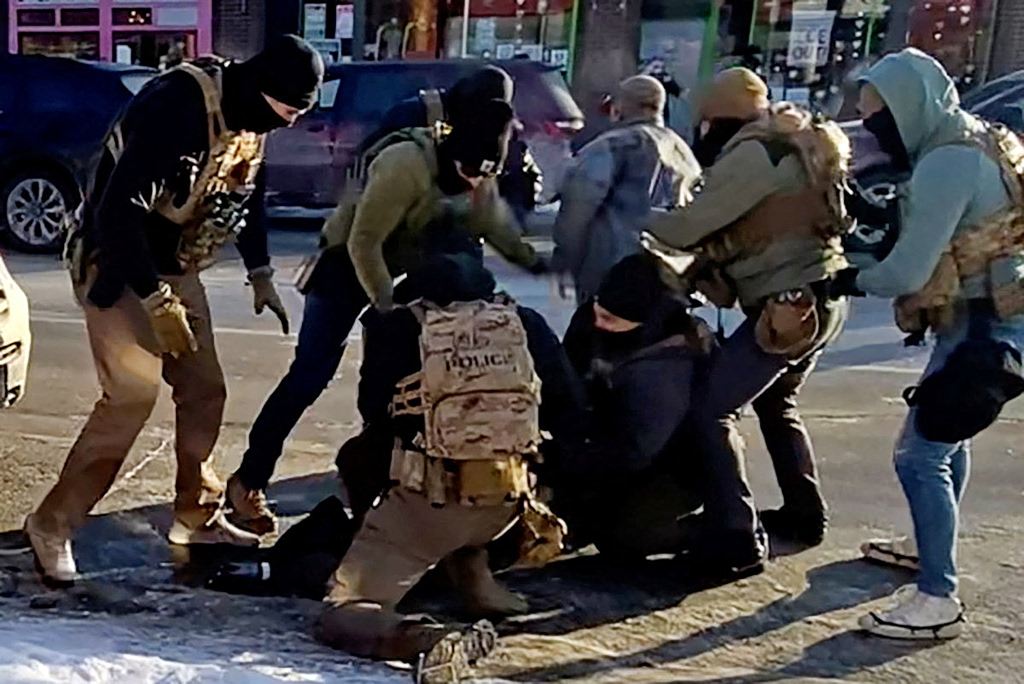
The moment that the first shot is fired, as heard on the video sound file, after an agent (in green) had already drawn his weapon while a man identified as Alex Pretti is being detained by federal officers, and after Pretti’s gun was retrieved from a waistband holster by a federal officer (in light grey jacket) in Minneapolis, Minnesota, U.S., January 24, 2026 is seen in a still image of a video obtained by Reuters.
Inside the White House, the sentiment is mixed, with several of Trump’s political advisers privately expressing the belief that the operation has gone too far, and the administration should be looking for an off-ramp, according to people familiar with the matter. Others say that any retreat from Minneapolis would amount to a capitulation to the left.
Throughout the past year, federal officials have focused immigration enforcement on blue cities one at a time, both to manage resources and maximize media attention. ICE and Border Patrol agents have been sent to the city on four-to-six week deployments, but even before this weekend, officials were discussing where to move operations next.
Some Republicans on Sunday appeared to distance themselves from the administration on the issue. Oklahoma Gov. Kevin Stitt said Trump was getting “bad advice” on immigration. “Americans don’t like what they’re seeing right now,” Stitt told CNN. “Nobody likes feds coming into their state.”
On Thursday, Vice President JD Vance came to Minneapolis on a mission, he said, “to lower the temperature.” At a news conference flanked by Border Patrol and ICE agents, Vance blamed the city and its leadership for inflaming a lawful federal operation. “We’re seeing this level of chaos only in Minneapolis,” the vice president said.
Vance didn’t meet or even speak with Frey or Minnesota Gov. Tim Walz. To the mayor, the snub reflected the White House’s determination to continue what he described as a campaign of “performative, political retribution.” Vance met with Keith Ellison, the state’s attorney general, as well as local business leaders.
In the aftermath of Good’s shooting earlier this month, the Minneapolis police were sidelined by federal officials and largely outnumbered. On Saturday, local police were determined to draw a line, rushing to the scene of Pretti’s shooting to secure evidence of a potential crime, rebuffing demands by federal agents to leave.
In a striking dynamic, city residents are calling police to protect them from federal agents. At 10:51 a.m. on Saturday, the Minneapolis Police Department received a report that “Border Patrol/ICE agents were lining up wearing riot gear and masks.” According to a court filing from the city attorney’s office later that day, “The caller wanted assurance that MPD was on the scene.”
Elected officials urged residents to join patrols, such as Defend the 612, a group named for a local area code. The Minnesota Department of Corrections launched a 24-hour fact-check website intended to counter negative claims about the state by Noem and Attorney General Pam Bondi that later turned out to be inaccurate or incomplete.
“We’re in uncharted territory here,” said Drew Evans, the superintendent of the Minnesota Bureau of Criminal Apprehension, which sued the Trump administration late Saturday to keep them destroying or concealing evidence in the Pretti killing.
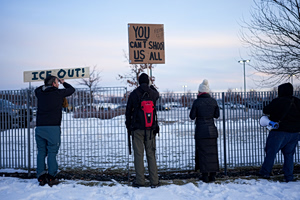
On the streets, loose networks of protesters have jelled into a larger movement to resist the federal agents, using loud whistles to warn of their presence and phones to record their actions. Volunteers give three short whistle blasts if ICE is approaching, and one longer blast when someone is being arrested.
At some schools, volunteers form human chains to try to keep ICE agents away from students and workers entering and leaving. Others deliver groceries to immigrant families to spare them from having to leave their homes.
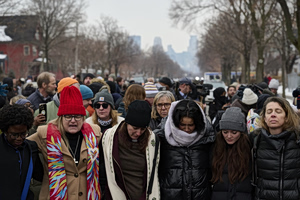
Even residents who aren’t directly in the fray say they feel touched by the crisis. “My favorite restaurant got shut down. They took the cook,” said Melia Derrick, 70, who—along with thousands of others—endured subzero temperatures to attend a protest march in downtown Minneapolis on Friday afternoon. The city was otherwise a ghost town, with many local businesses closed for the day in sympathy.
Derrick’s friend, Pam Jacobson, 69, noted that even in her predominantly-white suburb, Lino Lakes—some 30 miles outside the city—ICE agents had turned up in search of her Hmong neighbor. Now, a few nights a week, Jacobson guards the door at a church where her daughter teaches English classes.
A historic cold snap hasn’t dimmed the protesters’ resolve. On a recent afternoon, with temperatures well below zero and the wind gusting, a young man stood on Portland Avenue, where a makeshift shrine marked the spot where Good was fatally shot. He held aloft a thick strand of silver whistles. Passing cars stopped, one after the next, and rolled down their windows.
“Can I have three?” one woman asked.
“I don’t need one, but thank you for being out here,” another said.
Different times
“I’m ashamed to see this,” said Patrick Magnussen, a 50-year-old financial services executive. He was gazing down at the protesters on Friday afternoon from one of the elevated skyways that link Minneapolis’ office towers.
Magnussen, who said he voted three times for Trump, expressed sympathy for immigration agents trying to do their jobs while hounded by observers with cameras and whistles. “I think they’re putting up with an awful lot,” he said. “You get out of Minneapolis proper, especially the first ring of suburbs, nobody supports this.”
He took a dim view of Frey: “He’s an awful mayor. He got elected because his opponent was worse.”
This isn’t Frey’s first time in the national spotlight—or as a foil for Trump.
After a single term on the city council, the quintessential young-man-in-a-hurry ousted an incumbent mayor in 2017 with a promise to spur economic development in the city center. Frey also promised to protect the city from Trump and his anti-immigration policies.
The mayor was beset by the Covid-19 pandemic and then the mayhem that followed the police killing of George Floyd. HIs performance was uneven as unrest turned into rioting.
A report commissioned by the city would later fault him and the police chief at the time for a bungled emergency response that left residents feeling abandoned. City and state officials pointed fingers at one another over a delay in calling in the National Guard. Trump, meanwhile, seizing on the images of violence and looting as an example of blue-city misgovernance, called Frey “weak.”
Yet Frey distinguished himself to many constituents by holding the line against a left-leaning city council. While Frey might appear progressive to a national audience, in deep-blue Minneapolis, he is regarded as a moderate.
In one crucial moment, the city council voted to defund the police, giving impetus to what would become a national movement. Hundreds of protesters turned up outside Frey’s house, demanding he follow suit. When the young mayor at last emerged, he enraged them by refusing.
“He really defined himself at that point,” said Kathleen O’Brien, 80, a lifelong resident who has served on the city council, among other civic posts. “I believe a lot of folks were very impressed with his courage at a critical time.”
This time is different, Frey said. After Floyd’s murder, Minneapolis was at war with its police department and itself. This time, it faces an outside force. Frey, too, has changed. “I’m not the same mayor as I was back then,” he said. “I’m barely the same person.”
From the outset of Operation Metro Surge, Frey has struck a forceful tone. At a news conference following Good’s shooting, he memorably called the federal government’s explanation “bulls—” and told ICE “to get the f—k out of Minneapolis.”
Some analysts have condemned those comments as inflammatory and unwise. “He’s allowed himself to be positioned as the shrill, far-left, angry Mayor,” said Lawrence Jacobs, a government professor at the University of Minnesota.
Many in Minneapolis, though, welcomed a measure of outrage. “It was crucial that he gave voice to that anger,” said Sarah Stoesz, the former longtime chief executive of Planned Parenthood North and a longtime Frey supporter. It has been difficult for her and other residents trying “to make sense of what our own federal government is doing here in Minneapolis,” she said. “They are lying to us.”
Others aren’t happy with the mayor. “He’s done absolutely nothing,” said Rae Johnson, 26. “It’s all words.”
Even before Pretti’s shooting, and the resulting images and videos that ricocheted across screens all weekend, Frey was hopeful that national opinion was swinging in favor of Minneapolis and against the White House.
“I’m hearing from a ton of people that this is not what they voted for,” Frey said.
With both sides dug in and the battle of Minneapolis now taking on national dimensions, the mayor doesn’t see an obvious path out of the crisis. Some have speculated that the teeth-rattling cold, which reached minus 21 degrees on a recent morning, colder than northern Alaska, might freeze the tempo of operations and bring calm.
But, said Frey, it wouldn’t weaken Minneapolitans’ resolve to defend their city. “We’re not going anywhere,” he said. “We’re prepared. We’ve got warm jackets—and each other.
Write to Joshua Chaffin at joshua.chaffin@wsj.com and Michelle Hackman at michelle.hackman@wsj.com