The chairman of oil producer DNO was flying from New York to Oslo early on Feb. 28 when he told staff to turn off the company’s oil wells in Iraq.
America and Israel had just attacked neighboring Iran. Bijan Mossavar-Rahmani wasn’t taking any chances, having weathered a drone strike on the company’s oil fields in Iraqi Kurdistan last summer. By the time he landed, the pumps had stopped—the first oil shutdown of the war.
To the south, another problem was brewing. An apparent recording of an Iranian naval captain telling ships not to enter the Strait of Hormuz spread through industry WhatsApp groups.
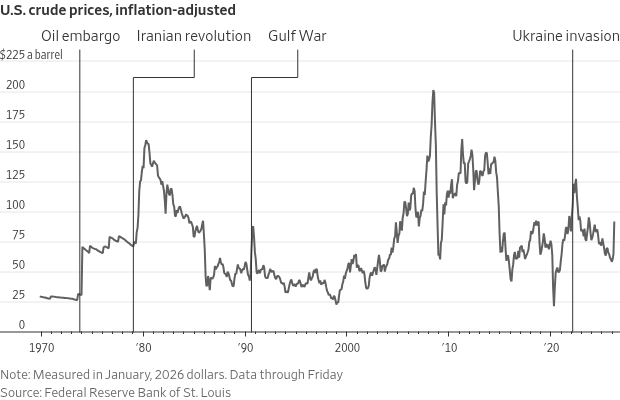
Tanker traffic slowed to a trickle. The doomsday some oil analysts believed could never happen was coming to pass. Unable to ship crude to world markets, much bigger producers in Iraq began to run out of places to put it. The country cut output by more than two-thirds . Tanks in Kuwait were next to fill up . U.S. oil prices vaulted above $100 a barrel Sunday for the first time since the fallout of Russia’s war on Ukraine.
“In the whole written history of the strait, it has never been closed, ever,” said JPMorgan Chase analyst Natasha Kaneva. “To me, it was not just the worst-case scenario. It was an unthinkable scenario.”
On Saturday, the Abu Dhabi National Oil Co. signaled it too was slowing production so tanks didn’t overflow. If the strait is still closed this Friday, daily output in the region could fall by more than four million barrels, Kaneva estimates. The decline could reach around nine million by the end of March, representing almost a 10th of global demand.
One week into President Trump’s war on Iran, the most severe shock to energy markets since the 1970s is cascading through the world economy. The disruption quickly fed into higher gasoline and diesel prices at the pump, and higher mortgage rates and borrowing costs for the U.S. government, endangering Trump’s economic priorities.
To be sure, the U.S. has more shock absorbers this time around. Oil is a far smaller component of gross domestic product than it once was, and the U.S. has become a top energy exporter in its own right.
Appearing Sunday on Fox, U.S. Energy Secretary Chris Wright said that “energy will flow soon” through the Strait of Hormuz. He blamed the rise in prices on “the unknown that this could be some long, you know, drawn-out crisis. But it won’t be.”
But the impact will still reverberate, especially in Europe and Asia. For decades, the U.S. military and its allies have spent billions of dollars ensuring the Strait of Hormuz stays open. Just 21 miles across at its narrowest stretch, and flanked to the northeast by a sworn enemy of the West, the channel between Oman and Iran is a superhighway for about a fifth of global supplies of oil and liquefied natural gas.
Massive amounts of fertilizer sail through these waters, feeding crops on every continent. The few ships that have left the strait since the start of the war were mostly carrying Iranian oil. Traders say crude markets could soar even higher if the strait doesn’t open within days, either with U.S. naval escorts or because shipowners think the danger has receded.
Force majeure
The strait’s closure is spilling through commodity markets. Aluminum prices hit multiyear highs after Middle Eastern smelters declared force majeure—a legal maneuver that means suppliers aren’t liable if they fail to deliver. Norsk Hydro , which is curtailing output in Qatar, said a full restart could take six to 12 months.
“We are looking at what is by far the biggest disruption in world history in terms of daily oil production,” said energy historian Daniel Yergin . “If it goes on for weeks, it will reverberate across the global economy.”
That is exactly what Iran wants, Yergin said. Attacking energy facilities and shipping appears to be a Hail Mary attempt to make the war so painful for the American and allied economies that Trump backs down—as when Russia slashed natural-gas supplies in a failed bid to splinter Ukraine’s backers in 2022.
Analysts fear that even a weakened Iran could keep the strait closed with missile and drones, similar to the tactics its Yemeni allies, the Houthis, employed in the Red Sea in recent years.
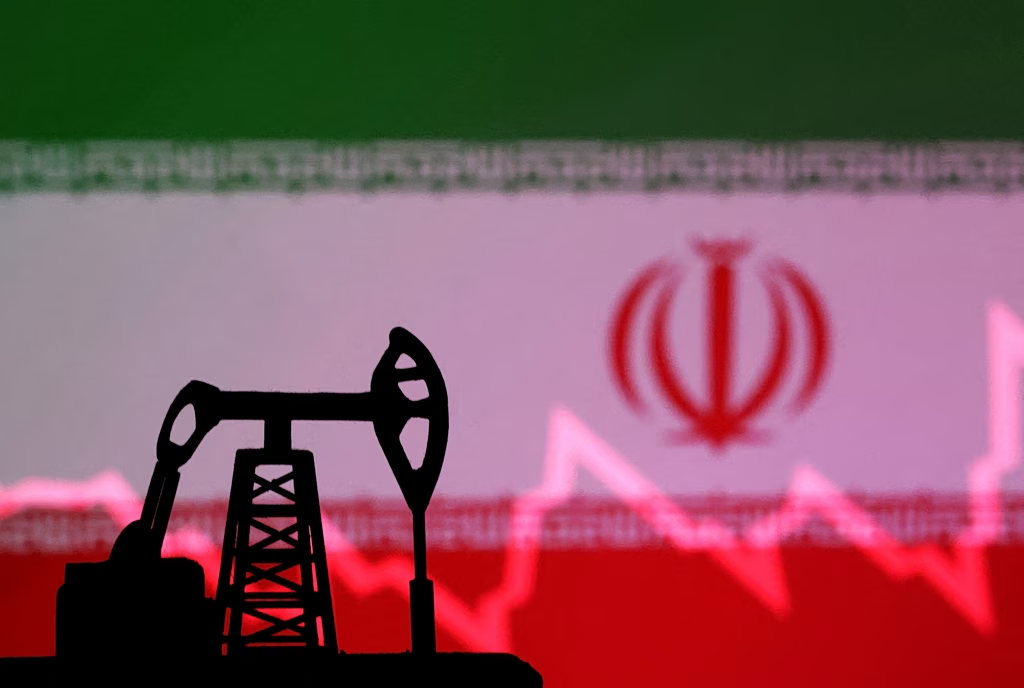
U.S. crude futures shot up 36% last week, their biggest surge since the market began in 1983. After Trump’s call on Friday for Iran’s unconditional surrender squashed hope on Wall Street that he might reach a speedy peace deal, prices rose more than they have on a single day since rebounding from the pandemic crash in 2020. They rose another 20% after markets opened on Sunday evening.
The strait isn’t officially closed or physically blocked, and a small number of vessels have traversed it, some carrying Iranian crude. Still, on Sunday, more than 1,000 ships were waiting to pass through, their owners and sailors scared of being attacked after strikes on at least nine vessels that left one crew member dead.
Traders fear that both sides will ramp up targeting of energy infrastructure. Saudi Arabia intercepted a drone heading toward an oil field on Saturday, likely from Iran, officials said. Israel said it struck several fuel-storage complexes in Iran over the weekend, lighting up the sky in Tehran.
The world economy has been knocked off course by Middle East oil turmoil repeatedly over the years. The mother of all shocks—the oil embargo by Arab producers in response to Nixon’s support for Israel in the 1973 Yom Kippur War—has no comparison, said Rystad Energy analyst Jorge León. Within three months, oil prices quadrupled, rocking the global economy and shaping U.S. energy and foreign policy for decades.
Iran was at the center of another crisis five years later when the country’s crude output plunged after the Islamic revolution began. Crude prices more than doubled, contributing to recessions in the U.S. and arguably spelling the end of Jimmy Carter’s presidency.
The U.S. led a naval convoy to protect ships going through the Gulf in 1987, when the Iran-Iraq war imperiled oil flows.
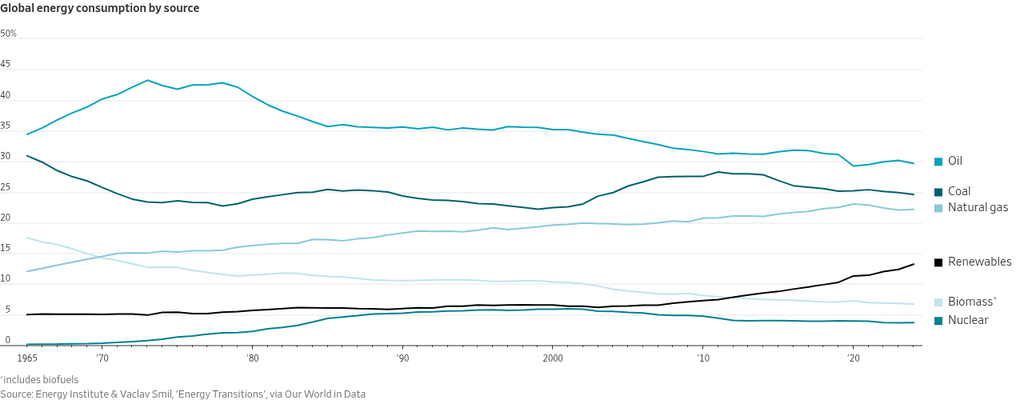
The region and the world have tried to insulate themselves from further shocks. Decades of automotive efficiency gains, America’s conversion from oil importer to exporter and the advent of renewables have fortified the world economy against sudden drops in Gulf supplies.
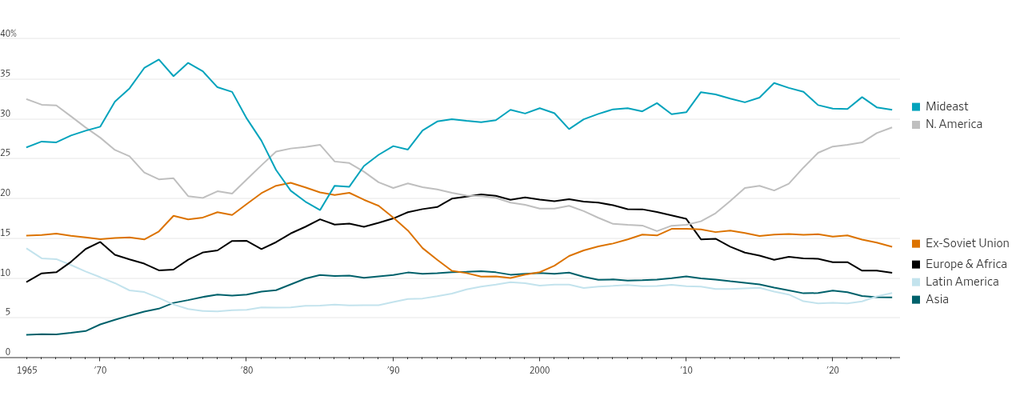
The Middle East pumps roughly a third of global production, about the same as in the early 1970s. But crude markets are more flexible these days, with fewer long-term contracts and traders better able to push cargoes to buyers who need them most.
China has an enormous stockpile—enough to cover 200 days of imports—if crude prices surge toward record highs of $150 a barrel, as some on Wall Street forecast. Saudi Arabia built a pipeline to its western coast, which it has activated to divert some sales via the Red Sea.
But elsewhere in Asia, which imports around 80% of the petroleum that sails through the Gulf, many countries are more immediately vulnerable. In recent days, Myanmar’s junta launched a rationing system for cars, while Thailand suspended some fuel exports. The Philippines told government offices to turn off computers at lunch and set air conditioning no lower than 75 degrees Fahrenheit.
In the weeks before the latest attacks, a certain degree of complacency had taken hold in global oil markets. Gulf oil producers were reassured by U.S. officials that retaliatory attacks on their soil, if they were to happen, would likely be limited to U.S. bases, according to Arab Gulf officials. Iran wouldn’t go after their energy infrastructure or attempt to close the Strait of Hormuz, they were told. After all, the chokepoint had remained open during last June’s Israeli-U.S. 12-day bombing of Iran.
The Gulf states nevertheless began to prepare. Saudi Arabia increased security on its Red Sea pipeline and the United Arab Emirates did the same on a pipeline that bypasses Hormuz to Fujairah, a port on the Gulf of Oman, the officials said. Kuwait boosted production to get more oil into the market while it could.
When Israel and the U.S. launched their attacks, officials were initially sanguine that it would play out as previous conflicts had. Several shared memes of Mr. Bean giving the middle finger, likening Iranian retaliatory attacks on the Gulf to the bumbling comedic character.
At a meeting of the Organization of the Petroleum Exporting Countries on the Sunday after the attacks started, officials agreed to increase output, but didn’t talk much about Iran.
“We surely didn’t think Iran would actually go after the entire Gulf and throw our ties with it out of the window,” said a senior Saudi official.
The mood changed as it became clear the strait would be a no-go zone for merchant ships.
In Kuwait, the oil-rich monarchy whose industry was all but destroyed when Iraq invaded in 1990, officials suddenly had the problem of what to do with all their oil. With most of Kuwait’s production close to export facilities on the coast, the emirate never bothered to invest much in storage, officials said.
Without enough storage, producers need to turn off wells, a process known in the industry as “shutting in.” Unlike a kitchen faucet, an oil tap isn’t easy to turn back on.
After decades of production, wells in Saudi Arabia and Kuwait have become more vulnerable to losing pressure, even those that are close to the surface. Some wells that are shut in never regain their original flow. The Saudi Red Sea pipeline, meanwhile, can’t handle all the kingdom’s output, or that of its neighbors.
Natural gas hit
One way this crisis is different from the past: Qatar’s emergence as a giant exporter of supercooled natural gas. Over the past 20 years, European and Asian economies have pivoted away from oil and coal to the cleaner-burning fuel.
But doing so has fostered another dependence that is being brutally exposed by Doha’s decision to halt output after Iran fired drones at its Ras Laffan gas complex.
Shutting the jungle of pipes and towering flare stacks dominating the desert shoreline took a fifth of supercooled gas supplies from the world market at a stroke. At the end of a cold winter that drained storage caverns, gas prices rocketed in Europe. They rose even higher in Qatar’s main export market, Asia.
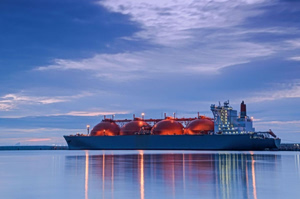
With Qatari gas off limits, a bidding war for cargoes from elsewhere broke out on the high seas. Clean Mistral, an LNG tanker, was cruising toward Spain from the U.S. midweek when it made a 90-degree turn to head toward of Asia. As traders who handle export logistics spotted the chance to profit in the more lucrative market, several tankers made similar pivots, according to ship-tracking data.
There are ways for the global economy to adjust. Qatar’s biggest customer, China, can burn more coal if gas prices get too high, S&P Global analyst Ross Wyeno said.
South Korea, another large buyer, built up a storage buffer over the winter—though its semiconductor industry could take a hit from a sudden shortage of helium, a natural gas byproduct.
Taiwan, India, Pakistan and Bangladesh are more exposed, said Wyeno. He expects demand to fall in all four countries as well as bids to attract cargoes heading to Europe, though exorbitant prices will put some buyers off. Pakistani energy bills could soar under the terms of recent International Monetary Fund loans.
Qatari production won’t recover straight away if the strait reopens. A liquefaction train, which cools the gas, is like a giant refrigerator, but unlike an unplugged fridge at home, restoring it could take weeks.
In India, gas-intensive companies such as fertilizer producers might be forced to throttle back production, which could imperil crop yields in a country that still suffers from malnutrition. The government ordered oil refiners to make as much cooking fuel as possible after a plunge in imports from the Middle East.
U.S. impact
The U.S. is somewhat insulated thanks to ample supplies of domestically produced energy . But oil markets are global, and prices at the pump are expected to keep rising, acting as a tax on consumers.
Airline executives have warned a leap in jet-fuel prices—which hit a record in Europe and shot up in the U.S., too—would harm quarterly results and push up fares.
There have been other knock-on effects. The Trump administration’s efforts to reduce the impact of the Gulf closure risk undermining another recent push: to isolate Russia’s oil industry over the Ukraine war. The Treasury Department eased sanctions on Moscow’s crude to give India an alternative to oil stuck in the Gulf.
Write to Joe Wallace at joe.wallace@wsj.com , Summer Said at summer.said@wsj.com , Rebecca Feng at rebecca.feng@wsj.com and Georgi Kantchev at georgi.kantchev@wsj.com