After a group of thieves brazenly broke into Paris’s Louvre Museum and snatched eight pieces of jewelry that form part of France’s crown jewels, the chase is on to find them before they filter into the black market.
The fear: that these historic artifacts could be dismantled and sold for parts.
“Everybody in the business is talking about this right now,” said Robert Wittman, a former art-crime investigator with the Federal Bureau of Investigation who runs his own art-recovery practice. By everybody, he means both jewelry thieves and the private investigating firms who make a living hunting them down.
The clandestine global network for stolen art, including jewels, trades billions of dollars’ worth of illicit pieces a year, according to the FBI, stretching from diamond-cutting shops in Dubai and Delhi to jewelers in New York, Antwerp and Tel Aviv. The U.S. alone logs more than $1.2 billion in jewelry thefts a year.
If there is no reward or chance for a quick ransom, private investigators say the thieves will likely seek to smuggle the Louvre’s stolen gems to black-market jewelers willing to re-cut and reshape the bigger jewels into smaller, untraceable ones that can be resold anywhere.

Unlike Picasso paintings or Rolex watches, stolen gems can be broken out of their jewelry settings and their gold settings can be melted down because such commodities retain value as precious metals and gems. They won’t fetch as much without the luster of their Napoleonic ties, but they’ll still be evaluated on their natural qualities as gemstones.
Sunday’s theft follows a rash of gold-related thefts across Europe over the past couple of years, a spree jewelers link to the climbing price of gold on the commodities markets. Tobias Kormind, managing director of online jeweler 77 Diamonds, said the temptation for thieves to steal anything gold or glittery from museums has grown now that gold can be resold for over $4,000 an ounce, up 60% in the past year alone.
It is unclear whether this heist was the work of organized criminals. Nearly 40% of jewelry thefts in the U.S. are snatch-and-grab jobs by organized crime outfits, according to the National Retail Federation. Some theft rings are more sophisticated than others, with thieves donning weapons, wigs or prosthetic disguises. The most infamous jewelry-theft gang with Balkan ties is known as the Pink Panthers, an outfit cited across Europe and Asia for dozens of jewel thefts worth hundreds of millions of dollars over the past couple of decades.
But the Pink Panthers rarely leave behind any evidence, Wittman said, whereas the Louvre incident saw several missteps.
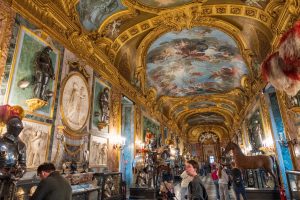
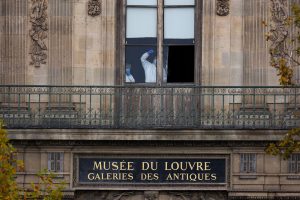
The team of four burglars at the Louvre parked a truck-mounted furniture lift on the street outside the Louvre Palace on Sunday morning and used its ladder to climb a window and break directly into one of the museum’s upper galleries, speeding away on scooters with the historic jewels in under seven minutes. But the thieves also left behind the furniture lift and the angle grinders they used to cut through the window and the display cases. They also left behind an element of their disguise—a yellow construction vest.
Most significantly, they dropped the 1855 crown of Empress Eugénie, Napoleon III’s wife, with nearly 1,400 diamonds and 56 emeralds. It was found damaged on the street outside the museum, officials said.

“Whoever did this is audacious, but amateurish,” Wittman said.
Anthony Roman, a private investigator with art-crime experience, said he was surprised the crown was left behind, given its historic and market value. “If the thieves are going to drop a crown, they’re not pros,” he said.
The fact that the gems that were stolen had been fashioned into jewelry in the 1800s might have played a role in their appeal to the thieves. Newer and lab-grown gems are often embedded or scored with microscopic serial numbers, but older jewels lack such markers, said Chris Marinello, founder of Art Recovery International, a global art-recovery firm. But whatever their era, jewels appeal to thieves because they are easy to hide and move.
“Who wants to get caught with a Picasso hiding under their bed when they can melt down the gold and break the jewels out of their settings and just sew them into a jacket and fly to a dodgy jeweler?” Marinello said.
It is unclear how pure the gold is on the jewelry settings among the Louvre pieces—sometimes historic pieces are less pure than today’s jewelry. Among the stolen pieces was a large, diamond-encrusted bow brooch that belonged to the same empress.

The fact that the Louvre pieces also contain myriad smaller diamonds may have also made them desirable targets, as they won’t need to be whittled or reshaped in order to be offered for resale. Bigger gems might contain more inclusions, or small, internal flaws that can serve to identify them.
“The bigger the stones are, the more difficult it is to get rid of them,” Kormind said.
Ironically, the thieves are unlikely to profit much from their stolen haul. Roman said thieves rarely get more than 10% of a gem’s market value for their illicit goods, in part because they have to share their cut with others who know about the crime to protect their confidentiality.
On the other hand, thieves could earn more hawking stolen jewels on the black market than they might with stolen paintings, given that looted or missing artworks tend to get logged into global databases like the Art Loss Register. Nothing equivalent exists for historic, stolen jewelry. Punishments and prison sentences for jewel thieves also tend to be minimal compared with more violent crimes.
Marinello said that could change if countries stiffened the penalties for stealing cultural heritage by calling it cultural terrorism. Museums also need to do more to protect what they display and store, and the ways they potentially screen visitors, he said. Marinello said the placement of the furniture lift outside the Louvre suggested that the thieves had cased the space ahead of time. He thinks museums could require visitors to show photo identification as they enter, just as airports and many commercial office buildings do.
Of course, if the Louvre started asking tourists to show their IDs before they could get in the door, “they’d have lines around the block all day long,” Wittman said.
But on Monday, there were no lines to be seen. Because of the theft, the museum remained closed.
Write to Kelly Crow at kelly.crow@wsj.com