DAVOS, Switzerland—The West avoided an open rupture this week. But, instead of celebrating, European leaders are bracing for more serious shocks to the trans-Atlantic relationship in the months ahead.
“We are not yet out of the woods,” Latvia’s President Edgars Rinkēvičs said in an interview in Davos on Thursday, after President Trump U-turned on threats of military action and punitive tariffs to seize Greenland from Denmark. “Are we in an irreversible rift? No. But there is a clear and present danger. If we want to preserve the alliance, both sides need to be very, very careful.”
The crisis over Greenland, though defused through a compromise negotiated by North Atlantic Treaty Organization Secretary-General Mark Rutte , already has many European leaders worrying about long-term damage.
“We are in a much better place today than we were at the beginning of this week,” Norwegian Foreign Minister Espen Barth Eide said in an interview Thursday. “But of course, the very fact that we are relieved that a NATO country is not going to attack another NATO country tells us that we are somewhere where we never thought we would be. And that, in itself, will linger.”
Trump’s approach to Greenland has also prompted leaders in Europe and Canada to focus more on reducing their countries’ economic, technological and military dependence on the U.S., the kind of derisking previously reserved for China and Russia. Some European officials have started seriously worrying about the exposure of their economies to U.S. software, payment systems and communications platforms that could be switched off or disrupted in case of an escalating conflict.
“Trump drove Europeans for the first time to genuinely focus on alternatives to America and derisking,” said Philip Gordon , national-security adviser to former Vice President Kamala Harris and a scholar at the Brookings Institution. “We can’t just go back to where we were pre-Greenland threats.”
The Trump administration has repeatedly criticized its European allies since coming to power a year ago. Administration officials have painted European leaders as out of touch with their voters, while promoting far-right and nationalist opposition parties in Germany, France and other countries.
Vice President JD Vance’s speech in Munich last February focused on how the U.S. no longer shares values with Europe’s leaders. The U.S. National Security Strategy, signed by Trump in November, set “cultivating resistance to Europe’s current trajectory within European nations” as America’s policy priority, and Trump dedicated part of his Davos speech this week to blasting what he sees as Europe’s civilizational decline.
While Europeans had sought to appeal to Trump—in part because of concerns about the future of Ukraine—the key takeaway from the Greenland crisis for many European leaders is that playing hardball with the U.S. president can work.
“The conclusion is that, when Europe reacts in a united way, using the tools at its disposal when it is under threat, it can force others to respect it,” French President Emmanuel Macron said Thursday.
Already last February, soon after Vance’s Munich speech , an abrupt cutoff in U.S. intelligence sharing with Ukraine jolted many European nations. For the first time, many of them started to weigh whether they should rely on American-made technology that could be weaponized to achieve political goals.
This month’s Greenland crisis, which involved several European nations sending a small number of troops to the island, significantly reinforced the conviction that continuing dependence on American technology and weapons could represent a security vulnerability for Europe. That conviction will remain even if Trump no longer questions Greenland’s status, some European officials say.
“We need to be prepared for scenarios that some might think are unthinkable,” Dutch Defense Minister Ruben Brekelmans said in an interview. “There are fewer pressure points on us if you are able to do it yourself.”
These efforts should include developing a European alternative to the U.S. nuclear umbrella, said Roderich Kiesewetter , a lawmaker from Germany’s CDU ruling party. “A trans-Atlantic alliance cannot be built upon surprises. With Trump, we cannot calculate, and we cannot rely on the U.S. Full stop. And we must be aware that he will come up with other surprises.”
Such thinking among allies represents a problem for American leadership, said John Herbst, a former U.S. ambassador to Ukraine and senior director at the Atlantic Council’s Eurasia Center. “This has not been a good week for American diplomacy,” he said. “We are seen as less than stable, and a leader doesn’t want to be seen in that fashion.”

The White House has described Trump’s Davos trip as a resounding success, and Trump ally Steve Bannon praised the president’s address as “the greatest speech since Pericles in Athens.”
Bannon wasn’t alone in reaching for references to ancient Greece. Canadian Prime Minister Mark Carney referenced Thucydides’s concept of raw power in international relations—“the strong do what they can, and the weak suffer what they must”—a lawless world that many in Davos view as the essence of Trump’s doctrine.
“This aphorism of Thucydides is presented as inevitable—the natural logic of international relations reasserting itself. And faced with this logic, there is a strong tendency for countries to go along to get along. To accommodate. To avoid trouble. To hope that compliance will buy safety. It won’t,” Carney said in his speech that has become the talk of the town.
Serbia’s President Aleksandar Vučić , who is also attending Davos, didn’t hide his pessimism about the months ahead as the international order continues to fall apart. Relations between Europe and the U.S. won’t get any better, he cautioned.
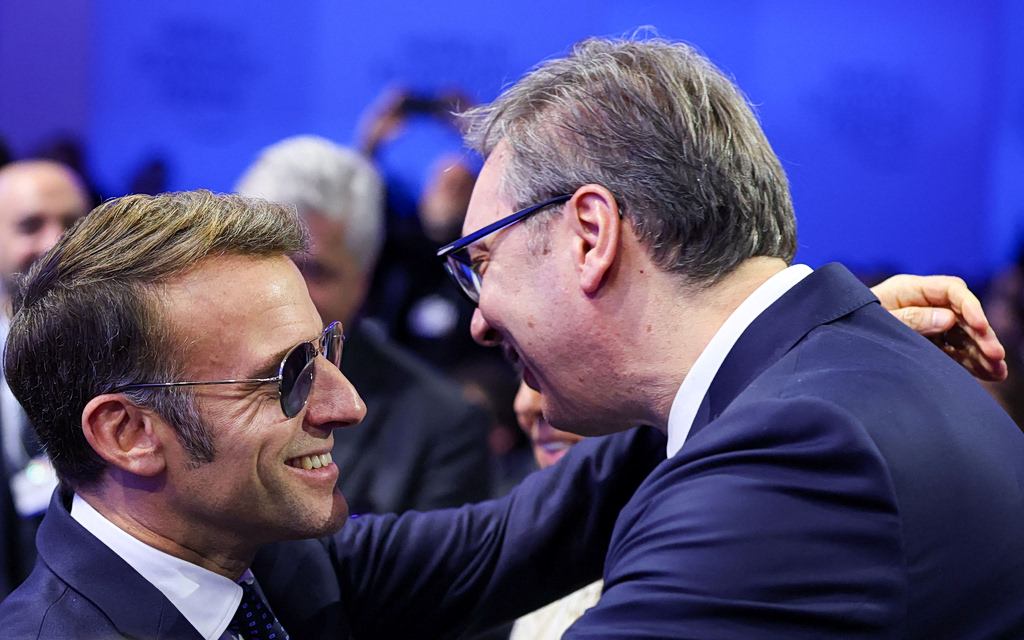
France’s President Emmanuel Macron and Serbia’s President Aleksandar Vucic meet at the 56th annual World Economic Forum (WEF) meeting in Davos, Switzerland, January 20, 2026. REUTERS/Denis Balibouse
“That rift will stay for a long period of time. Trump didn’t impose any new tariffs against Europeans, and they were happy, and he was happy because the market soared. But as a matter of fact this will happen again, but it will be deeper and more problematic, and everyone will have to take care of their own interests,” Vučić said in an interview Thursday. “Differences are deep.”
He noted that the conference in Davos, which assembled business and political elites, was notable by how fearful the participants were to speak out, a tinderbox. “This year, it was in a way the most hectic atmosphere, but at the same time people were very silent, not open at all, not discussing the real issues, trying to stay in the safe zone, not offend anyone,” he said. “Now, all of us, we look like zombies looking around and thinking what will happen tomorrow. Nobody feels secure in today’s world.”
Write to Yaroslav Trofimov at yaroslav.trofimov@wsj.com