US President Donald Trump said “Iran’s new regime president” had just asked the U.S. for a cease-fire, in a post on his Truth Social network. Iran has a new supreme leader but not a new president. “We will consider when Hormuz Strait is open, free, and clear,” Trump wrote. Trump plans to address the nation Wednesday at 9 p.m. ET, and is expected to tout the military operation as successful and reiterate a two-to-three-week timeline for ending the war. The Journal will live stream his comments.
Iran’s Islamic Revolutionary Guard Corps said the Strait of Hormuz remains firmly under its control and dismissed Trump’s “performative actions,” while the Foreign Ministry said Trump’s statements about Tehran’s request for a cease-fire are false and baseless. An Iranian official said the country’s new supreme leader, Mojtaba Khamenei, “is in full health” but staying out of the public eye due to “wartime conditions.”
Iran continued to fire projectiles at Gulf countries and Israel, while Israel struck regime sites in Tehran.
Trump said he is considering withdrawing the U.S. from NATO, according to an interview with a British newspaper.
The International Energy Agency is considering whether another emergency oil release is needed, its executive director said.
China and Pakistan issued a five-point peace initiative to “restore peace and stability” in the region.
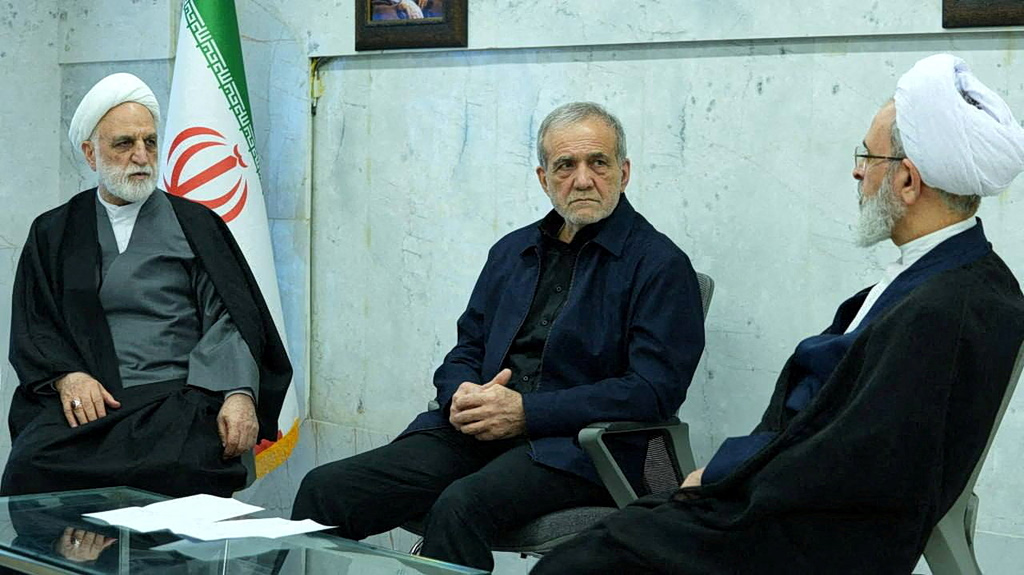
File photo: Iranian President Masoud Pezeshkian, Gholam-Hossein Mohseni-Eje’i, the head of the judiciary and Alireza Arafi, deputy chairman of the Assembly of Experts, attend the meeting of the interim leadership council of Iran in an unknown location, amid the U.S.-Israel conflict with Iran, in Iran, March 1, 2026. IRIB/WANA (West Asia News Agency)/Handout via REUTERS
Iran’s President Appeals Directly to Americans in Public Letter
Iranian President Masoud Pezeshkian issued a public letter Wednesday to the American people, portraying Iran as having historically peaceful ties with the U.S. and questioning the rationale behind U.S. attacks.
“Iran has never initiated a war,” he wrote, arguing that the country’s military posture was rooted in “legitimate self-defense” rather than aggression, while accusing Washington of sustaining tensions to justify its regional presence.
In the message, which was released by state media, Pezeshkian warned that continued military action risked long-term instability, signaling that Tehran is seeking to frame itself as open to engagement while blaming the U.S. for the conflict.