President Trump added a new dimension into his increasingly aggressive pursuit of Greenland , telling Norway that he no longer needed to think “purely of peace” after being snubbed for the Nobel Peace Prize.
European leaders were already scrambling to talk him out of a damaging trans-Atlantic trade war over the island, in which he launched an opening salvo this weekend.
So far, the European Union and the U.K. have held off openly wielding retaliatory tariffs in response to Trump’s threat to hit them with 10% tariffs for their opposition to a U.S. takeover of Greenland, a semiautonomous Danish territory.
European leaders are looking to take the heat out of the rapidly escalating issue, in hope that Trump won’t follow through with his pledge.
But the president threw another curveball into the debate on Sunday, linking his pursuit of the world’s largest island to missing out on the Nobel Peace Prize, which is awarded by a committee based in Norway.
According to the Norwegian prime minister, Trump said in a text message that the world wouldn’t be secure unless the U.S. has “Complete and Total Control of Greenland.”
“Considering your country decided not to give me the Nobel Peace Prize for having stopped 8 Wars PLUS,” Trump wrote in the message, according to Prime Minister Jonas Gahr Støre, “I no longer feel an obligation to think purely of Peace, although it will always be predominant but can now think about what is good and proper for the United States of America.”
On Monday, Støre said he had responded to the message. “We pointed to the need to de-escalate,” he said in a statement, adding that he had told Trump repeatedly that the Norwegian government has no say in who gets the peace prize.
The White House didn’t immediately respond to a request for comment.
The tempered reply points to a difficult reality for European nations: America is too embedded in their collective security, both economically and militarily, for them to threaten a quick punch-back.
In Brussels, EU officials and diplomats are taking the U.S. threats extremely seriously and see them as the latest evidence of a fundamental reshaping of trans-Atlantic ties.
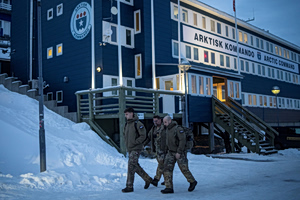
European officials are searching for ways to respond to the president without escalating the situation into a broader trade spat or capitulating on security in the face of his trade threats. The frantic diplomacy comes days after an attempted show of European strength, in which several nations sent troops to Greenland , appears to have badly backfired, prompting Trump to go on the offensive.
Italian Prime Minister Giorgia Meloni on a visit to South Korea said Sunday that the deployment of troops shouldn’t be interpreted as being “directed against the United States, but rather against other actors.”
“Clearly it seems that there’s been a problem of understanding and communication,” she said.
At a meeting of senior EU member state officials on Sunday evening, the emphasis was on not rushing to decisions and keeping diplomacy with the White House on the front burner. Officials agreed that while the EU needed to be ready to retaliate if necessary, the bloc wouldn’t be the one to take escalatory steps. Rather, they would make clear they are ready to respond if Trump pushes ahead.
“There will be a united and clear response from Europe, and we are now preparing coordinated countermeasures with our European partners,” German Finance Minister Lars Klingbeil said Monday. “We are ready to find solutions. We are extending our hand, but we are not prepared to be blackmailed.”
In an address to the nation on Monday morning, U.K. Prime Minister Keir Starmer criticized the Trump administration’s tariff threats as “completely wrong,” but declined to lay out what the U.K. would do in response. Starmer, who pioneered a kowtow approach to Trump that many other European leaders copied, said his main goal was to avoid any escalation. “Being pragmatic does not mean being passive,” he said.
The attempt to buy time comes after a mind-bending start to the year in which Trump has repeatedly claimed that the U.S. must control Greenland, either by buying it from Denmark or using military action.
Trump pledged to impose the 10% tariffs against Denmark, Norway, Sweden, France, Germany, the U.K., the Netherlands and Finland starting Feb. 1. The tariffs would increase to 25% on June 1 and remain in place until a deal is reached.
Given that Trump has repeatedly stated that he views control of Greenland as a U.S. national-security priority, it isn’t clear what Europe can offer Trump in terms of an off-ramp, said Sophia Gaston, a foreign-policy expert at King’s College London. In the end, European diplomacy can at best kick U.S. action over Greenland into the long grass, she said, but ultimately some sort of formulation that will give Trump the impression of greater sovereignty over the island will be required. “We have few cards to play,” she said.
So far, the only step the bloc has taken in retaliation is to effectively freeze the process of approving last summer’s EU-U.S. trade deal in the European Parliament. The EU already has a list of U.S. goods worth more than $100 billion on which it could impose retaliatory tariffs if Washington moves ahead. That list was put on hold temporarily last year but is due to kick in on Feb. 7 unless the bloc takes steps to extend the suspension.
Germany and France are among the nations raising the specter of a never-before-deployed tool—often dubbed the bazooka—that allows the EU to fight back when under economic coercion from another country.
That anti-coercion tool would give the bloc significant leeway to implement export controls, place tariffs on services, restrict intellectual-property rights and curb American companies’ ability to bid on public contracts in Europe, among other measures.
EU leaders will meet Thursday evening to discuss the talks with the U.S. and the way forward. But officials said they aren’t likely to make a final decision until Washington has acted.
Weighing on any EU decision, diplomats and officials say, is the understanding that Washington holds massive leverage over the bloc in terms of its defense and its support for Ukraine. That reinforces the argument that the bloc is determined not to be the one to escalate the standoff.
European officials also point out that imposing tariffs on some—but not all—EU countries would be very difficult to enforce because the bloc operates as a single market. While it is technically possible, a commission spokesman said Monday, “It is immensely bureaucratically and procedurally complex to do so.”
However, few believe Trump will take the tariff threat off the table, leaving EU-U.S. trade relations facing precisely the kind of uncertainty the bloc’s leaders hoped to avoid when they agreed to a lopsided trade deal with the U.S. last summer, which was shaped by Trump’s demands.
Write to Max Colchester at Max.Colchester@wsj.com , Laurence Norman at laurence.norman@wsj.com and Kim Mackrael at kim.mackrael@wsj.com