President Trump signed legislation authorizing the Justice Department to release files related to convicted sex offender Jeffrey Epstein , giving Attorney General Pam Bondi 30 days to make available unclassified documents related to the disgraced financier and his associate Ghislaine Maxwell.
Trump’s signing of the bill Wednesday marks the end of an uncomfortable saga for many lawmakers in Congress, where all House Democrats and four Republicans bypassed leadership through a petition maneuver to get the bill up for a vote. House Speaker Mike Johnson (R., La.) delayed the process in various ways only to have Trump flip and support the bill . The House approved the measure 427-1 on Tuesday.
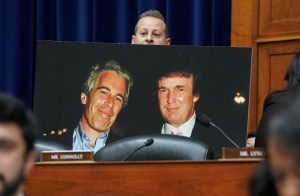
Now, the focus shifts to the release of files that have the potential to raise new questions over Epstein’s high-profile friends and associates. More than 20,000 documents from Epstein’s estate were recently made public by Congress, some of which mentioned Trump , along with Rep. Stacey Plaskett , a Democrat representing the U.S. Virgin Islands and former Harvard University president Larry Summers, who has since stepped down from the OpenAI board and other public commitments . Summers was criticized for previously undisclosed correspondence between him and Epstein.
Asked Wednesday if she would release the documents, Bondi said: “We will continue to follow the law, again while protecting victims, but also providing maximum transparency.”
Being mentioned in the emails isn’t an indication of wrongdoing. The Justice Department and Federal Bureau of Investigation concluded last summer that they had no evidence that Epstein blackmailed powerful figures or kept a “client list.” Epstein died by suicide in jail in 2019. Trump and Epstein socialized in the 1990s and 2000s when they were Palm Beach neighbors; Trump has said he cut off ties with the financier before Epstein pleaded guilty in 2008 to soliciting a minor for prostitution.
The Trump administration and Johnson initially resisted the vote to release the files. The Republicans who signed the discharge petition were pressured to remove their names, and the swearing-in of Rep. Adelita Grijalva (D., Ariz.), who won a special election in September, was delayed, preventing her from adding the 218th signature needed to bypass House leadership for a vote.
Late Sunday, however, Trump said that he would sign the bill if Congress passed it, changing the calculation of support for many Republicans and leading to its near-unanimous support in the House on Tuesday. The Senate then passed it by unanimous consent later that day, sending it straight to Trump’s desk with no further debate.
The president also has directed Bondi to investigate Democrats mentioned in the files released by Congress. Bondi assigned Jay Clayton , U.S. attorney for the Southern District of New York, to handle the probe.
The bill requires a systematic disclosure of documents from the Justice Department, including flight logs, internal memos, personal communications, metadata and immunity agreements. It stipulates that the released material must be fully searchable and downloadable. The bill allows redactions for victim-identifying information and materials depicting child sex abuse. An additional report to Congress outlining what was redacted is required within 15 days of publication.
Many Republicans originally cited privacy concerns for their opposition to the bill, and Johnson called for the Senate to amend the legislation—which it didn’t. The bill allows the attorney general to withhold or redact victims’ personal and medical information, anything that contains child pornography, information that would jeopardize an active investigation and images of death or abuse. It requires the Justice Department to justify its redactions to Congress.
The Justice Department could also cite the new investigation requested by Trump as a reason to redact some of the files.
“Our promise to the victims and to the American people is this: this will not and cannot be the end of the work,” said Senate Minority Leader Chuck Schumer (D., N.Y.) “We’ll keep the pressure up, pressure for the president to sign and then pressure on the DOJ to release the full unredacted files.”
In a lengthy social-media post in which he announced that he signed the bill Wednesday, Trump suggested that the push to release the files related to Epstein would backfire on Democrats. “Perhaps the truth about these Democrats, and their associations with Jeffrey Epstein, will soon be revealed, because I HAVE JUST SIGNED THE BILL TO RELEASE THE EPSTEIN FILES!” he said.
Write to Natalie Andrews at natalie.andrews@wsj.com and Sadie Gurman at sadie.gurman@wsj.com