President Trump’s claims of Chinese interference in the 2020 U.S. elections add a new irritant to a tenuous detente with Beijing already strained by trade and technological competition.
Delivered in a televised speech on Thursday, the allegations marked an escalation in Washington’s long-running criticism of perceived Chinese efforts to influence American politics—typically centered on the alleged use of propaganda and subterfuge to shape U.S. policies toward Beijing.
Trump’s remarks jarred with the relative calm in U.S.-China relations that had prevailed since his trip to Beijing in May, when he and Chinese leader Xi Jinping sought to stabilize ties after a bruising trade war last year.
While the allegations of election interference aren’t likely to derail the current trajectory of U.S.-China relations, “it could add to other tensions leading to some sort of breakdown of the ‘constructive strategic stability’ ” that Trump and Xi agreed upon, said Ja Ian Chong , a political scientist at the National University of Singapore.
China has generally denied meddling in the elections and internal affairs of other countries, a position it reiterated in response to Trump.
“The U.S. allegations have no factual ground and are aimed at vilifying China,” Chinese Foreign Ministry spokesman Lin Jian said at a regular briefing on Friday. “We have no interest in interfering with the U.S. elections and have never done so.”
Claims of Chinese espionage and influence operations in the U.S. have long found receptive audiences in Washington. A bipartisan consensus has coalesced around the need to respond more robustly to Beijing’s alleged efforts to hack into sensitive U.S. infrastructure, steal American secrets and promote China’s narratives.
In recent years, U.S. officials have reported what they called China-linked attempts to break into U.S. broadband networks, access private communications and recruit operatives in the U.S. to act surreptitiously on Beijing’s behalf. China has repeatedly denied these allegations.
Trump’s claims of Chinese interference came months before the November midterm elections in which Republicans are at risk of losing control of their majorities in Congress. Democrats have warned that Trump would seek to undermine confidence in the U.S. election system ahead of the vote.
Some Chinese scholars say Beijing likely wouldn’t overreact to Trump’s remarks, which seem driven by domestic political factors rather than antagonism toward China.
“The Republican Party senses significant pressure regarding the midterm elections, over issues such as inflation and low public satisfaction with the Trump administration’s economic policies,” said Wu Xinbo, dean of the Institute of International Studies at Fudan University in Shanghai.
If Trump follows up with punitive measures against Beijing, “that would certainly affect China-U.S. relations,” though “my assessment is that this is unlikely to happen, as the primary focus remains on the midterm elections,” Wu said.
Asked if Trump’s remarks could affect Xi’s plans to visit the U.S. in September for another summit with Trump, Lin, the Foreign Ministry spokesman, said Beijing urges Washington to “do more things that are conducive for China-U.S. relations.”
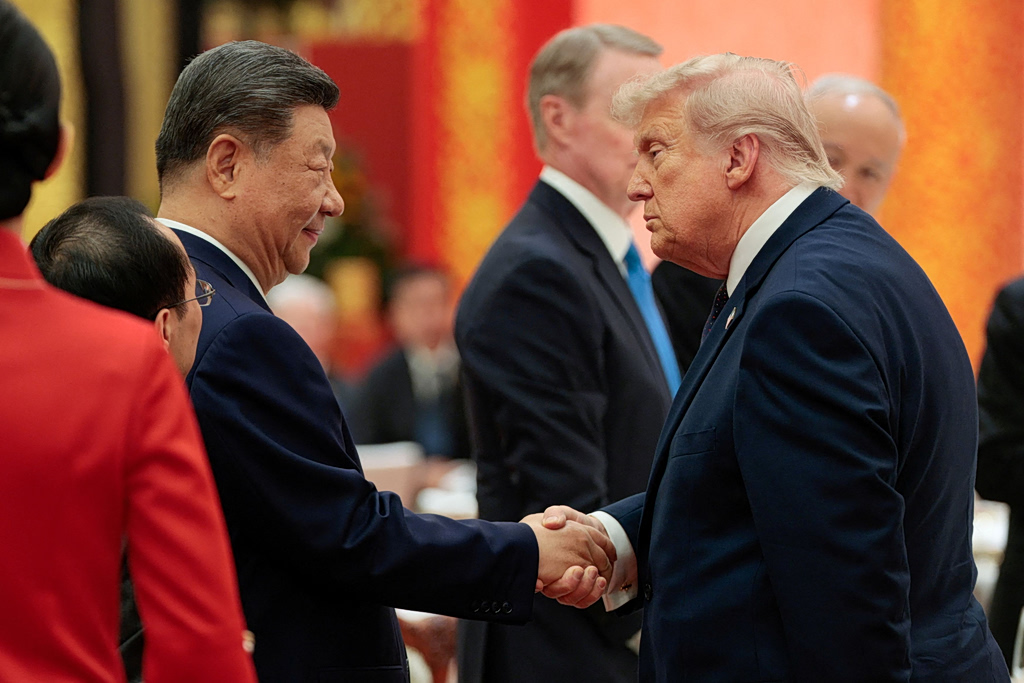
Chinese President Xi Jinping and U.S. President Donald Trump shake hands at a state banquet at the Great Hall of the People in Beijing, China, May 14, 2026. REUTERS/Evan Vucci
A U.S. intelligence assessment released in March 2021 assessed with “high confidence” that Beijing considered an influence campaign to affect the outcome of the 2020 election but ultimately didn’t deploy it.
The U.S. intelligence community found no indication that China—or any other foreign actor—tried to alter voter registration, ballots, vote counting or the reporting of the results of the 2020 election. It further concluded China didn’t attempt to compromise election infrastructure or fund American candidates or political parties.
Some elements of Trump’s claims, such as his assertion that Chinese actors collected or possessed large quantities of U.S. voter-registration data, echoed similar allegations from other Western governments. In 2024, British authorities accused Beijing of hacking the U.K. electoral register to steal the personal details of tens of millions of voters.
Even so, some analysts say Western governments are generally concerned about China’s efforts to influence opinions and policymaking toward Beijing, rather than about attempts to manipulate or alter votes.
“Beijing’s appetite for bulk data on foreign populations is well documented. Much American voter data is legally purchasable in the first place,” said Fergus Ryan , a senior analyst at the Australian Strategic Policy Institute, a Canberra-based think tank.
“But it’s very important to distinguish influence operations, which target opinions, from interference, which targets the machinery of voting,” Ryan said. “I’ve seen nothing around President Trump’s claims that bridges the gap between holding data about voters and actually manipulating votes.”
To supplement Trump’s speech on Thursday, the White House released a trove of documents that it said showed an effort to “suppress and downplay information about the extent of China’s sinister election meddling.” The heavily redacted documents included emails written by U.S. intelligence analysts expressing frustration over differences in internal assessments on whether China was trying to meddle in the 2020 elections.
The trove also included an FBI report that cited an unidentified source’s claims that China had in 2020 produced and exported to the U.S. fake American driver’s licenses that would allow Chinese students and immigrants in the U.S. to cast fraudulent votes. The source also claimed that China collected private U.S. user data from millions of TikTok accounts—including names and addresses—which could be used to create fake driver’s licenses.
The report included an FBI comment noting that address information “was not a valid field when creating a TikTok account” and that the source didn’t specify how China could have acquired U.S. address data. The report was later rescinded, according to another document in the trove.
Notwithstanding these allegations, some analysts say the Trump administration appears to have pulled its punches on other points of contention with China.
“Notably, the Trump administration has also been relatively quiet about issues that may have gotten stronger reactions from previous U.S. administrations, including the detention of U.S. citizens in [China] and the expulsion of journalists working for U.S. news organizations,” said Chong, the Singapore-based scholar.