The U.S. and Israel are pounding Iran’s missile-launching sites, hitting some over and over across almost a month of war. But Tehran’s missiles keep flying.
Iran has shifted to firing from deeper inside its territory with longer-range missiles, military analysts and former U.S. officers said, after airstrikes early in the war inflicted a heavy toll on Iranian bases and truck launchers near the Persian Gulf coastline. Iran is firing far fewer missiles now—down to around a dozen a day—but they have turned them against less-defended targets in Israel and Gulf Arab states, causing greater damage in some cases.
Even in small numbers, the weapons have helped Tehran achieve its goals—prolong the conflict, raise the economic costs on oil-exporting Gulf countries and in the U.S., and survive to fight another day.
“They’re not doing the big volleys like they were doing in the early days, but they don’t need to,” said retired Gen. Joseph Votel , the former commander of U.S. Central Command. “All they really have to do is get something through, and they get a big bang for the buck.”
The resilience of Iran’s missile systems to sustained American-Israeli bombing raises the prospect that a key war aim—preventing Tehran from threatening the Middle East with missiles and drones—will remain unfulfilled, with President Trump looking for a swift end to the war in the coming weeks.
Halting the war with Iran’s missile arsenal damaged but still intact would allow it to rebuild over time, salvaging missiles from underground bases and rebuilding production factories, some analysts said.
“If you cut the operations short, then the regime or any rump state that survives would almost certainly go and extract those missiles and launchers in a postconflict scenario,‘’ said Behnam Ben Taleblu, director of the Iran program at the Foundation for Defense of Democracies, a Washington nonprofit that favors overthrowing the Tehran government.
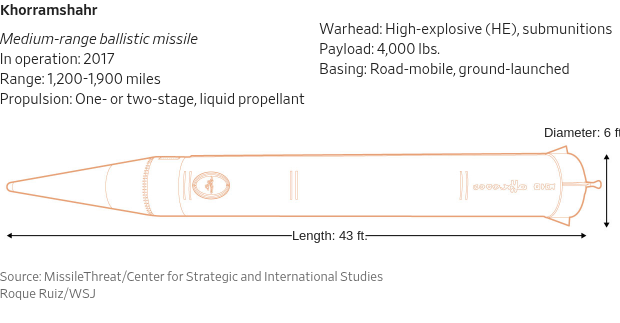
The difficulty of taking on Tehran’s missile capability is illustrated by continued U.S. strikes on Iran’s Imam Hussein Strategic Missile headquarters near the city of Yazd, an important hub for the regime’s Khorramshahr missile, which carries a massive warhead and can travel more than 1,200 miles. Satellite photos show that on Saturday the underground facility appeared partly caved in and plumes of smoke rose from the base—the aftermath of recent U.S. strikes.
U.S. and Israeli warplanes have attacked at least three times at the site dug into the barren mountains south of the city, including once early in the war when airstrikes demolished buildings on the surface and damaged hillside entrances.
It is unclear whether Iran has been able to continue firing from Yazd, but the repeated strikes over several weeks suggest Iran is finding ways to adapt to the U.S.-Israeli air campaign, military analysts said.
“They have been able to withstand the bombing campaign,” said Nicole Grajewski , a nonresident scholar in the Nuclear Policy Program at the Carnegie Endowment for International Peace. “There is something they are doing that enables them to sustain these operations.‘’
An isolated desert city 500 miles from the coast, Yazd is a challenging target for the U.S. and Israel. During its 12-day war with Iran last summer, Israel first tried to take out the facility in a daylight strike, in one of the farthest attacks inside Iran that it conducted. Yet the U.S. or Israeli warplanes have returned to the facility at least twice since the war started on Feb. 28.
Signs suggest that the bombardment is taking a toll: Iran upgraded the latest version of Khorramshahr in 2017 with a more stable propellant, reducing the time it takes to prepare the missile for launch. Yet several have blown up during launch, spewing toxic fuel into the air, said a person familiar with the incidents.
Other Iranian bases have been struck multiple times as well. At Haji Abad, another missile facility in southern Iran, there are signs of escalating airstrikes over multiple weeks. A picture of the base by the commercial satellite company Planet Labs on the second day of the war showed three destroyed vehicles outside tunnels leading into the underground facility. A video released by Central Command on March 20 showed the location being hit again with heavy munitions.
The U.S. and Israeli militaries said they are methodically taking out Iran’s missile capabilities.
U.S. and Israel warplanes have hunted Iran’s missile-carrying mobile launchers and circled over dozens of cavernous bases, striking when the vehicles emerge to fire. Waves of heavy bombers have dropped munitions on the sites, entombing the Iranian weapons in some locations.
The result is that Iran no longer appears capable of launching missiles and drones by the hundreds as it did in the opening week of the war. Its missile-production facilities have been decimated, making a quick rebuild of its once-formidable arsenals a far steeper task.
Navy Adm. Brad Cooper, the top commander in the region, said Wednesday that the U.S. had hit 10,000 targets in Iran and Israel had hit “thousands more,” noting that Iran’s drone- and missile-launch rates are down by more than 90%. More than two-thirds of Iran’s missile-, drone- and navy-ship production facilities are destroyed.
“Their ability to attack American forces and regional neighbors is drastically reduced,” he said in a video statement released by Central Command.
Israel’s military says it has destroyed or disabled around 330 of Iran’s estimated 470 mobile missile launchers. Around half of those launchers were destroyed in strikes, and another half were rendered unusable after Israel struck tunnel entrances to underground facilities where the launchers are kept hidden before surfacing before an attack. Israel estimated Iran had as many as 2,500 ballistic missiles before the war.
Even so, Iran has shown it is still able to fire Khorramshahr and other types of missiles.
Last weekend, Iran struck the Israeli cities of Dimona and Arad, most likely with Khorramshahr missiles, which have among the longest ranges and heaviest payloads in Iran’s arsenal. The missile carries heavy warheads that spew small clusters of munitions over a wide area.
Iranian missiles are striking targets at a higher rate than early in the conflict, said Kelly Grieco , a senior fellow at the Stimson Center, a Washington think tank, citing a review she did of open-source strike data. Instead of firing at military targets, Iran has shifted to hitting oil facilities, hotels and civilian areas, she said.
“If they get any hits, they have greater impact,” she said.
Iran has independent missile commands around the country, and each just needs to shoot off one or two a day to continue the present rate, said experts. Iranian crews can wait until they know aircraft aren’t nearby and either rush out launchers for an attack or work to clear away tunnels collapsed by strikes.
“Iran is an extremely large country and no one has an eye in the sky everywhere,” said Tal Inbar , a senior research fellow at the Missile Defense Advocacy Alliance, who spent decades working on Israeli air-defense systems.
Write to David S. Cloud at david.cloud@wsj.com and Dov Lieber at dov.lieber@wsj.com