The European Union is moving to strengthen its capacity to monitor the world’s oceans, launching a new initiative called OceanEye and proposing an international alliance aimed at expanding global ocean observation.
The plan was announced by European Commission President Ursula von der Leyen during the opening of the European Ocean Days in Brussels. The EU will contribute €50 million from the bloc’s research programme Horizon Europe for 2026–2027 to support the initiative and encourage other countries to join.
The proposed alliance would bring together EU member states and international partners to strengthen ocean monitoring and improve access to ocean data worldwide. The effort is intended to support the Global Ocean Observing System, which is coordinated with the UNESCO Intergovernmental Oceanographic Commission.
A growing need for ocean data
Oceans absorb more than 90% of the excess heat generated by climate change and play a critical role in regulating the planet’s climate. Yet scientists say large parts of the global ocean remain poorly monitored, leaving gaps in understanding how marine ecosystems and climate systems are evolving.
Ocean observation systems combine satellites, sensors, research vessels and underwater instruments to measure variables such as sea temperature, currents, salinity and biological productivity. These data are used to improve weather forecasting, monitor marine ecosystems and help predict the impacts of climate change.
The new European initiative builds on existing EU capabilities, including the Copernicus Marine Service, which provides data used by scientists, policymakers and maritime industries across Europe.
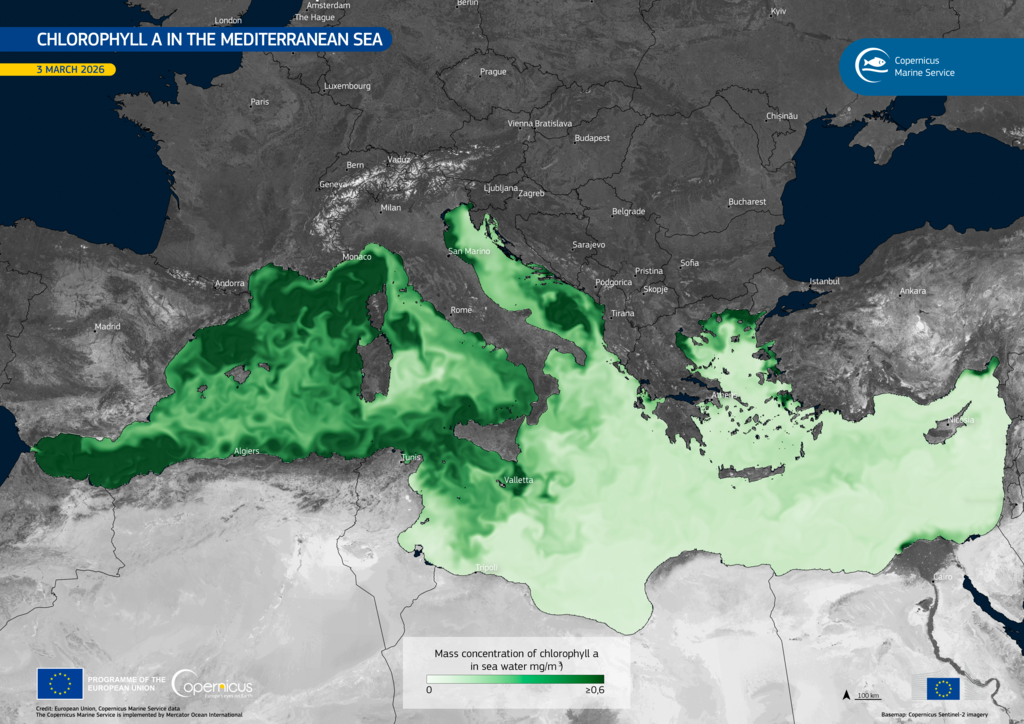
Credit: European Union, Copernicus Marine Service
Strategic and economic stakes
Better ocean monitoring is also increasingly viewed as an economic and security priority. Europe’s blue economy—which includes shipping, fisheries, offshore energy and coastal tourism—supports around 5 million jobs and generates roughly €250 billion in economic value across the EU.
Reliable ocean data can help improve maritime safety, manage fisheries, support offshore renewable energy projects and track environmental changes affecting coastal communities.
The Mediterranean Sea, for example, is one of the regions where ocean observation data are widely used to monitor marine conditions. Satellite data from Copernicus can track indicators such as chlorophyll-a concentrations, which help scientists measure ocean productivity and detect environmental changes.
Part of a broader EU ocean strategy
OceanEye forms part of the European Ocean Pact, which aims to strengthen ocean research, monitoring and protection across Europe.
The initiative will also build on existing EU projects such as the European Digital Twin of the Ocean, a system designed to simulate ocean conditions and help policymakers test scenarios ranging from climate change impacts to maritime planning.
EU officials say the longer-term goal is to help establish a fully operational European ocean observation system by 2030, while strengthening international cooperation on ocean monitoring.
A pledging conference expected later this year will seek additional contributions from governments and research institutions interested in joining the proposed alliance.